

Maddy summaryThe SCOPE Act directs the Environmental Protection Agency (EPA) to develop standardized guidance for reporting scope 3 emissions - indirect emissions from a company’s supply chain and product use - within 12 months of enactment. It requires the EPA to establish reporting thresholds, calculation methods, monitoring frequency, data quality standards, and recordkeeping procedures for facilities already subject to EPA greenhouse gas reporting rules (like major industrial plants). The guidance will help direct emitters (facilities currently reporting under EPA regulations) understand how to measure and report these indirect emissions. This bill does not mandate reporting but creates a framework for future EPA rules on scope 3 emissions.
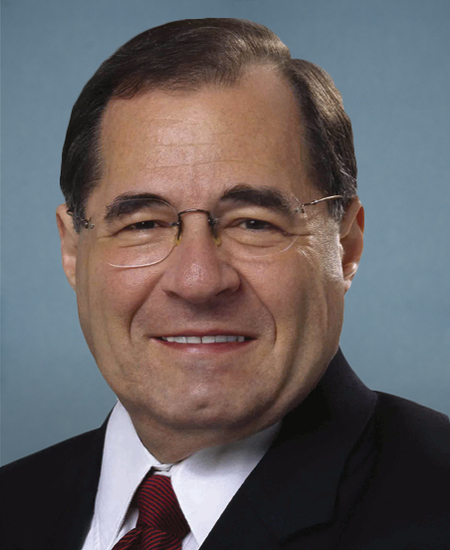
Rep. Jerrold Nadler
Sponsored bills
Maddy summaryThis non-binding House resolution expresses the House's support for keeping guns out of schools by stating federal funds should not be used to arm school personnel or provide them firearm training. It references existing laws like the STOP School Violence Act (2018) and research showing arming staff does not improve safety, citing data on failed interventions and disproportionate impacts on students of color. The resolution affirms current policy guidance without creating new legal requirements. It serves as a formal statement of the House's position based on evidence and existing legislative frameworks.
Maddy summaryHR 9299, the IRAN Act, requires the U.S. Secretary of State to lead federal efforts promoting internet freedom and access to information in Iran. It amends a 2012 law to mandate specific strategy updates, including evaluating how activists use virtual private networks (VPNs) and satellite tech, developing guidance to prevent sanctions from blocking internet tools for Iranians, and planning to bypass government internet blackouts. The bill directs the State Department to coordinate with Treasury, Commerce, USAID, and intelligence agencies to implement these updates. This affects U.S. government agencies' coordination and aims to improve internet access for Iranian civil society activists.
Maddy summaryThe Safer Skies Act of 2024 requires certain smaller airlines to adopt the federal security screening program currently used by larger carriers. Specifically, it mandates that airlines operating passenger planes with more than 9 seats (that do not use TSA checkpoints, offer individual seats in advance with public schedules) must comply with the Aircraft Operator Standard Security Program within 360 days of enactment. The Transportation Security Administration must revise its rules to enforce this new requirement. This directly affects regional carriers that currently skip standard airport security screenings but serve passengers under these specific operational conditions. The bill extends existing security standards to cover these previously exempt airlines without creating new security protocols.
Maddy summaryThis bill (HR 9255) is a simple naming resolution that renames a specific U.S. Postal Service facility. It designates the post office at 114 John Street in New York, New York, as the "Jack Greenberg Post Office." The bill requires all federal references to the building (in laws, maps, documents, etc.) to use the new name. This is a procedural change affecting only the official name of that single post office location.
Maddy summaryThe NO BAN Act (HR 9244) prohibits U.S. immigration authorities from denying visas or entry based on national origin, religion, or sex. It amends immigration law to explicitly ban such discrimination in visa decisions and tightens restrictions on the president’s power to suspend entry of certain groups under Section 212(f). The bill requires specific evidence, narrow tailoring, time limits, and congressional notification for any entry restriction, while mandating public reports on visa denials and waivers. It directly affects nonimmigrant visa applicants (e.g., students, workers) and federal agencies administering immigration policy.
Maddy summaryHR 9223, the Nondebtor Release Prohibition Act of 2024, prohibits bankruptcy courts from approving plan provisions that release non-debtor entities (like other companies or individuals) from liability for claims against them. It specifically blocks courts from discharging, releasing, or modifying liabilities of entities other than the debtor or estate, and limits stays on lawsuits against non-debtors to 90 days without the affected party's explicit consent. This bill directly affects creditors and third parties who might otherwise be shielded from liability through bankruptcy proceedings. The law amends Chapter 11 of the U.S. Bankruptcy Code to clarify that courts cannot create authority for nondebtor releases or extended stays, applying to all pending or future bankruptcy cases.
Maddy summaryThis bill reauthorizes the Debbie Smith DNA Backlog Grant Program, which provides federal funding to state and local law enforcement agencies to reduce backlogs in processing DNA evidence from crime scenes. It extends the program's funding period from fiscal years 2024 through 2029 (previously ending in 2024). The bill also updates audit requirements to ensure grant funds are used properly through 2029. This directly affects law enforcement agencies that receive these grants to accelerate DNA analysis for criminal investigations.
Maddy summaryThis bill permanently removes a 2026 expiration date for a tax exclusion allowing employers to pay employees' student loans through educational assistance programs without those payments being counted as taxable income. It directly affects employees who receive employer-sponsored student loan repayment assistance and employers offering such programs. The key provision amends the Internal Revenue Code to make this tax exclusion permanent, applying to all future payments made after the bill's enactment. This change simplifies the tax treatment for both employers and employees participating in these student loan repayment programs.
Maddy summaryHRES 1375 is a non-binding resolution recognizing extreme weather as a critical threat to children's health and well-being, emphasizing that children face unique vulnerabilities due to their developing bodies, higher exposure to pollutants, and heightened risks during events like heatwaves, wildfires, and poor air quality. It expresses Congress's view that solutions must be developed and deployed rapidly and equitably, with specific attention to children's physical and mental health needs. The resolution suggests concrete measures such as improved air filtration in schools, accessible public alerts for extreme heat, expanded cooling centers, and better infrastructure for child-friendly emergency spaces, though it does not create new laws or mandates.