

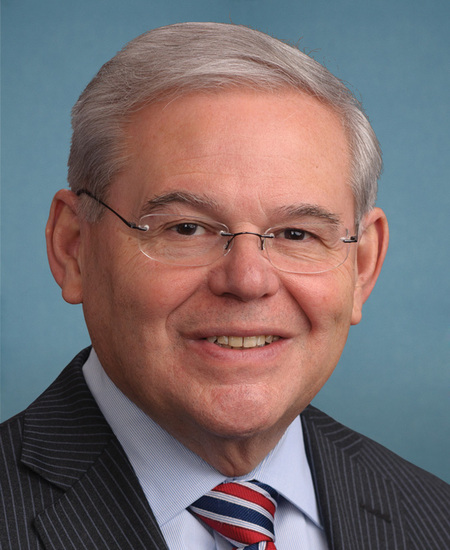
Photo of Robert Menendez
D United States House · District 8 · New Jersey On the 2026 ballot

Rep. Robert Menendez

Compare
Total votes
1,879
all sessions
Attendance
99%
15 missed
Higher than 96% of chamber peers
With party
97%
of cast votes
Near the chamber average
Bipartisan score
2%
crosses aisle rarely
Near the chamber average
Sponsored
630
bills & resolutions
Near the chamber average
Committees
4
assignments
630 bills and resolutions

Sponsored bills

Total
630
Primary
35
Co-sponsor
595
This page
630
matching current filters
Co-sponsor HR 7288
In committee · Indiana House · Co-sponsor
Armenian Protection Act of 2024

Maddy summaryHR 7288, the Armenian Protection Act of 2024, repeals the waiver authority that allows the President to bypass restrictions on U.S. aid to Armenia. Specifically, it prevents the waiver of Section 907 of the Freedom Support Act for fiscal years 2024 and 2025, which currently blocks U.S. assistance to Armenia due to historical disputes. This bill directly affects Armenia's eligibility for certain U.S. foreign aid programs by removing the possibility of executive branch waivers for those years. The key mechanism is the permanent removal of the waiver option under the specified appropriations law, changing the policy landscape for U.S.-Armenia aid relations.

In committee Feb 7, 2024 1 co-sponsor
Co-sponsor HR 7165
In committee · Indiana House · Co-sponsor
Credit for Caring Act of 2024

Maddy summaryThe Credit for Caring Act of 2024 creates a new federal tax credit for family caregivers. It allows eligible caregivers to claim a credit equal to 30% of qualified caregiving expenses (like home modifications, medical supplies, or respite care) exceeding $2,000 per year, capped at $5,000 annually. To qualify, caregivers must earn over $7,500 in income and provide care for a relative (like a spouse or parent) certified by a healthcare provider as needing long-term care for at least 180 days. The credit phases out for higher earners, with a $75,000 income threshold for single filers and $150,000 for joint returns.

In committee Jan 31, 2024 1 co-sponsor
Co-sponsor HR 7127
In committee · Indiana House · Co-sponsor
FAIR Act

Maddy summaryHR 7127, the FAIR Act, establishes pay adjustments for federal employees in 2025. It increases base pay by 4% for most federal workers under statutory pay systems and for "prevailing rate" employees (like those in specific geographic areas), while raising locality pay rates by 3.4%. The bill directly affects all federal employees receiving pay under these systems, as it modifies their 2025 salary calculations. These changes are based on statutory formulas under Title 5 of the U.S. Code, with no new policy mechanisms beyond the specified percentage increases. The adjustments apply to pay rates in effect as of the end of fiscal year 2024.

In committee Jan 30, 2024 1 co-sponsor
Co-sponsor HR 7056
In committee · Indiana House · Co-sponsor
Access to Family Building Act

Maddy summaryHR 7056, the Access to Family Building Act, establishes federal rights for individuals to access assisted reproductive technology (ART) like IVF without unreasonable restrictions, directly affecting patients seeking fertility treatments and health care providers offering ART services. The bill prohibits states from imposing limitations on ART that are more burdensome than those for comparable medical procedures, fail to advance safety, or unduly restrict access, while allowing health and safety regulations that are necessary and least restrictive. It creates federal enforcement mechanisms, including lawsuits by the Attorney General or affected individuals to challenge violating state laws, and preempts conflicting state regulations. The bill explicitly preserves state authority over health/safety regulations and does not alter existing state insurance coverage laws for ART.

In committee Jan 19, 2024 1 co-sponsor
Co-sponsor HR 7039
In committee · Indiana House · Co-sponsor
Stronger Communities through Better Transit Act

Maddy summaryThe Stronger Communities through Better Transit Act establishes a new federal grant program to improve public transportation service. It provides funding to urban areas, states, and Indian tribes to cover up to 50% of public transit operating costs (up to 80% in persistent poverty areas and 100% for Indian tribes), with requirements to report on service frequency, access to jobs, and conduct community surveys. The program mandates that a majority of funds must benefit underserved communities and areas of persistent poverty, defined as census tracts with high poverty rates or minority populations. Recipients must maintain their transit funding levels and report on improvements in access to essential services. The bill authorizes $20 billion annually for fiscal years 2024-2027.

In committee Jan 18, 2024 1 co-sponsor
Co-sponsor HR 7012
In committee · Indiana House · Co-sponsor
Transit Emergency Relief Act

Maddy summaryThe Transit Emergency Relief Act (HR 7012) amends federal transportation law to provide more flexible funding for public transit agencies facing emergencies. It allows funds designated for emergency relief (under 49 U.S.C. § 5324) to remain available until spent, be used for prior or current fiscal years, and not reduce existing funding. The bill also increases annual funding caps for transit programs and adds $50 million per year (2024-2027) specifically for this emergency relief program. Public transportation agencies receiving federal grants are directly affected, as the changes simplify access to funds during crises while requiring compliance with labor standards (49 U.S.C. § 5333). This creates more predictable support for transit systems recovering from unexpected disruptions.

In committee Jan 17, 2024 1 co-sponsor
Co-sponsor HR 6928
In committee · Indiana House · Co-sponsor
CONNECT Act of 2024

CONtinuity in Necessary Evaluative Crisis Treatment Act of 2024 or the CONNECT Act of 2024 This bill requires the Substance Abuse and Mental Health Services Administration to award grants to certain crisis centers for providing follow-up care to individuals who receive suicide prevention and crisis intervention services.

In committee Jan 12, 2024 1 co-sponsor
Co-sponsor HR 6929
In committee · Indiana House · Co-sponsor
Affordable Connectivity Program Extension Act of 2024

Maddy summaryThe Affordable Connectivity Program Extension Act of 2024 allocates $7 billion in funding for the Affordable Connectivity Program (ACP) during fiscal year 2024. The ACP provides subsidies to low-income households to help cover the cost of internet service and connected devices like laptops or tablets. This funding ensures the program can continue supporting eligible households throughout the year, with the money remaining available until fully spent. The bill extends existing program funding without changing eligibility criteria or service requirements.

In committee Jan 10, 2024 1 co-sponsor
Primary HR 6907
In committee · Indiana House · Lead sponsor
Parental Workforce Training Act

Maddy summaryThe Parental Workforce Training Act (HR 6907) creates a federal grant program to help parents cover childcare costs while participating in employment and training activities. Local boards receive competitive grants to provide direct childcare assistance to eligible individuals - parents with dependent children enrolled in workforce programs under the Workforce Innovation and Opportunity Act (WIOA). The program authorizes $10 million in funding to support these services, requiring grantees to use funds solely for childcare costs tied to employment training participation. The Secretary of Labor must also report annually on participant enrollment and program effectiveness.

In committee Dec 29, 2023 0 co-sponsors
Co-sponsor HR 6876
In committee · Indiana House · Co-sponsor
CTPAT Pilot Program Act of 2023

Customs Trade Partnership Against Terrorism Pilot Program Act of 2023 or the CTPAT Pilot Program Act of 2023 This bill requires the Department of Homeland Security to carry out a pilot program that assesses whether allowing certain entities to participate in the Customs Trade Partnership Against Terrorism (CTPAT) would enhance port security, combat terrorism, prevent supply chain security breaches, or otherwise satisfy the goals of CTPAT. Such entities are (1) non-asset-based third-party logistics providers that arrange international freight transportation and are licensed or bonded by specified federal agencies; or (2) asset-based third-party logistics providers that facilitate cross-border activity, are licensed or bonded by specified federal agencies, and execute logistics services using their own warehousing assets and resources. The bill requires the Government Accountability Office to report on the effectiveness of CTPAT.

In committee Dec 19, 2023 1 co-sponsor
Showing 431 to 440 of 630 bills
Previous 1 … 43 44 45 … 63 Next