This resolution recognizes law enforcement agencies and officers for their tireless work to protect us and make our communities safer. It also condemns calls to defund, disband, dismantle, or abolish the police.
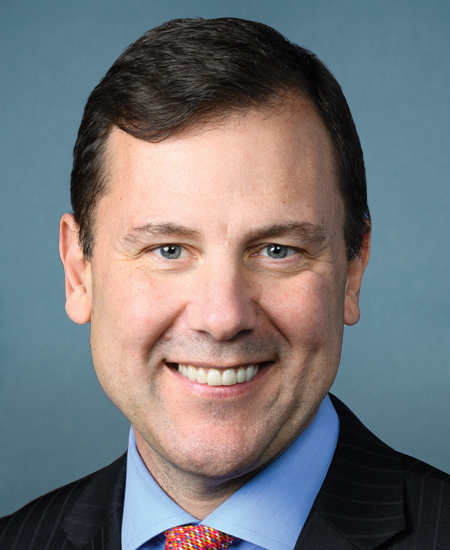
Rep. Thomas H. Kean, Jr.
Sponsored bills
Securing Access to Lower Taxes by ensuring Deductibility Act or the SALT Deductibility Act This bill repeals the temporary restrictions in taxable years 2018 through 2025 on the deductibility of state and local taxes.
Verifying Accurate Leading-edge IVCT Development Act of 2023 or the VALID Act of 2023 This bill requires the Food and Drug Administration (FDA) to regulate in vitro clinical tests (IVCTs). Currently, the FDA and the Centers for Medicare & Medicaid Services have authority to regulate in vitro diagnostic devices. The bill defines IVCTs, which includes in vitro diagnostic devices, as tests intended for the collection, preparation, analysis, or in vitro clinical examination of specimens from the human body to provide information about a disease, condition, or treatment. An IVCT may not be introduced into interstate commerce unless it has received FDA premarket approval or is covered by certain exemptions, such as an exemption for a test that (1) was developed and introduced before this bill's enactment and meets certain requirements, (2) is a low-risk test, (3) is solely for public health surveillance, (4) is covered by a technology certification issued under this bill, or (5) has received a humanitarian exemption or emergency use authorization. The FDA may grant upon application a technology certification. Generally, such a certification covers a group of tests that use a single technology and may be evaluated using a representative test. While such a certification is valid, a qualifying IVCT that falls within the scope of the certification shall be cleared for interstate commerce. The bill also imposes various requirements related to IVCTs, including those related to quality control, labeling, and reporting adverse events. The FDA shall have various enforcement authority, including authority to order the recall of an IVCT with a reasonable probability of causing serious adverse health consequences.

Maddy summaryHR 1839, the Combating Illicit Xylazine Act, makes the illicit use and distribution of xylazine a federal crime by adding it to the Controlled Substances Act. The bill broadly defines xylazine to cover numerous chemical variants and prohibits human use or non-licit distribution, while preserving legitimate veterinary and pharmaceutical uses. It requires tracking xylazine in drug supply chains and mandates two reports to Congress within 1 and 4 years on its prevalence, sources, and whether it should be rescheduled. The bill directly affects individuals distributing or using xylazine illicitly, including as an additive to drugs like fentanyl, and aims to address its public health risks. Congress declared illicit xylazine an "emerging drug threat" under existing law.
Maddy summaryHR 2510 makes the federal adoption credit for children with special needs refundable, meaning families who adopt such children can receive a cash refund even if they don't owe federal income tax. The bill directly affects adoptive parents who claim the credit for children with special needs, allowing them to get the full credit amount as a refund rather than just reducing their tax bill. Key provisions define "special needs adoption expenses" as qualified costs for these adoptions and adjust tax code language to treat this portion as a refundable credit. The changes apply to taxable years beginning after December 31, 2023.
Maddy summaryHR 1740 amends the Water Infrastructure Finance and Innovation Act (WIFIA) to require payment and performance security for projects receiving WIFIA assistance. It directly affects water infrastructure projects funded through WIFIA loans or grants by mandating that construction must have security covering at least 50% of the contract value, or accept equivalent state/local requirements. The bill specifies that if state or local law already requires such security, it may be used instead, but the amount must still meet the 50% minimum. This adds a new financial safeguard to ensure project completion without requiring new funding or changing WIFIA’s core structure.
Supporting Our First Responders Act This bill establishes a competitive grant program to support medical transport and emergency medical services (EMS). The Department of Health and Human Services (HHS) must award the grants to EMS organizations (including for-profit organizations) or state, tribal, territorial, or local governments. Grant-funded activities include (1) providing salaries and stipends for EMS workers; (2) purchasing vehicles, personal protective equipment, and other resources; and (3) establishing community paramedicine or mobile integrated health care initiatives. HHS must also report to Congress about health insurance reimbursement for medical transport and EMS and the feasibility of establishing a federal EMS office.
Fairness for Rural Teaching Hospitals Act of 2023 This bill modifies the payment methodology for the Medicare-Dependent Hospital program, which provides additional payments to certain small rural hospitals that have a high proportion of Medicare patients. Specifically, the bill excludes indirect medical costs from initial payment calculations and instead requires an additional, separate payment for such costs.
Maddy summaryThe ALIGN Act (HR 2406) permanently allows businesses to deduct the full cost of qualified equipment and machinery in the year of purchase, rather than spreading the deduction over multiple years. This applies to property placed in service after September 27, 2017, directly affecting businesses that make capital investments in eligible assets like manufacturing equipment or commercial facilities. The bill eliminates the previous requirement to depreciate these costs over time, reducing taxable income in the purchase year. It makes a temporary 2017 tax provision permanent, impacting businesses across various industries that purchase qualifying property.
Maddy summaryHR 2382, the September 11 Day of Remembrance Act, would establish September 11 as a federal public holiday to honor the victims of the 2001 terrorist attacks. This change would require all federal offices to close on September 11 each year, directly affecting federal employees and government operations. The bill amends Title 5 of the U.S. Code to add this day to the list of designated federal holidays, ensuring consistent observance without altering existing holiday rules.