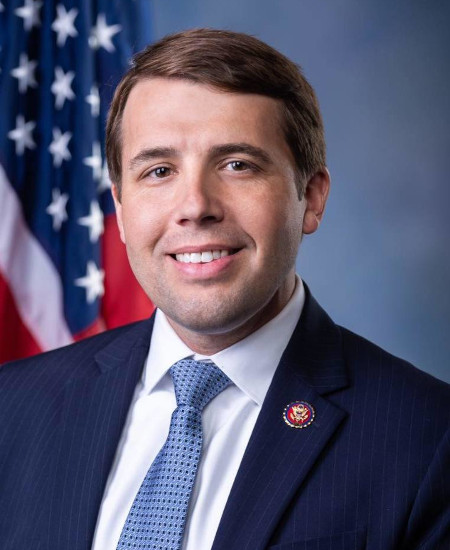
Photo of Chris Pappas
D United States House · District 1 · New Hampshire

Rep. Chris Pappas

Compare
Total votes
2,837
all sessions
Attendance
99%
15 missed
Higher than 96% of chamber peers
With party
93%
of cast votes
Lower than 88% of chamber peers
Bipartisan score
3%
crosses aisle rarely
Higher than 87% of chamber peers
Sponsored
1,655
bills & resolutions
Near the chamber average
Committees
7
assignments
1,655 bills and resolutions

Sponsored bills

Total
1,655
Primary
140
Co-sponsor
1,515
This page
1,655
matching current filters
Co-sponsor HR 8264
In committee · Indiana House · Co-sponsor
Backlog Justice Act of 2022

Backlog Justice Act of 2022 This bill requires certain actions to address the backlog of untested sexual assault kits. For example, the bill (1) directs the Bureau of Justice Assistance to establish a publicly accessible online database regarding untested kits, and (2) requires the Department of Justice to provide an increased amount of certain grant funding for states that have in place electronic evidence tracking systems for these kits.

In committee Nov 1, 2022 1 co-sponsor
Co-sponsor HR 8106
In committee · Indiana House · Co-sponsor
Fighting Foreign Influence Act

Fighting Foreign Influence Act This bill addresses foreign influence in federal elections. For example, the bill (1) requires tax-exempt charitable organizations to disclose in annual reports contributions and gifts exceeding $50,000 received from foreign governments and foreign political parties; and (2) prohibits any individual from registering or otherwise serving as the agent of a foreign principal if the individual at any time served as a Member of Congress, a senior political appointee, or a general or flag officer of the Armed Forces.

In committee Nov 1, 2022 1 co-sponsor
Co-sponsor HR 7961
In committee · Indiana House · Co-sponsor
SAVE Act

Safety From Violence for Healthcare Employees Act or the SAVE Act This bill establishes a new criminal offense for knowingly assaulting or intimidating hospital personnel during the performance of their official duties in a manner that interferes with their performance of the duties or limits their ability to perform the duties. Additionally, the bill authorizes grants to reduce the incidence of violence at hospitals, including violence or intimidation against hospital personnel in the performance of their duties.

In committee Nov 1, 2022 1 co-sponsor
Primary HR 7300
In committee · Indiana House · Lead sponsor
Dark Web Interdiction Act of 2022

Dark Web Interdiction Act of 2022 This bill establishes enhanced criminal penalties for distributing controlled substances via the dark web. It also establishes other programs and requirements to address the use of the dark web for illicit drug activities. ( Dark web means the portions of the internet with hidden sites and services that (1) are not generally searchable, and (2) can only be accessed with specialized devices or services that conceal the identities and locations of users.) Specifically, the bill provides an enhanced criminal penalty for delivering, distributing, or dispensing controlled substances via the dark web. The bill also provides statutory authority for the Joint Criminal Opioid and Darknet Enforcement Task Force, which supports the investigation and prosecution of drug offenses committed via the dark web domestically and internationally. In addition, the Department of Justice must report on how and to what extent virtual currencies are used for opioid distribution via the dark web.

In committee Nov 1, 2022 0 co-sponsors
Co-sponsor HR 7238
In committee · Indiana House · Co-sponsor
Timely Treatment for Opioid Use Disorder Act of 2022

Timely Treatment for Opioid Use Disorder Act of 2022 This bill allows opioid treatment programs to admit individuals who have been addicted to opioids for less than one year for maintenance treatment (the use of medications such as methadone in treating opioid addiction). Current regulations generally bar an opioid treatment program from admitting individuals for such treatment unless they have been addicted to opioids for more than one year. The bill requires the Department of Health and Human Services to revise its regulations to allow admission when the duration of an individual's opioid addiction is less than one year.

In committee Nov 1, 2022 1 co-sponsor
Primary HR 6946
In committee · Indiana House · Lead sponsor
SAFE Act of 2022

Save Americans from the Fentanyl Emergency Act of 2022 or the SAFE Act of 2022 This bill permanently places fentanyl-related substances as a class into schedule I of the Controlled Substances Act. A schedule I controlled substance is a drug, substance, or chemical that has a high potential for abuse; has no currently accepted medical value; and is subject to regulatory controls and administrative, civil, and criminal penalties under the Controlled Substances Act. It limits the application of mandatory minimum penalties for certain offenses involving fentanyl-related substances, establishes a process to deschedule or remove certain fentanyl-related substances that have a low potential for abuse, and allows a federal court to vacate or reduce the sentence for convictions of offenses involving a fentanyl-related substance that is descheduled or moved to a schedule other than schedule I or II. The bill establishes a new, alternative registration process for schedule I research. It also makes other changes to registration requirements for conducting research with controlled substances, including permitting a single registration for related research sites in certain circumstances, waiving the requirement for a new inspection in certain situations, and allowing a registered researcher to perform certain manufacturing activities with small quantities of a substance without obtaining a manufacturing registration. Finally, the bill requires the Government Accountability Office to analyze the implementation and impact of permanently placing fentanyl-related substances into schedule I of the Controlled Substances Act.

In committee Nov 1, 2022 0 co-sponsors
Co-sponsor HR 6860
In committee · Indiana House · Co-sponsor
Latonya Reeves Freedom Act of 2022

Latonya Reeves Freedom Act of 2022 This bill prohibits government entities and insurance providers from denying community-based services to individuals with disabilities that require long-term service or support that would enable such individuals to live in the community and lead an independent life. Specifically, these entities may not discriminate against such individuals in the provision of community-based services by such actions as imposing prohibited eligibility criteria, cost caps, or waiting lists or failing to provide a specific community-based service. Additionally, community-based services must be offered to individuals with such disabilities prior to institutionalization. Institutionalized individuals must be notified regularly of community-based alternatives. The bill requires the Department of Justice to issue regulations requiring government entities and insurance providers to offer community-based long-term services to individuals with such disabilities who would otherwise qualify for institutional placement. Government entities must ensure sufficient availability of affordable, accessible, and integrated housing that is not a disability-specific residential setting or a setting where services are tied to tenancy. Regulations shall also (1) require government entities and insurance providers to perform self-evaluation on current services, policies, and practices and concerning compliance with requirements of this bill; and (2) require government entities to submit a transition plan. The bill provides funds for FY2022 for the Department of Health and Human Services to provide technical assistance with respect to transition plans. The bill allows civil actions by individuals subjected to, or about to be subjected to, a violation of its requirements.


In committee Nov 1, 2022 1 co-sponsor
Co-sponsor HR 6853
In committee · Indiana House · Co-sponsor
Russian Travel Sanctions for a Democratic Ukraine Act

Russian Travel Sanctions for a Democratic Ukraine Act This bill imposes visa-blocking sanctions on certain citizens of Russia. Specifically, the President must impose such sanctions on citizens of Russia who are (1) Russian oligarchs, (2) employees of Russia's government, or (3) employees of companies that are owned by or receive funding from Russia's government. The President must also impose the sanctions on family members of such individuals. The President must coordinate with allies, including NATO member states, on the imposition of such sanctions. The President may waive the application of such sanctions in certain instances.

In committee Nov 1, 2022 1 co-sponsor
Co-sponsor HR 6852
In committee · Indiana House · Co-sponsor
Porch Pirates Act of 2022

Porch Pirates Act of 2022 This bill extends federal criminal penalties for obstruction of correspondence and theft of stolen mail matter (which apply to U.S. Postal Service mail) to matter (e.g., packages) sent or delivered by private or commercial interstate carriers.

In committee Nov 1, 2022 1 co-sponsor
Co-sponsor HR 6375
In committee · Indiana House · Co-sponsor
COPS on the Beat Grant Program Reauthorization and Parity Act of 2022

COPS on the Beat Grant Program Reauthorization and Parity Act of 2022 This bill reauthorizes through FY2031 and makes changes to the Community Oriented Policing Services grant program. Among the changes, the bill reduces the required matching contribution for certain rural communities during the first three years of a grant and eliminates the preference for agencies that exceed the matching requirements; allows grant funds to be used to increase wages of career law enforcement officers in states or localities that have a median household income of less than 70% of the national median household income and qualify for a reduced matching contribution; and provides statutory authority for the Office of Community Oriented Policing Services within the Department of Justice. Additionally, the bill requires the Government Accountability Office to report on whether law enforcement workforces are representative of the communities they serve, the percentage of law enforcement employees who live in the community they serve, the average pay of officers compared to the cost of living in the community they serve, and recommendations for improvements.

In committee Nov 1, 2022 1 co-sponsor
Showing 1,071 to 1,080 of 1,655 bills