Maddy summaryHR 6751 authorizes the U.S. Mint to produce commemorative coins honoring Roberto Clemente, a Hall of Fame baseball player and humanitarian, including 50,000 $5 gold coins, 400,000 $1 silver coins, and 750,000 half-dollar coins. The coins must feature Clemente's image and inscriptions like "Roberto Clemente" and "2027," with all sales including a surcharge ($5-$35 per coin) paid to the Roberto Clemente Foundation. The foundation, which supports youth sports, education, and disaster relief programs, will use these funds for its mission, while the U.S. Treasury must recover all production costs. The coins will be sold exclusively in 2027, with no net cost to the government.
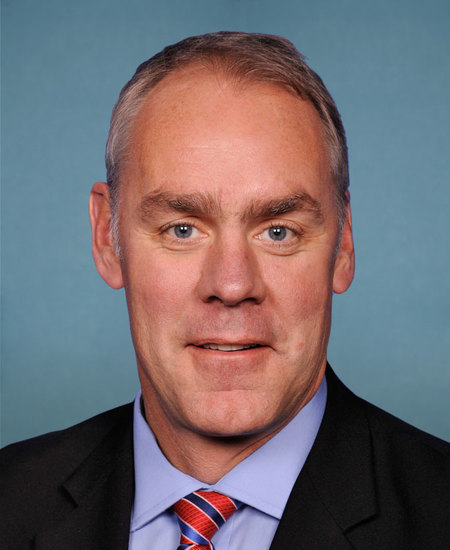
Rep. Ryan K. Zinke
Sponsored bills
Maddy summaryThis bill establishes a Truth and Healing Commission to investigate the history and impacts of U.S. Indian Boarding School policies on Native American communities, including cultural, emotional, and physical effects on survivors, descendants, and tribal communities. The Commission will document these impacts through research, public meetings, and testimony, working with two advisory committees focused on Native American perspectives and Federal agency coordination. The Commission will operate for six years, with annual reports to Congress and a final report containing recommendations for Federal action. The bill also includes provisions for managing burial sites related to boarding schools and ensures the Native American Graves Protection and Repatriation Act applies to remains found on Federal lands related to these schools.
Maddy summaryThis bill enhances the existing American Battlefield Protection Program by expanding eligibility for grants to include Tribes, nonprofit organizations, and educational institutions, alongside States and local governments. It clarifies that eligible sites must be identified in the 1993 Civil War battlefield report or 2007 Revolutionary War/War of 1812 report, excluding sites already within National Park boundaries. The bill also requires the Secretary to submit updated battlefield condition reports to Congress every 10 years, starting two years after enactment, tracking preservation efforts and battlefield changes. These changes streamline program administration and ensure ongoing assessment of historic battlefield sites.
Maddy summaryThis bill transfers specific mineral rights to the Crow Tribe and the Hope Family Trust. It requires the Hope Family Trust to convey its mineral interests in the Hope Family Tracts (4,660 acres in the Crow Reservation) to the Crow Tribe, while the U.S. government conveys mineral interests in the Bull Mountains Tracts (4,530 acres) to the Hope Family Trust. The mineral rights transferred to the Tribe will be held in trust by the U.S. and exempt from Montana state taxation. The Tribe must later agree on a revenue-sharing formula with the Hope Family Trust if the minerals are developed. This directly affects the Crow Tribe, the Hope Family Trust, and Montana's tax jurisdiction over these lands.
Maddy summaryHR 6441, the Ranching Without Red Tape Act of 2023, simplifies minor improvements for ranchers on federal grazing lands managed by the U.S. Forest Service (USFS) and Bureau of Land Management (BLM). It requires the agencies to issue regulations within one year allowing permittees to make small fixes - like repairing fences, wells, or water pipelines - without lengthy approvals. Specifically, ranchers must notify the local manager 30 days in advance; if no response is given within that period, the work can proceed. The bill also mandates that agencies respond to improvement requests within 30 days and expedite approved projects using existing administrative tools. This directly affects ranchers holding grazing permits on USFS and BLM lands.
Maddy summary# Summary of Proposed Higher Education Act Amendments This document outlines significant proposed amendments to the Higher Education Act of 1965, primarily as part of the "College Cost Reduction Act." The key elements include: ## Accreditation Reform - Major overhaul of accreditation standards, requiring accrediting agencies to demonstrate independence from trade associations - New requirements for accrediting agencies to assess student achievement outcomes, including median value-added earnings relative to median total price charged - Introduction of an "Alternative Quality Assurance Experimental Site Initiative" to test non-accredited institutions - Protections for religious institutions, including a new process for appealing accreditation decisions related to religious mission - Removal of "litmus tests" that would require institutions to support specific political viewpoints ## Student Success Initiatives - Establishment of "Postsecondary Student Success Grants" to increase participation, retention, and completion rates for high-need students - Focus on evidence-based practices, with tiered requirements (tier 1, 2, and 3 reforms) - Mandatory inclusion of high-need student populations (low-income, first-generation, military-connected, etc.) - Requirements for institutions to report on completion rates, retention rates, and student demographics ## Regulatory Changes - Repeal of numerous existing regulations including: * Closed school discharges * Borrower defense to repayment * Pre-dispute arbitration * False certification requirements * Ability-to-benefit rules * Financial responsibility regulations - New restrictions on incentive compensation for recruiters - Changes to third-party servicer definitions and regulations ## Transfer and Credit Policies - New requirement that institutions cannot deny transfer credit based solely on the source of accreditation - Requirements for transparent transfer policies - Changes to reverse transfer policies ## Other Key Provisions - Modifications to the National Advisory Committee on Institutional Quality and Integrity (NACIQI) - New definitions for "total price" and "value-added earnings" - Changes to the process for institutions to change accrediting agencies - New requirements for institutions to report on student outcomes The overall focus of these proposed amendments is to reduce regulatory burden on institutions, promote transparency, improve student outcomes (particularly for high-need students), modernize accreditation processes, and protect religious institutions' rights in accreditation decisions.

Maddy summaryThe Fix Our Forests Act creates a new system for managing wildfire risk on federal lands by designating "firesheds" (landscape-scale areas with high wildfire risk) and establishing a central coordination center called the Fireshed Center. It streamlines environmental reviews for vegetation management projects in these areas, requires public tracking of wildfire risk and management activities through a Fireshed Registry, and limits legal challenges to these projects. The bill affects federal land management agencies (like the Forest Service and Bureau of Land Management), communities in wildfire-prone areas, and utility companies managing vegetation near power lines. It also includes provisions for community wildfire risk reduction programs and research on new wildfire management technologies, aiming to accelerate risk reduction while maintaining transparency about where and how these projects are implemented.
Maddy summaryThe Parity for Tribal Law Enforcement Act would allow tribal law enforcement officers working under federal contracts or compacts (via the Indian Self-Determination Act) to enforce federal law on tribal lands, provided they complete equivalent training, pass background checks, and receive Bureau of Indian Affairs certification. It designates these officers as federal law enforcement officers for legal protections under specific federal laws, such as the Federal Tort Claims Act. The bill requires the Secretary of the Interior to establish a credentialing process within 24 months and directs the Attorney General to coordinate federal public safety efforts in Indian communities through improved data collection and training. This policy change directly affects tribal officers and communities by expanding their enforcement authority and legal recognition.
Maddy summaryThis bill amends Section 4013 of the Water Infrastructure Improvements for The Nation Act to allow water districts and project developers who received federal loans for western U.S. water infrastructure projects to repay those loans faster. It adds a new provision (paragraph (3)) directing repayment authority under Section 4011, streamlining the process for accelerating loan repayment. The change directly affects entities managing federally funded water projects in the western United States, enabling earlier repayment without altering loan terms or funding amounts.
Maddy summaryHR 9718, the "Extending and Enhancing U.S.-U.K. Nuclear Cooperation for Mutual Defense Purposes Act," allows the U.S. government to implement an updated nuclear cooperation agreement with the United Kingdom without following the standard congressional review process under the Atomic Energy Act of 1954. The bill waives normal requirements for congressional consideration of the amendment to the existing 2024 U.S.-U.K. nuclear agreement, enabling it to take effect immediately upon the bill's enactment. This procedural change directly affects the U.S. and U.K. governments by facilitating faster implementation of their mutual defense nuclear cooperation framework.