

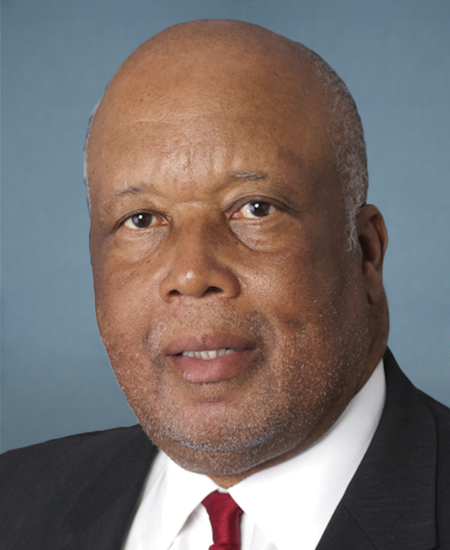
Photo of Bennie G. Thompson
D United States House · District 2 · Mississippi On the 2026 ballot

Rep. Bennie G. Thompson

Compare
Total votes
2,837
all sessions
Attendance
98%
63 missed
Near the chamber average
With party
98%
of cast votes
Higher than 77% of chamber peers
Bipartisan score
1%
crosses aisle rarely
Lower than 78% of chamber peers
Sponsored
1,263
bills & resolutions
Higher than 78% of chamber peers
Committees
1
assignment
1,263 bills and resolutions

Sponsored bills

Total
1,263
Primary
43
Co-sponsor
1,220
This page
1,263
matching current filters
Co-sponsor HR 1271
In committee · Indiana House · Co-sponsor
To provide additional funding for scholarships for students at 1890 institutions, and for other purposes.

Maddy summaryHR 1271 increases funding for scholarships at 1890 institutions - historically Black colleges and universities established under the Second Morrill Act - by adding mandatory annual support. It amends existing law to explicitly include bachelor's and graduate programs in scholarship eligibility and requires $15 million annually from the Commodity Credit Corporation starting in fiscal year 2025, to remain available until spent. This funding directly supports students at these institutions by expanding access to financial aid for higher education. The bill updates previous funding language to ensure ongoing support beyond 2023.

In committee Mar 28, 2025 1 co-sponsor
Co-sponsor HRES 267
In committee · Indiana House · Co-sponsor
Recognizing the 10th Anniversary of Educators Rising.

Maddy summaryHouse Resolution HRES 267 formally recognizes the 10th anniversary of Educators Rising (rebranded in 2015) and its work preparing high school students for teaching careers. The resolution commends the program for addressing teacher shortages through local "Grow Your Own" initiatives that connect students to teaching pathways. It highlights Educators Rising’s national reach (1,400+ chapters) and role in fostering educator diversity, but contains no new policies, funding, or direct impacts on individuals or schools. As a symbolic resolution, it does not create legal obligations or alter existing programs.

In committee Mar 27, 2025 1 co-sponsor
Co-sponsor HR 2477
In committee · Indiana House · Co-sponsor
Portable Ultrasound Reimbursement Equity Act of 2025

Maddy summaryHR 2477, the Portable Ultrasound Reimbursement Equity Act of 2025, would amend Medicare rules to require equal reimbursement for portable ultrasound transportation and setup services as is currently provided for portable X-ray services. This change directly affects Medicare beneficiaries needing portable ultrasound exams and healthcare providers (like mobile clinics) who offer these services. The bill mandates that Medicare pay separately for portable ultrasound transportation and setup in the same way and to the same extent as portable X-ray services, using similar supplier requirements as existing regulations. The policy change would take effect for services provided on or after January 1, 2027.

In committee Mar 27, 2025 1 co-sponsor
Co-sponsor HR 2411
In committee · Indiana House · Co-sponsor
UNRWA Funding Emergency Restoration Act of 2025

Maddy summaryThis bill, HR 2411, directs the U.S. government to immediately resume funding for the United Nations Relief and Works Agency for Palestine Refugees (UNRWA) by repealing two prior funding restrictions. It requires the State Department to restart payments to UNRWA under existing authorities and mandates the President to rescind a 2025 executive order ending UNRWA support. The bill affects Palestinian refugees in Gaza, Jordan, Lebanon, Syria, and the West Bank who rely on UNRWA for humanitarian aid, as well as U.S. funding mechanisms. It also requires quarterly reports through 2028 on UNRWA’s progress implementing accountability reforms from an independent review led by Catherine Colonna.

In committee Mar 27, 2025 1 co-sponsor
Co-sponsor HR 2038
In committee · Indiana House · Co-sponsor
American Housing and Economic Mobility Act of 2025

Maddy summary# Summary of the American Housing and Economic Mobility Act of 2025 This comprehensive legislation addresses housing affordability, civil rights, financial inclusion, and tax policy through multiple titles: **Fair Housing Expansion (Title I):** - Expands protections under the Fair Housing Act to include gender identity, sexual orientation, marital status, source of income, and veteran status - Requires housing providers receiving federal assistance to comply with enhanced accessibility standards (twice as many units must be accessible) **Community Reinvestment Act Strengthening (Title II):** - Requires banks to form diverse Community Advisory Committees in each metropolitan area - Mandates regular biannual consultations between bank executives and community advisory groups - Requires detailed data collection on lending practices by demographic factors (including race, ethnicity, and disability status) - Establishes new requirements for banks to analyze and report on disparities in access to credit **Veterans' Housing Access (Title III):** - Expands eligibility for VA home loans to include direct descendants of veterans who served between June 22, 1944, and April 11, 1968, who are first-time, first-generation homebuyers **Public Housing Improvements (Title IV):** - Requires public housing agencies to analyze where participants live and develop strategies to increase access to higher-opportunity neighborhoods - Mandates regional collaboration among housing agencies to reduce disparities in access - Requires HUD to develop mapping tools to help agencies analyze neighborhood access **Estate Tax Reforms (Title V):** - Increases estate tax rates for large estates (over $13 million) - Reduces the basic exclusion amount from $13 million to $3.5 million - Imposes a 10% surtax on estates exceeding $1 billion - Increases the exclusion limit for farm real property from $750,000 to $3 million - Increases the exclusion for land subject to conservation easements from $500,000 to $2 million - Creates a new 5-8% surcharge on high-income estates and trusts **Additional Provisions:** - Strengthens credit union service to underserved areas - Raises public welfare caps for banks to increase investments in low-income communities - Requires new data collection and reporting requirements for financial institutions This legislation represents a significant expansion of housing rights, financial inclusion, and tax policy reforms aimed at reducing disparities in access to housing and financial services while reforming the estate tax system.

In committee Mar 27, 2025 1 co-sponsor
Co-sponsor HR 1725
In committee · Indiana House · Co-sponsor
Sgt. Isaac Woodard, Jr. and Sgt. Joseph H. Maddox GI Bill Restoration Act of 2025

Maddy summaryThis bill provides housing loans and education assistance to Black World War II veterans who were denied GI Bill benefits due to racial discrimination, or to their surviving spouses, children, or direct descendants. To qualify, applicants must certify they were denied benefits on racial grounds under the original 1944 GI Bill and apply within five years of the law's enactment. The Department of Veterans Affairs must implement these provisions within 90 days and report to Congress on participation and program costs. It specifically addresses documented historical discrimination where Black veterans were steered toward vocational training instead of college, with only 6% earning degrees compared to 19% of White veterans.

In committee Mar 27, 2025 1 co-sponsor
Co-sponsor HR 2381
In committee · Indiana House · Co-sponsor
SCREENS for Cancer Act of 2025

Maddy summaryHR 2381, the SCREENS for Cancer Act of 2025, reauthorizes and updates the National Breast and Cervical Cancer Early Detection Program (NBCCEDP). It directly affects low-income, uninsured, or underinsured women across all 50 states, territories, and tribal communities by expanding access to breast and cervical cancer screenings, diagnostic services, and patient navigation support. Key provisions include updating program language to emphasize prevention alongside detection and control, adding specific strategies to reduce disparities, and appropriating $235 million annually for fiscal years 2026-2030. The bill also requires a GAO study by 2027 to assess program eligibility, service trends, and barriers to screening access.

In committee Mar 26, 2025 1 co-sponsor
Co-sponsor HR 17
In committee · Indiana House · Co-sponsor
Paycheck Fairness Act

Maddy summaryThe Paycheck Fairness Act strengthens equal pay protections by expanding the definition of "sex" to include pregnancy, childbirth, sexual orientation, gender identity, and sex characteristics. It modifies employer defenses for pay disparities to require proof that any pay difference is job-related, not based on sex, and accounts for the entire pay gap. The bill prohibits employers from asking about salary history, enhances penalties for violations, and requires employers with 100+ employees to collect and report detailed pay data by race, sex, and job category. It also establishes training programs for employers on eliminating pay bias and creates a National Equal Pay Enforcement Task Force to coordinate enforcement efforts. This legislation directly affects employers, particularly those with 100+ employees, and aims to address pay disparities impacting women, people of color, and other underrepresented groups.

In committee Mar 25, 2025 1 co-sponsor
Co-sponsor HJRES 80
In committee · Indiana House · Co-sponsor
Establishing the ratification of the Equal Rights Amendment.

Maddy summaryH.J. Res. 80 would declare the Equal Rights Amendment (ERA) part of the U.S. Constitution, asserting it has been ratified by 38 states (three-fourths of the states) despite the original 1972 deadline. If passed, this resolution would formally establish the ERA as a constitutional amendment, requiring all federal and state laws to align with its gender equality protections. The bill does not create new laws but confirms the ERA's status as part of the Constitution, affecting how laws are interpreted and enforced. It is a procedural step to resolve the legal dispute over the ERA's validity after decades of debate.

In committee Mar 24, 2025 1 co-sponsor
Co-sponsor HRES 239
In committee · Indiana House · Co-sponsor
Raising awareness of the racial disparities in the impact of colorectal cancer on the Black community.

Maddy summaryHRES 239 is a non-binding resolution recognizing racial disparities in colorectal cancer (CRC) outcomes, specifically highlighting that Black Americans face 20% higher CRC rates and 40% higher death rates compared to non-Hispanic Whites. It directly affects Black communities disproportionately impacted by these disparities, which include the lowest 5-year survival rate for CRC. The resolution encourages the CDC to research screening disparities and develop strategies to eliminate them, promotes adherence to U.S. Preventive Services Task Force screening guidelines, and urges states to expand coverage for early CRC screenings, particularly for Black individuals and other high-risk groups. It does not create new laws but aims to raise awareness and guide existing public health efforts.

In committee Mar 21, 2025 1 co-sponsor
Showing 351 to 360 of 1,263 bills
Previous 1 … 35 36 37 … 127 Next