

Maddy summaryThis bill expands legal protections for domestic violence and stalking survivors by broadening key definitions. It adds current and former dating partners to the definition of "intimate partner" and includes children of dating partners in domestic violence protections. The bill also creates a new federal definition for "misdemeanor crime of stalking," requiring a course of harassment causing fear for specific people (including intimate partners, family, or shared-residence individuals) or their pets/service animals. Convictions under this new definition would trigger firearm restrictions, with specific safeguards for due process in court proceedings. These changes directly affect survivors in dating relationships and their children, strengthening federal protections for vulnerable individuals.
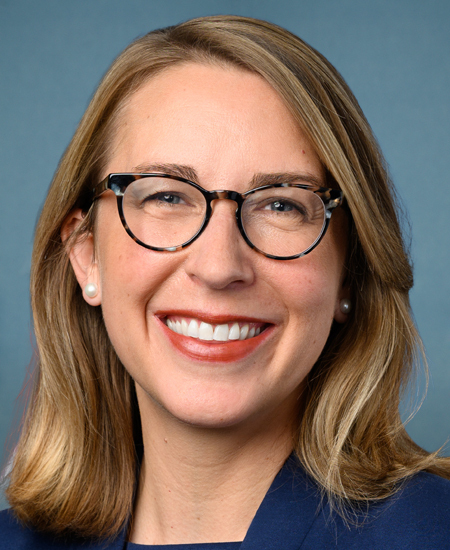
Rep. Hillary J. Scholten
Sponsored bills
Maddy summaryThe Equal Dignity for Married Taxpayers Act amends the Internal Revenue Code to replace gendered terms like "husband and wife" with gender-neutral language such as "married couple" or "spouses" throughout tax law. This bill affects all married couples filing federal taxes by making the tax code consistent for all married couples regardless of gender. It makes over 30 specific changes to tax code sections, including replacing "his spouse" with "the individual's spouse" and updating references to marital status. The bill does not alter tax rates, deductions, or credits - it only updates language to be more inclusive. This is a technical language update to ensure the tax code treats all married couples equally without gendered references.
Maddy summaryThis bill amends the Older Americans Act of 1965 to better serve LGBTQI older adults (ages 60+). It adds specific definitions for "LGBTQI" and "HIV" in the law, redesignates "minority" to explicitly include LGBTQI individuals, and creates an Office of LGBTQI Inclusion within the Administration on Aging. The bill establishes a National Resource Center on LGBTQI Aging to provide training, technical assistance, and educational resources to organizations serving this community. It also requires the collection and analysis of data on discrimination against LGBTQI older adults in long-term care settings.
Maddy summaryThis bill prohibits defendants in federal criminal cases from using a victim's LGBTQ identity (sexual orientation, gender identity, or expression) as a defense to excuse or reduce punishment for violent crimes. It amends federal law to ban arguments that claim a "nonviolent sexual advance" or inaccurate perception of someone's LGBTQ status justified the defendant's actions. The law allows limited admission of past trauma evidence under standard federal rules but requires the Attorney General to annually report on federal prosecutions involving bias-motivated violence against LGBTQ individuals. This directly affects defendants in federal court cases where such defenses were previously used, aiming to end the practice of treating LGBTQ victims' identities as justification for violence.
Maddy summaryThe Women's Health Protection Act of 2025 would protect access to abortion services across the United States by prohibiting states from imposing restrictions that are more burdensome than those on comparable medical procedures. The bill directly affects people seeking abortion care and health care providers by banning restrictions such as mandatory in-person visits, requirements for specific tests, limitations on telemedicine, and rules based on a patient's reason for seeking abortion. It prohibits state laws that single out abortion for unnecessary restrictions while allowing post-viability abortions when necessary to protect a patient's life or health. The bill preempts conflicting state laws and provides enforcement mechanisms through private lawsuits and actions by the Attorney General.
Maddy summaryThis bill prohibits state officials from blocking abortion access for patients traveling from other states, including restricting providers who offer legal abortions in their state to out-of-state patients. It protects people traveling across state lines for legal abortions, those assisting such travel, and the interstate transport of FDA-approved abortion medication. Violations can be challenged by the Justice Department or affected individuals through civil lawsuits seeking injunctions and damages. The law applies broadly across all states, territories, and tribal nations, defining "abortion service" to include both medical procedures and related care.
Maddy summaryThis bill creates federal funding for community-based violence intervention programs in high-violence areas, targeting communities with 35+ homicides annually or 20+ homicides with rates double the national average. It establishes grants for community organizations to implement trauma-informed violence interruption strategies, hospital-based programs for injured patients, and job training for "opportunity youth" (16-25 year olds not in school or work). The legislation authorizes $300 million in 2026, increasing to $700 million annually through 2033, with requirements for evidence-based approaches that reduce violence without contributing to mass incarceration. It creates a National Community Violence Response Center to coordinate data collection, research, and best practices for these programs. The focus is on prevention through economic opportunity, trauma care, and community-driven interventions rather than traditional law enforcement approaches.
Maddy summaryThe Caring for Survivors Act of 2025 increases monthly dependency and indemnity compensation for surviving spouses of veterans. It changes the calculation method from a fixed $1,154 to 55% of a specific veteran compensation rate, effective six months after enactment. The bill also reduces the required continuous disability rating period for survivors from 10 years to 5 years, and provides a proportional payment for cases where the rating period is shorter than 10 years. Surviving spouses of veterans who died before January 1, 1993, receive the greater of their current benefit or the new calculation. This directly affects surviving spouses eligible for benefits under Title 38, U.S. Code, particularly those with veterans who died prior to 1993.
Maddy summaryHRES 529 is a symbolic resolution honoring Boys and Girls Clubs of America during National Boys and Girls Club Week (June 23-27, 2025). It calls on U.S. citizens to celebrate the organization and recognize its work in serving over 3.3 million young people annually through programs like STEM education, career readiness, and academic support across 5,500 locations in all 50 states and territories. The resolution has no binding policy impact - it simply encourages public acknowledgment of the Clubs' role in youth development. This is a ceremonial gesture, not a legislative change affecting laws or funding.
Maddy summaryThis bill requires major internet companies (including social media, streaming services, and app stores) and broadband providers to contribute to the Universal Service Fund, which subsidizes affordable broadband in rural and high-cost areas. It exempts smaller companies that transmit less than 3% of U.S. broadband data or earn under $5 billion annually. The Federal Communications Commission must create a new support mechanism to help rural broadband providers cover costs, while ensuring contributions remain fair and predictable. The bill explicitly states it does not grant the FCC new authority over these companies.