

Maddy summaryThe Toxic-Free Beauty Act of 2025 bans 15 specific harmful chemicals and contaminants in cosmetic products, directly affecting manufacturers and retailers selling cosmetics in the U.S. market. It prohibits ingredients like formaldehyde, mercury, certain parabens, phthalates, and triclosan, while setting strict limits for contaminants such as lead and 1,4-dioxane in products. The law includes a non-preemption clause allowing states to maintain or enforce stricter rules than federal standards, and the ban will take effect for products introduced into interstate commerce starting January 1, 2027. This legislation aims to reduce consumer exposure to chemicals linked to health risks by defining key terms like "contaminant" and "intentionally added ingredient."
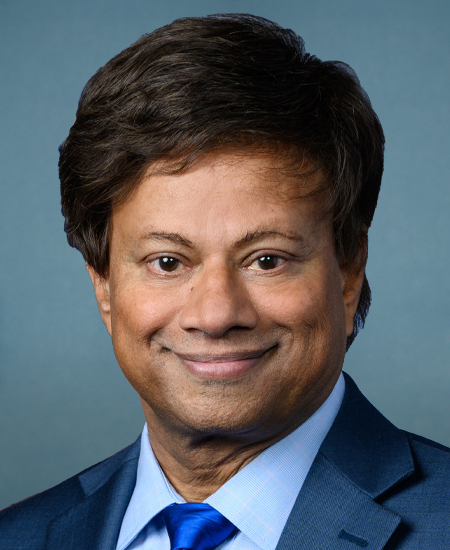
Rep. Shri Thanedar
Sponsored bills
Maddy summaryThis bill establishes federal worker heat protection standards to prevent heat-related illness and injury. It requires employers to provide a workplace free from heat stress hazards, including access to cool water, scheduled rest breaks, shaded cooling areas, and training on heat illness symptoms. The Secretary of Labor must create these standards within one year, incorporating evidence-based practices like engineering controls (e.g., ventilation), administrative measures (e.g., adjusted schedules), and employer-paid personal protective equipment. The law directly affects all employers in high-heat work environments - such as construction, agriculture, and manufacturing - and strengthens whistleblower protections for workers reporting safety violations.
Maddy summaryThe Housing Is a Human Right Act of 2025 creates new federal programs to address homelessness and housing instability. It establishes a CDBG Plus program to fund permanent affordable housing, supportive services, and basic infrastructure like public bathrooms and rest areas for homeless individuals. The bill prohibits criminalizing homelessness (such as sleeping in public) and requires jurisdictions to adopt "Housing First" approaches that connect people to housing without preconditions like sobriety requirements. It also creates new taxes on luxury real estate sales and large landlords to fund these programs, and includes provisions to help homeless people vote by removing barriers like ID requirements. The bill directly affects people experiencing homelessness, housing instability, and those who are cost-burdened (spending over 22% of income on housing), as well as local governments and housing providers.
Maddy summaryHR 4453 would amend federal law to add Parkinson's disease to the list of illnesses automatically considered work-related for firefighters. Specifically, it inserts "Parkinson's disease" into Section 8143b(b) of Title 5, U.S. Code, which determines which conditions qualify for disability benefits under the Federal Employees' Compensation Act. This change directly affects firefighters who develop Parkinson's disease during their fire protection duties, making it easier for them to qualify for federal disability compensation without needing to prove direct causation. The bill modifies existing code language to include this condition among other work-related illnesses already covered for firefighter benefits.
Maddy summaryHR 4440, the *Protecting Federal Employee Rights to Personnel Files Act of 2025*, requires federal agencies to provide current and former employees with copies of their official personnel files. Current employees must receive copies within seven days of requesting them, while employees who separated after the law's enactment get copies within seven days of separation. Former employees who separated before the law's enactment must receive copies within 21 days of requesting them from the Office of Personnel Management. The bill mandates these copies be provided in both electronic and physical formats, directly affecting all federal workers seeking access to their personnel records.
Maddy summaryThe Cool Corridors Act of 2025 expands the existing Healthy Streets program to fund tree planting, shade structures, and green infrastructure along transportation corridors - like bus stops, transit hubs, and school zones - to reduce heat exposure. It directly affects communities facing extreme heat and limited tree canopy (especially low-income or historically underserved areas), as well as state/local transit agencies, schools, and environmental groups. Key provisions include requiring projects to prioritize heat-vulnerable regions, mandate annual reporting on temperature reduction and equity outcomes, and ensure tree planting doesn’t obstruct traffic safety. The bill also extends program funding through 2030 and mandates coordination with agencies like the EPA and Forest Service.
Maddy summaryThis bill prohibits bear baiting on federal lands by requiring the Secretary of the Interior and Secretary of Agriculture to enforce existing bans on feeding bears for hunting purposes in National Parks and wildlife refuges, and to adopt new regulations banning baiting on Bureau of Land Management and National Forest lands within one year. It directly affects licensed hunters who currently use bait stations (piles of human-scented food like meat or fruit) to attract bears for hunting on federal lands where state law permits it. The bill aims to reduce bear habituation to human food, lower property damage costs, and decrease human-bear conflicts by ending baiting practices that make bears lose natural wariness. Exceptions are allowed only for extraordinary cases involving bear welfare, public safety, or authorized research.
Maddy summaryThe Child Care for Working Families Act creates a federal program to provide affordable, high-quality child care for working families with children under age 6. It would provide direct child care assistance through certificates or grants to parents, with no copayment required for families at or below 85% of state median income. The program requires states to implement quality standards for child care providers, including a tiered quality system and minimum wage requirements for staff (at least a living wage equivalent to elementary educators). The bill appropriates $20 billion for the program over five years, with additional funding for quality improvement initiatives and universal preschool services.
Maddy summaryHR 4396, the Uterine Cancer Study Act of 2025, mandates a study by the Department of Health and Human Services (HHS) into the potential link between chemical hair straighteners and uterine cancer, with a specific focus on higher incidence rates among women of color. The study will review existing research, examine impacts across all racial and ethnic groups, analyze different hair straightener types (including those with dyes or bleach), and assess whether the FDA should require additional safety testing for these products. HHS must submit its study methodology within 45 days of the bill's enactment, begin the study within 180 days, and deliver a final report to Congress within two years. This bill does not create new regulations but directs a specific research effort to gather evidence on a potential health concern. The study directly affects women, particularly women of color, who use hair straightening products and may face elevated uterine cancer risks.
Maddy summaryThis bill would allow states to create their own universal health care systems by applying for waivers that replace federal health programs with state-based coverage. States would need to demonstrate they can cover at least 95% of residents within 5 years, maintain comparable benefits and affordability, and provide comprehensive coverage including reproductive health services. The federal government would redirect funds that would have gone to federal programs like Medicaid and Medicare to the states, with states required to submit regular reports on coverage progress and costs. The bill includes specific protections for Indian health care providers and ensures coverage for vulnerable populations without imposing new costs on them. This framework would apply to states that choose to implement their own universal health care system rather than relying on existing federal programs.