

Maddy summaryHR 5094, the "Protect Patients from Costly Care Act," repeals two specific provisions from a prior reconciliation law (Public Law 119-21) that would have increased patient costs. It restores Medicaid cost sharing rules to their pre-2023 state, directly affecting Medicaid beneficiaries by preventing higher out-of-pocket costs. It also reverses changes to orphan drug exclusions under the Drug Price Negotiation Program, bringing those medications back under federal price negotiation rules for manufacturers. The bill does not create new policies but undoes specific cost-increasing changes to existing programs.
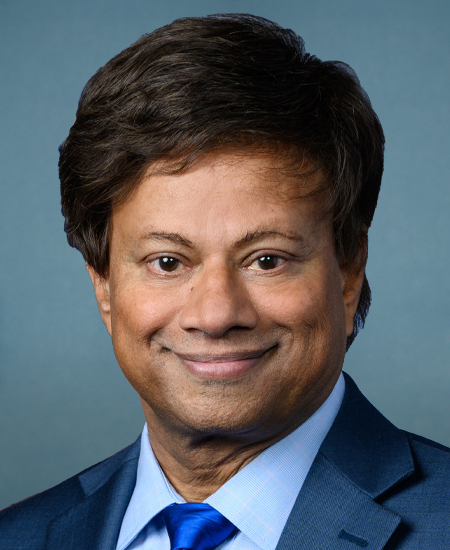
Rep. Shri Thanedar
Sponsored bills
Maddy summaryThis bill repeals the provision allowing the President to assume emergency control of the District of Columbia's police force. It directly affects the District of Columbia government by transferring full authority over police emergency management from the federal government to local DC officials. The key mechanism is removing Section 740 of the District of Columbia Home Rule Act, which previously permitted the President to intervene in police operations during emergencies. This change formalizes DC's local control over its police department during crises.
Maddy summaryHR 5051 requires members of the U.S. Armed Forces serving in Washington, D.C., under a presidential order addressing crime or civil disturbance to wear body cameras during their deployment. This applies to service members performing active duty in the District under such orders, mandating participation in a program matching the District's Metropolitan Police Department's body-worn camera requirements established under D.C. law. The requirement takes effect 30 days after the bill becomes law. The bill directly affects military personnel deployed to D.C. for civil disorder response, not civilian law enforcement or the public.
Maddy summaryThis bill expands programs that employ service coordinators in federally assisted housing projects (like those under Section 202 of the Housing Act of 1959) to help residents access supportive services for housing stability, health, and aging in place. It requires housing owners to reserve $2,500 annually per project for coordinator training and establishes new grant programs with $225 million in annual funding (2026-2030) for hiring coordinators, prioritizing projects serving elderly/disabled residents or in rural/persistent poverty areas. Coordinators must meet training requirements and coordinate services without forcing residents to accept them. The bill also adds similar provisions for rural housing (Section 515) and public/Indian housing, with separate funding allocations.
Maddy summaryThe SUN Act (HR 4998) requires the President to submit a detailed report to Congress within 15 days whenever National Guard members are deployed domestically for non-disaster purposes under specific laws. The report must include the legal basis for the deployment, evidence of reduced violence, input from local law enforcement, total costs, and a certification that the deployment won’t interfere with disaster response capabilities. It applies to all domestic uses of the National Guard except for responses to natural disasters under the Stafford Act. The bill aims to enhance congressional oversight of military deployments on U.S. soil.
Maddy summaryHJRES 113 designates August 20 as Slavery Remembrance Day to commemorate the arrival of the first 20 enslaved Africans in Virginia in 1619 and honor the enduring legacy of slavery. The resolution requests the President issue a proclamation encouraging the public to observe this day through ceremonies and activities that acknowledge slavery's horrors and its lasting impacts. It includes historical context about the transatlantic slave trade, the Middle Passage, and figures like Harriet Tubman, while posthumously recognizing Reconstruction-era Black Congress members. As a symbolic commemorative resolution, it does not create new laws or directly affect any group, but serves to raise awareness about slavery's history and consequences.
Maddy summaryThis bill (HJRES 115) terminates a presidential emergency declaration made on August 11, 2025, which claimed a "crime emergency" in Washington, D.C. It directly affects the District of Columbia by ending federal restrictions that prevented D.C. from using $1 billion in locally-raised funds for public safety, law enforcement, fire services, and schools. The resolution cites that the emergency declaration was legally flawed - section 740 of the DC Home Rule Act does not permit federalizing the Metropolitan Police Department - and notes that D.C. violent crime has reached a 30-year low. The bill formally ends the emergency under the DC Home Rule Act, restoring D.C.'s authority over its own budget and public safety resources.
Maddy summaryThis resolution (HRES 659) is a symbolic congressional expression of support for designating August 15, 2025, as "Indian Independence Day: A National Day of Celebration of the World’s Two Largest Democracies." It does not create new law but formally recognizes India’s independence from British rule on August 15, 1947, and celebrates the shared democratic values between the U.S. and India. The resolution specifically acknowledges India’s 78th independence anniversary, honors Americans of Indian descent for their contributions to U.S. society, and reaffirms the U.S.-India partnership based on democracy and mutual respect. It has no binding effect but aims to foster goodwill through ceremonial recognition.
Maddy summaryHRES 658 is a symbolic resolution recognizing the nonprofit sector’s contributions to communities and supporting the designation of August 17, 2025, as "National Nonprofit Day." It highlights nonprofits as the nation’s third-largest employer (12 million workers) and key community partners, without creating new laws or funding. The resolution formally honors nonprofits’ role in services like education, health, and shelter but does not alter policies or obligations. This is a non-binding gesture of appreciation, not a legislative change.
Maddy summaryThe Community Parks Revitalization Act establishes a federal program to improve parks and recreation facilities in urban areas through grants and secured loans. It provides competitive grants to eligible local governments for rehabilitation and construction of parks (including safety improvements), innovation programs (like youth services and veteran support), and recovery planning. The program requires local matching funds (3/7 of grant amount) and prioritizes projects that increase access for low-income residents, veterans, and people with disabilities, while incorporating sustainable design features like stormwater management and green infrastructure. The bill also authorizes secured loans and loan guarantees for larger park infrastructure projects with dedicated revenue streams, aiming to improve community health outcomes and economic development through better recreational spaces.