

Maddy summaryThis bill requires the Department of Homeland Security to publicly share flight details within 72 hours for aircraft used by ICE, CBP, or the Coast Guard in immigration enforcement operations involving detention, deportation, or transporting individuals in custody. It mandates disclosure of specific data including departure/arrival times, airport codes, aircraft registration, number of detainees, and demographic information (nationality, age, family status, and restraints used). Private aircraft operators working directly with immigration enforcement agencies can no longer claim privacy for these flights, ending their eligibility to withhold such information. The law applies specifically to federally funded flights for immigration enforcement, not general aviation.
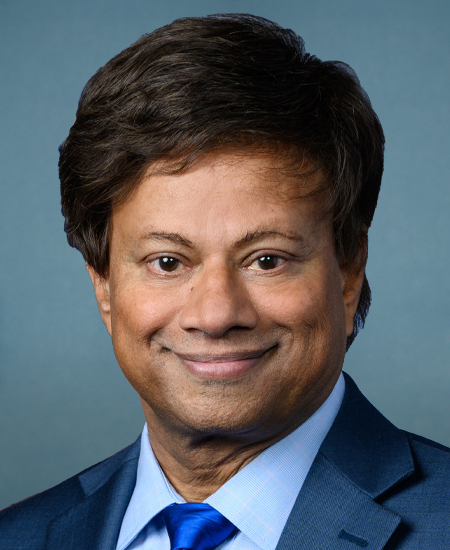
Rep. Shri Thanedar
Sponsored bills
Maddy summaryHR 7173, the Follow the Science Act, restricts political appointees from influencing National Institutes of Health (NIH) operations and grant decisions. It prohibits most political appointees (defined broadly as those in policy-making roles) from being employed by NIH or participating in grant reviews, funding selections, or policy implementation. The bill requires the NIH Director to report on past political appointee involvement in these activities to Congress within 30 days of enactment. These changes aim to ensure NIH decisions are based on scientific merit rather than political influence, with limited exceptions for other federal agencies.
Maddy summaryHR 3307, the Eastern Mediterranean Gateway Act, directs the U.S. government to prioritize diplomatic and security cooperation with Egypt, Greece, Cyprus, and Israel to support their role as a strategic gateway for the India-Middle East-Europe Economic Corridor (IMEC). The bill requires the Secretary of State to institutionalize strategic dialogues with these countries, prioritize energy and defense cooperation in the region, and submit annual reports on implementation and multilateral initiatives. It also mandates studies on expanding U.S. bilateral programs (like those with Israel) to include Eastern Mediterranean partners and analyzing the Cyprus security center as a model. The bill does not create new funding but guides existing U.S. policy and coordination efforts.
Maddy summaryHR 7161, the "No Private Bounty Hunters for Immigration Enforcement Act," prohibits the Department of Homeland Security (DHS) from using private contractors for immigration enforcement tasks like tracking individuals (skip tracing), surveillance, or location verification. It bans DHS from entering new contracts for these purposes after enactment, terminates existing contracts allowing them, and amends others to prohibit them. The bill also blocks federal funds from paying private entities per-person or via bonuses for locating individuals under immigration detainers, except for limited government-supervised data tools. DHS must audit all relevant contracts within 30 days of the bill's enactment to ensure compliance.
Maddy summaryThis bill creates a new grant program to increase U.S. artificial intelligence research capacity by funding specific institutions. It provides competitive funding to institutions not in the top 100 for federal research spending, historically Black colleges, minority-serving institutions, Tribal Colleges, or consortia of these entities. Funds can be used for AI research programs, faculty development, student bridge programs, research resources, and integrating ethical AI practices. The program aims to broaden participation in AI from underserved communities and avoid duplicating existing federal AI initiatives.
Maddy summaryThis bill amends a federal program to promote pollinator-friendly vegetation along roadsides and highway rights-of-way. It expands eligibility to include 501(c)(3) nonprofits managing such projects and requires consultation with the Fish and Wildlife Service before finalizing plans. The bill increases annual funding from $150,000 to $500,000 for program administration and raises the annual funding cap for projects from $2 million to $5 million (for fiscal years 2026-2031). These changes directly affect state transportation departments, federal land agencies, and qualifying nonprofit organizations managing roadside vegetation. The key policy shift is broadening partnership opportunities while increasing funding and clarifying consultation requirements.
Maddy summaryHR 7137, the Shutdown Fairness Act, requires federal agencies to pay covered employees (including most federal workers and military personnel) and covered contractors their regular pay during government shutdowns. It appropriates funds from the Treasury to cover standard employee compensation and contractor payments for work performed during a lapse in regular appropriations, ensuring pay continues without delay (within 7 days if a shutdown is ongoing at enactment) and aligns with regular pay schedules. The bill applies only to individuals employed or with accepted offers before the shutdown began and mandates that these payments be charged to future appropriations. It does not change agency obligations under existing contracts or authorize new spending beyond the specified shutdown period.
Maddy summaryHR 7138 disallows tax deductions for mortgage interest and depreciation on single-family homes (1-4 units) owned by large investment entities with over $100 million in assets, while imposing a 100% excise tax on sales or transfers of such properties. The bill directly affects institutional landlords (e.g., large real estate investment firms), excluding government entities, nonprofits, and federally assisted housing. Revenue from the tax will fund low-income housing programs via the Housing Trust Fund. It also prohibits Fannie Mae, Freddie Mac, and Ginnie Mae from purchasing or guaranteeing mortgages for these properties. The provisions apply 18 months after enactment.
Maddy summaryThe PATH to Education Act creates federal grants to help public transportation providers partner with educational institutions like community colleges, Head Start programs, and career schools to improve transit access for students. Grant funds can be used for adding bus stops or routes near campuses, increasing service frequency, or adjusting schedules to help students and Head Start participants commute. The bill allocates $1 million in 2027, rising to $5 million by 2031, with priority given to projects involving schools where over 25% of students receive Pell Grants. This policy directly affects transit agencies and eligible schools by funding concrete transit improvements to support education access.
Maddy summaryThis bill requires U.S. Department of Homeland Security (DHS) law enforcement officers and agents to follow a new department-wide policy on use of force. It mandates that officers use only objectively reasonable force, prioritize de-escalation, ban chokeholds and carotid restraints, and complete regular training. The policy also requires DHS components to establish internal review teams to analyze incidents and report detailed data every six months - including incidents causing injury, death, or involving deadly force - to the public via the DHS website. Additionally, DHS must brief Congress and inform the public within 24 hours of any incident resulting in hospitalization or death.