

Maddy summaryHJRES 144 is a congressional disapproval resolution targeting a specific rule issued by the Department of Veterans Affairs (VA) on December 31, 2025, which addressed "Reproductive Health Services" (90 Fed. Reg. 61310). This resolution directs Congress to disapprove the VA rule under Chapter 8 of Title 5, U.S. Code, meaning the rule would have no legal effect if passed. The bill directly affects the VA's implementation of reproductive health services for veterans, as it seeks to nullify the agency's existing policy. This is a procedural measure, not a substantive policy change, aimed solely at blocking the VA's rule through congressional action.
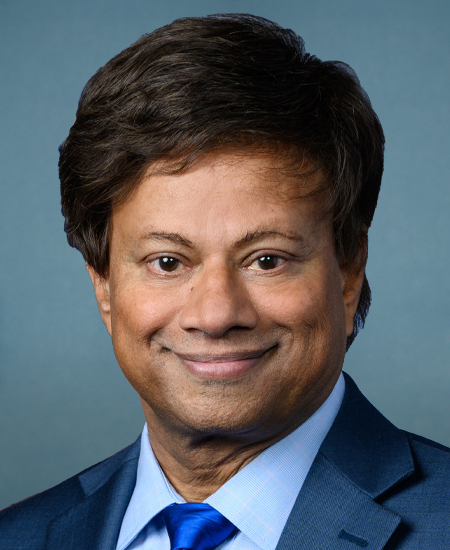
Rep. Shri Thanedar
Sponsored bills
Maddy summaryThe Prison Libraries Act of 2026 establishes a federal grant program to fund library services in state and territorial correctional facilities, directly benefiting incarcerated individuals. It requires grantees (states/territories) to submit plans demonstrating need, including demographic data on prison populations, and prohibits using funds for non-library purposes like food or facility maintenance. Grant funds must support library services such as digital access, educational programming (including job training and post-secondary curriculum), literacy initiatives, and partnerships with public libraries. The program authorizes $10 million annually from 2026-2031, prioritizes measurable outcomes like increased literacy and post-release employment opportunities, and mandates free access to all library resources for incarcerated people.
Maddy summaryHR 7233, the QR Act, requires U.S. Immigration and Customs Enforcement (ICE) and U.S. Customs and Border Protection (CBP) officers engaged in enforcement activities to wear a scannable QR code on their uniform. When scanned, the code directs to a public DHS website displaying the officer’s name, badge number, agency, unit, active status with timestamp, and a secure complaint portal for public use. The website may optionally show a photo but cannot display personal contact information, and must also show aggregated, non-identifiable complaint data for each officer. This bill directly affects ICE and CBP officers during enforcement interactions and aims to provide the public with immediate, verifiable information about officers they encounter.
Maddy summaryHR 7204, the School Bus Stop-Arm Safety Camera Act, directs federal agencies to study the benefits of requiring school buses to have stop-arm safety cameras and establish a grant program for states to adopt the technology. The bill requires the Federal Motor Carrier Safety Administration and National Highway Traffic Safety Administration to publish study findings and recommendations on data privacy, law enforcement sharing, and funding models within one year of enactment. It then authorizes the Transportation Secretary to create a grant program within 18 months, providing funds to state educational agencies to purchase or retrofit school buses with these cameras, or to install/maintain the technology. The law directly affects school districts and state education agencies by enabling financial support for implementing camera systems to improve student safety at bus stops.
Maddy summaryHCONRES 68 would require the President to remove U.S. military forces from Venezuela unless Congress has explicitly authorized their use through a declaration of war or a specific law. This applies to any U.S. Armed Forces currently stationed in Venezuela without such authorization. The resolution is based on the War Powers Resolution, which mandates congressional oversight of military deployments. It directs the immediate withdrawal of unapproved forces without adding new time limits or conditions.
Maddy summaryHRES 1018 is a resolution calling for the U.S. government and international partners to prioritize women's rights in Haiti's crisis response. It specifically demands ensuring at least 30% of Haiti's leadership positions (including security, humanitarian, and election roles) are held by women, funding services for gender-based violence survivors, and requiring gender-disaggregated data collection in all aid programs. The resolution also urges rebuilding U.S. Women, Peace, and Security programs and mandates that all policies address women's distinct needs in Haiti's transition. This resolution directly affects U.S. foreign policy implementation and Haiti's transitional government, emphasizing that women's inclusion is critical for stability.
Maddy summaryThe Language Access for All Act of 2026 requires federal agencies to ensure meaningful access to government services for people with limited English proficiency (LEP). Agencies must translate vital documents into languages commonly spoken in the U.S. (based on Census data), provide multilingual digital tools, interpretation services, and use bilingual staff as an alternative to professional interpreters. Each agency must create a language access plan within one year, detailing how it will serve LEP populations - including during emergencies - and annually certify compliance with technical standards. Noncompliance is treated as discrimination under civil rights law, with enforcement by the Department of Justice.
Maddy summaryHR 7206, the Farm and Family Relief Act, provides direct financial assistance to agricultural producers facing market challenges during the 2025 crop year. It establishes one-time payments for eligible crop producers (including wheat, corn, soybeans, and cotton) when expected costs exceed expected returns, with payment limits based on farming income (capping at $125,000 or $250,000 depending on farming income percentage). The bill allocates $5 billion for specialty crop producers, $500 million for timber industry assistance, and $330 million for sugar beet producers through cooperative block grants. Additionally, it delays certain cost-shift provisions in food assistance programs and terminates specific tariff-imposing executive orders.
Maddy summaryHR 7227, the Mental Health and MAMA Act of 2026, eliminates cost-sharing (like copays or deductibles) for mental health and substance use treatment services during pregnancy and for one year after childbirth. It directly affects pregnant and postpartum individuals covered by group health plans or individual insurance policies, requiring these plans to cover such services with no out-of-pocket costs from pregnancy diagnosis through the 12-month period following birth. The law applies to in-network providers and includes telehealth services, with implementation delayed until two years after enactment. It amends key laws including the Public Health Service Act, ERISA, and the Internal Revenue Code to standardize this coverage requirement across health insurance systems. This policy change aims to improve access to care during a critical health period without altering existing coverage definitions.
Maddy summaryThe Ensuring Access to General Surgery Act of 2026 directs the Health Resources and Services Administration to study how to better identify areas with insufficient general surgeons, particularly in rural and underserved communities. The study will evaluate current shortage designations and test a new methodology using hospital service areas and surgeon-to-population ratios to set accurate thresholds for shortage levels (e.g., critical shortage, adequate supply). Within one year, the Secretary must submit a report to Congress and publish data on surgeon availability, with annual updates to any designated shortage areas. This process aims to improve the accuracy of shortage identification to inform future resource allocation for surgical care access.