

Maddy summaryHRES 771 is a non-binding resolution expressing the U.S. House of Representatives' support for Israel following Hamas' October 7, 2023, attack. It condemns Hamas' actions, affirms Israel's right to self-defense, and calls for the immediate release of hostages. The resolution also urges enforcement of existing laws restricting aid to terrorists and sanctions against Iran for supporting Hamas. It does not create new policies or allocate funds, as it is a symbolic statement of congressional support.
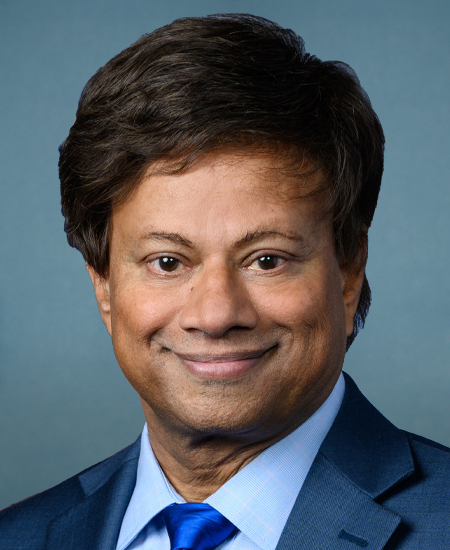
Rep. Shri Thanedar
Sponsored bills
Maddy summaryHRES 768 is a symbolic House Resolution expressing congressional support for Israel following Hamas' October 7, 2023 attacks. It condemns Hamas' actions, reaffirms Israel's right to self-defense, and calls for the immediate release of hostages. The resolution references the U.S. commitment to Israel's security through existing military aid programs, including the 2016 U.S.-Israel Memorandum of Understanding, and emphasizes enforcement of laws like the Taylor Force Act to prevent U.S. aid from reaching terrorist groups. As a symbolic resolution, it does not create new policy but serves as a statement of congressional support for Israel.
Maddy summaryHRES 762 is a non-binding House resolution expressing congressional support for increasing Latino representation in science, technology, engineering, and mathematics (STEM) careers. It highlights that Latinos make up 18% of the U.S. workforce but only 8% of STEM workers, despite growing population and interest in STEM fields. The resolution cites challenges like unmet financial needs (70% of Latino students) and notes STEM job growth (10.8%) outpaces non-STEM sectors. It formally acknowledges the underrepresentation in STEM, encourages federal support for initiatives targeting Latino students, and recognizes Hispanic-serving institutions' role - without creating new programs or funding.
Maddy summaryThis bill requires the Government Accountability Office (GAO) to conduct annual assessments of Transportation Security Administration (TSA) passenger screening practices. The assessments will check whether TSA's procedures comply with the agency's own non-discrimination policies and identify specific actions needed to improve compliance. The GAO must submit these reports to the House Homeland Security Committee and Senate Commerce Committee within 90 days of enactment and annually thereafter.
Maddy summaryThe Safe Schools Improvement Act (HR 6031) requires public elementary and secondary schools to implement comprehensive anti-bullying policies that specifically prohibit harassment based on protected characteristics like race, gender identity, disability, religion, and sexual orientation. It mandates schools to collect and publicly report annual data on bullying incidents while establishing clear grievance procedures for students and parents. The bill also requires states to submit biennial reports on school compliance and supports evidence-based interventions, such as restorative practices, to reduce exclusionary discipline. This legislation directly affects all public K-12 schools and students in the U.S., aiming to create safer learning environments through standardized policy requirements and data transparency.
Maddy summaryThis bill creates a 40% tax credit for individuals and businesses purchasing zero-emission electric lawn, garden, and landscape equipment, such as electric mowers or trimmers. The credit covers 40% of the equipment's cost, with a yearly cap of $25,000 and a 10-year aggregate limit of $100,000 per taxpayer. Qualifying equipment must run on electricity (via solar, batteries, fuel cells, or grid power) and cannot use gasoline, diesel, or manual effort. The bill also includes related items like batteries, repair tools, and retrofitting equipment in the credit scope while preventing double benefits with other tax credits.
Maddy summaryThe Medical Debt Relief Act of 2023 would prevent credit bureaus from reporting medical debt on credit reports and stop creditors from using medical debt information when making credit decisions. It defines medical debt as any debt related to medical services, products, or devices, and requires the removal of existing medical debt entries from credit reports. Within one year of enactment, the Consumer Financial Protection Bureau must update regulations to prohibit creditors from considering medical debt in loan or credit applications. This directly affects consumers with medical debt (who may see improved credit scores) and creditors (who must adjust their credit evaluation practices).
Maddy summaryHR 5999, the Small Business Regulatory Relief Act, creates a new Small Business Regulatory Enforcement Fairness Act Ombudsman within the Small Business Administration (SBA). This ombudsman will directly assist small businesses by helping them understand and comply with federal regulations through training, compliance guides, and webinars on new rules. The bill requires federal agencies with regulatory authority over small businesses to designate a primary point of contact to coordinate with the ombudsman and provide clear information about regulatory requirements. It mandates that agencies develop and share resources to help small businesses navigate compliance, including assistance with forms and specific regulatory questions.
Keeping Drugs Out of Schools Act of 2023 This bill allows the Office of National Drug Control Policy to award grants for eligible entities to implement school-community partnerships for preventing and reducing substance use and misuse among youth. Eligible entity refers to a coalition that (1) is a Drug-Free Communities funded coalition on or before the date on which the coalition submits a grant application, and (2) has a memorandum of understanding in effect with not less than one local school to establish a school-community partnership.
Maddy summaryHR 5955, the Safe Return Act, amends the State Department's repatriation program to replace loans with grants for specific groups. It directly affects U.S. citizens, lawful permanent residents, and third-country nationals needing financial assistance to return to the U.S. The bill changes eligibility to include destitute lawful permanent residents and updates the program to use "grants" instead of "loans," requiring written grant agreements rather than loan terms. The Secretary of State must also update the Foreign Affairs Manual to reflect these changes.