

Maddy summaryThis bill creates a tax credit for video distributors (like cable or streaming companies) that carry content from independent programmers meeting specific criteria. Distributors earn a credit up to $0.30 per subscriber for new or expanded carriage agreements reaching at least 40% of subscribers, based on license fees paid to qualifying creators. The credit applies only to content from small, independent creators (not owned by large media companies, publicly traded firms, or networks). The FCC must submit biennial reports tracking how many independent programmers benefit from this policy, including average carriage duration.
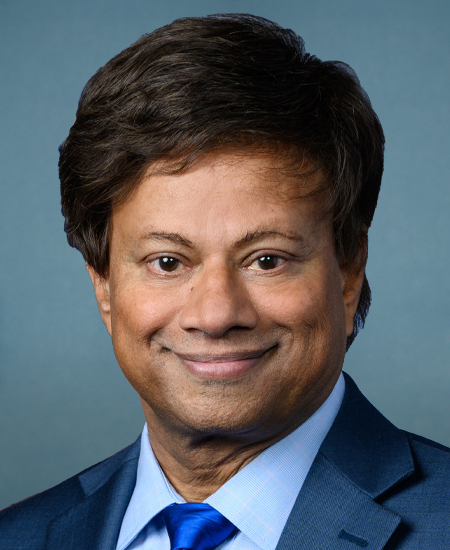
Rep. Shri Thanedar
Sponsored bills
Maddy summaryHR 5976, the Youth Mental Health Research Act, establishes a new NIH research initiative led by the National Institute of Mental Health. The bill directs collaboration between three NIH institutes to coordinate research on youth mental health, focusing specifically on building community resilience for at-risk youth and improving how mental health services reach young people in schools, communities, and other settings where they live and work. It authorizes $100 million annually for fiscal years 2024 through 2028 to fund this research. The bill does not create direct services but aims to generate evidence to inform future mental health support strategies for young people.
Maddy summaryThis bill excludes veterans' disability and dependency payments from income calculations for HUD housing assistance programs. It directly affects veterans and their families receiving disability compensation under Title 38, U.S. Code, by ensuring these benefits don't reduce their eligibility or housing assistance amounts. Specifically, it prevents HUD from counting these payments when determining eligibility, benefit amounts, or rent calculations for assisted housing. The policy change applies solely to HUD-administered housing programs, not other federal benefits.
Maddy summaryHR 6201, the Iranian Sanctions Enforcement Act of 2023, creates the Iran Sanctions Enforcement Fund to cover costs related to seizing and forfeiting property from Iran or its designated proxies (like Hezbollah or the Revolutionary Guard Corps) that violate U.S. sanctions. The fund, initially $150 million, pays for investigative costs, property management, informant rewards, and equipment for federal, state, and local agencies involved in enforcement. It also establishes an Export Enforcement Coordination Center within Homeland Security to improve interagency cooperation on enforcing export controls targeting Iran. The bill requires annual reports on fund usage and mandates repayment of the initial $150 million by 2034, unless waived for national security reasons.
Maddy summaryThe Counseling Not Criminalization in Schools Act prohibits federal funding for school police officers and establishes a $5 billion grant program to help schools replace law enforcement with mental health professionals like counselors, social workers, and psychologists. The bill directly affects schools serving marginalized students, particularly Black, Native American, Latino, and LGBTQI+ students, who disproportionately face school discipline and police involvement. Key provisions require schools to terminate police contracts within 30 days of receiving funds and use the money for trauma-informed services, restorative justice programs, and anti-bias training. The bill also prohibits using funds for surveillance technology, punitive discipline policies, or arming school staff, while requiring schools to report on disciplinary practices and demographic data. This legislation aims to address racial disparities in school discipline and shift school safety toward supportive, evidence-based approaches rather than criminalization.
Maddy summaryHR 5983, the Clean Water Act of 2023, redefines "protected water resources" under federal law to explicitly include all interstate and intrastate waters (such as intermittent and ephemeral streams), wetlands, and their tributaries. This directly affects federal agencies like the EPA, states managing water quality, and developers or landowners needing permits for activities near these waters. The bill eliminates the Supreme Court’s narrow "navigable waters" definition from Sackett v. EPA (2023), restoring protections for tens of millions of acres of wetlands and millions of miles of small streams. Key mechanisms require the EPA to annually review and adjust exclusions from protections based on scientific evidence, ensuring water bodies critical to drinking water, flood control, and ecosystems remain safeguarded.
Maddy summaryThis bill designates the federal building at 985 Michigan Avenue in Detroit, Michigan, as the "Rosa Parks Federal Building." It updates all federal references to the building to use this new name and repeals prior designations (Public Law 109-98 and sections of Public Law 109-101) that used different names for the same building. The bill affects federal records, maps, and documents referencing the location but does not create new policies or impact citizens.
Maddy summaryThe Student Support Act (HR 6091) establishes a federal grant program to address the critical shortage of mental health professionals in schools, authorizing $100 million annually through 2028. The bill sets specific target ratios for school-based mental health providers: one counselor for every 250 students, one psychologist for every 500-700 students, and one social worker for every 250 students. Funds would be distributed to states based on the number of children in poverty and total student enrollment, with states required to provide matching funds. This legislation directly affects public and private K-12 schools across the United States, particularly those serving low-income students who currently lack adequate mental health support.
Maddy summaryThis bill would require employers with 5 or more employees to provide 56 hours of paid leave annually for employees experiencing pregnancy loss, failed fertility procedures (including IVF), failed adoption or surrogacy arrangements, or fertility-impacting diagnoses. Employees could also use this leave to care for a spouse or domestic partner facing these circumstances. Employers would need to provide clear notice of this policy and cannot discriminate against employees who use this leave. The bill applies to private sector employers, government employees, and others covered under the defined terms, with enforcement mechanisms to protect employees' rights.
Maddy summaryThe All Students Count Act of 2023 amends the Elementary and Secondary Education Act to require states to collect and report detailed educational data for specific Asian American and Native Hawaiian/Pacific Islander subgroups, including Chinese, Filipino, Cambodian, Hmong, Samoan, and Chamorro communities. It mandates that states disaggregate student performance data by these specific ethnic subgroups rather than reporting only broad categories. This change directly affects public school systems and state education agencies, which must now collect and report data for these detailed groups as part of federal accountability requirements. The bill aims to address historical data gaps that obscured educational disparities affecting diverse communities, such as lower high school graduation rates or college enrollment among specific subgroups.