

Maddy summaryThe American High-Speed Rail Act expands federal funding and streamlines regulations to support the development of high-speed and higher-speed rail projects across the United States. It authorizes billions of dollars in grants for corridor planning, technology improvements, and construction, while allowing the federal government to cover up to 100% of project costs under specific conditions. The bill also introduces new provisions to facilitate land acquisition, prioritize border projects, and extend labor protections to workers involved in federally funded rail infrastructure. Additionally, the legislation defines higher-speed rail as trains traveling between 110 and 186 miles per hour and includes tax incentives for rail carriers that sell or lease property to support these projects.
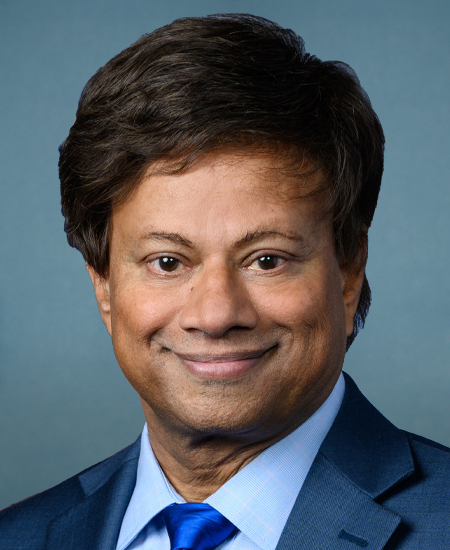
Rep. Shri Thanedar
Sponsored bills
Maddy summaryThis resolution condemns specific racist rhetoric directed at Indian and Chinese Americans and calls on all elected officials, including the President, to stop using language that promotes racial or ethnic division. It specifically addresses recent statements made by the President that characterized immigrants from India and China in derogatory terms and linked them to negative stereotypes. The bill affirms that immigrants from all backgrounds are vital to the United States and declares that attacks based on national origin are un-American. While it does not change laws or policies, it serves as a formal statement of disapproval from the House of Representatives regarding the targeted hate speech.
Maddy summaryThe Stay Cool Act establishes a comprehensive framework to help communities prepare for and respond to extreme heat events by creating cooling centers, improving housing conditions, and enhancing urban infrastructure. It directs federal funding to states and local governments to build and equip cooling facilities, install air conditioning in public housing, and develop green spaces and water features to lower temperatures. The bill also creates a national system to track heat-related health risks, mandates checks on vulnerable seniors during heatwaves, and allows tax credits for businesses that keep their doors open during heat emergencies. Additionally, it requires updates to utility assistance programs to account for cooling costs and calls for studies on heat-related mortality and safe residential temperature standards.
Maddy summaryThe Affordable Housing Credit Carryback Act allows developers of low-income housing projects to apply their tax credits to tax years up to five years prior to the current year. This change directly affects developers who may have incurred losses in earlier years and are unable to fully utilize the tax benefits generated by their projects. By amending the Internal Revenue Code, the bill enables these developers to carry back the low-income housing tax credit to offset taxes owed in those past years. This provision aims to improve the immediate financial viability of affordable housing developments without altering the total amount of tax credit available.
Maddy summaryThe SCREEN for Type 1 Diabetes Act of 2026 directs the Centers for Disease Control and Prevention to launch a national public awareness campaign focused on type 1 diabetes detection, screening, and management. This initiative will provide written materials and public service announcements across various media platforms, including social media and television, while consulting with health organizations, schools, and community groups to ensure the content is culturally and linguistically appropriate. The bill authorizes $5 million annually from 2027 to 2031 to fund grants for nonprofit entities and state or local health departments to distribute these resources and increase screening access in communities with high incidence rates. Additionally, the law requires the Secretary of Health and Human Services to submit a report to Congress within one year detailing the campaign's activities and its impact on diabetes detection and management.
Maddy summaryThis bill, the Provider Reimbursement Stability Act of 2026, aims to create more predictable payment adjustments for physicians and other healthcare providers under the Medicare program. It directly affects medical practices and providers who receive reimbursement for services through the physician fee schedule. The legislation increases a threshold for certain budget neutrality calculations from $20 million to $54.3 million in 2027, with automatic increases every five years thereafter. It also requires the government to correct payment estimates when actual service usage differs significantly from projections, mandates regular updates to cost calculations for practice expenses, and limits how much Medicare payment rates can change from year to year to a maximum of 2.5 percent.
Maddy summaryThis bill would add pharmacist services to Medicare Part B coverage for beneficiaries, specifically covering pharmacist-led testing and treatment for illnesses like flu, COVID-19, or strep throat during public health emergencies. It defines covered services as those performed under state law, often requiring collaboration with a physician, and sets payment at 80% of the lesser of the actual charge or 85% of physician payment rates. Pharmacists would be prohibited from balance billing for these services, ensuring Medicare beneficiaries pay only their standard copayment. The changes would take effect January 1, 2026.
Maddy summaryThis bill authorizes the U.S. Mint to produce commemorative $5 gold and $1 silver coins marking the 25th anniversary of the September 11, 2001, terrorist attacks. The coins must feature designs honoring victims and first responders (including the inscription "Never Forget") and will be sold only during 2027-2028. All surcharges ($35 per gold coin, $10 per silver coin) collected from sales will fund the National September 11 Memorial and Museum at the World Trade Center, with no net cost to the federal government. The coins are legal tender but primarily intended for collectors, not circulation.
Maddy summaryThe Smithsonian American Women’s History Museum Act authorizes the creation of a new Smithsonian museum dedicated to women’s history, to be located within the National Mall Reserve in Washington, D.C. If the site is managed by another federal agency, the bill requires that agency to transfer the land after notifying Congress and relevant committees. The museum must ensure exhibits and programs accurately represent diverse women’s experiences by consulting a broad range of experts and community voices. The Smithsonian will submit biennial reports to Congress detailing how the museum meets these representation standards.
Maddy summaryThe No Taxpayer-Funded Settlement Slush Funds Act of 2026 prohibits the use of federal money to pay specific settlements involving high-ranking government officials and their close associates. It bars payments to the President, Vice President, their immediate families, cabinet members, senior executive staff, political appointees, and individuals connected to these roles, as well as any entity owned by the President or Vice President. Additionally, the bill restricts settlements related to claims about the January 6 Capitol attack, foreign election interference, or previously dismissed lawsuits, while requiring Treasury reports for large settlements and allowing the government to seek repayment if rules are broken.