

Maddy summaryThe Public Banking Act of 2023 establishes a federal framework for public banks owned by state, tribal, or community entities. It creates a process for chartering public lending banks (which provide financial services to public entities) and public payment banks (which focus on payment services), while requiring democratic governance with community representation on boards. The bill sets specific lending preferences prioritizing environmental justice communities, quality job creation, and worker protections, while prohibiting loans to fossil fuel companies, private prisons, and tobacco industries. It also creates grant and incubator programs to help establish these banks and establishes public deposit insurance for them, fundamentally changing how public banking institutions operate in the United States.
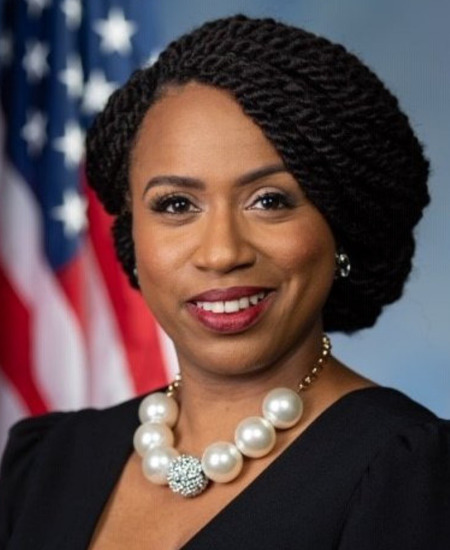
Rep. Ayanna Pressley
Sponsored bills
Maddy summaryHR 6768, the Public Health Nursing Act, authorizes $5 billion annually (2024-2033) to expand public health nursing services through federal grants to state and local health departments. The bill requires grantees to use funds for recruiting and training registered nurses in underserved areas, covering wages, medical supplies (like PPE), and administrative costs to improve maternal/infant health and chronic disease management. Priority is given to applicants serving communities with high chronic disease rates, maternal mortality, low-income populations, rural areas, or health professional shortage zones. This directly affects public health departments and their ability to hire nurses providing in-person care, home visits, and mobile clinic services.
Maddy summaryHR 6830, the "Books Save Lives Act," requires covered schools (elementary/secondary schools receiving federal funds) and public libraries receiving federal assistance to maintain staffed libraries with diverse book collections. These collections must include books written by, illustrated by, or about individuals from underrepresented communities - defined as racial/ethnic minorities, LGBTQ+ individuals, religious minorities, or people with disabilities. The bill states that excluding such "covered books" could be used as evidence of discrimination under civil rights laws like the Civil Rights Act of 1964. It also mandates a report on the impact of book-banning campaigns on these communities within 180 days of enactment.
Maddy summaryThe Brittany Clardy Missing and Murdered Black Women and Girls Act establishes a new Office within the Department of Justice to address the disproportionate rates of missing and murdered Black women and girls in the U.S. The Office will collect and analyze data on these cases - including case resolution times, Amber Alert usage, and trafficking links - and create a public dashboard for tracking. It also creates a grant program for community organizations to provide culturally appropriate prevention services, law enforcement training, and victim support. The Office must submit biennial reports to Congress with findings and recommendations to improve the criminal justice response to these cases. This bill directly affects Black women and girls facing violence, law enforcement agencies, and community organizations providing related services.
Maddy summaryThe Rent Relief Act of 2023 creates a new refundable tax credit for renters whose rent exceeds 30% of their adjusted gross income. It directly affects low-to-moderate income renters in their principal residence, with credit percentages ranging from 100% (for incomes under $25,000) down to 0% (for incomes over $100,000). The credit is limited to rent within HUD's fair market rent guidelines, and the IRS will make monthly advance payments starting July 2024 for eligible taxpayers who elect this option. The bill requires no additional tax filing for the credit but includes $50 million for outreach to help eligible households enroll.
Maddy summaryHR 6654, the Farewell to Foam Act of 2023, bans the sale and distribution of expanded polystyrene foam food containers, packaging peanuts ("loose fill"), and coolers starting January 1, 2026. It directly affects food service providers (like restaurants and schools), manufacturers, distributors, and retailers who sell these foam products. The bill prohibits selling these items, with enforcement starting with a written warning for first violations, followed by escalating civil penalties ($250 for a second violation, up to $1,000 for fourth+ violations), while exempting small businesses with low annual revenue from repeated penalties within a 7-day period.
Maddy summary# Summary of the Gun Violence Prevention and Community Safety Act of 2023 This comprehensive legislation introduces sweeping reforms to U.S. gun control laws, with several key provisions: ## Major Restrictions - **Semiautomatic assault weapons**: Requires registration of "grandfathered" weapons, mandates background checks for transfers, and imposes strict storage requirements - **Ghost guns**: Prohibits manufacturing, selling, or possessing untraceable firearms (those without serial numbers) with limited exceptions - **Undetectable firearms**: Bans weapons made of materials that can't be detected by airport security scanners - **Firearm accessories**: Bans trigger cranks, bump-fire devices, and other accessories that accelerate firing rate - **Silencers/mufflers**: Prohibits possession and sale of silencers/mufflers except for law enforcement and military use ## Dealer Reforms - Requires secure storage (locked cabinets, safes, security systems) at all gun dealers - Mandates annual inspections of high-risk dealers and triennial inspections for others - Requires background checks for all dealer employees before they can handle firearms - Requires dealers to maintain detailed records of all firearm sales and transfers - Establishes civil penalties for security violations (up to $20,000 per violation) ## New Funding Mechanisms - Increases excise taxes on firearms (30% on pistols, revolvers, and other firearms; 50% on ammunition) - Dedicates 39% of ammunition tax revenue to a Community Violence Intervention Fund - Allocates $60 million annually to DOJ and HHS for gun violence prevention research ## Community Programs - Creates a $120 million annual grant program for community violence intervention programs - Funds hospital-based violence intervention programs and street outreach initiatives - Requires evidence-based approaches to reducing homicides and group-related violence ## Implementation Timeline - Most provisions take effect 90 days after enactment - Some provisions (like ghost gun restrictions) have 1-2 year transition periods - Requires dealers to submit security plans within 1 year of enactment The legislation aims to reduce gun violence through both regulatory restrictions and investment in community-based prevention programs, with significant emphasis on closing loopholes that allow untraceable firearms to enter circulation.
Maddy summaryThis bill authorizes the posthumous presentation of a Congressional Gold Medal to honor Marshall "Major" Taylor, a pioneering Black cyclist who broke racial barriers in the late 19th and early 20th centuries. It recognizes his athletic achievements, including world records and international championship wins, as well as his advocacy for equality in sports. The medal, designed by the Treasury Secretary, will be presented to Taylor's great-granddaughter, Karen Donovan, following the congressional authorization. As a commemorative act with no policy changes, it serves solely to honor Taylor's legacy as a trailblazer and role model.
Maddy summaryThe Inclusive Democracy Act of 2023 protects voting rights for people with criminal convictions in federal elections, ensuring they can register and vote while incarcerated, on probation, or on parole. It requires states to notify individuals about their voting rights at key points (during conviction, on probation/parole, and in carceral settings), and mandates carceral settings to provide voter registration forms, absentee ballot applications, and voting information. The bill establishes procedures for transmitting registration and ballot applications with expedited processing near election deadlines, requires states to accept applications and ballots postmarked within 2 days of deadlines, and prohibits prosecution for voting in non-federal elections when registered for federal elections. The law applies to federal elections starting with the 2024 general election.
Maddy summaryHR 6592, the Fight Book Bans Act, provides federal grants to reimburse public school districts for legal costs when they choose to keep instructional or library materials after parental objections. It directly affects school districts (covered local educational agencies) that select materials for students and handle challenges to their removal. The bill authorizes up to $100,000 per case in grants to cover attorney fees and court costs, provided the district didn’t remove the materials and wasn’t reimbursed by the state. Funding of $15 million is authorized for fiscal years 2024-2028. The grants are strictly for legal challenges to decisions not to remove materials, not for the content of the materials themselves.