

Maddy summaryThe Lowering Drug Costs for American Families Act expands Medicare's drug price negotiation program from 20 to 50 drugs, allowing the government to negotiate lower prices for these medications. It requires private health insurance plans and group health coverage to apply these negotiated prices to their members' cost-sharing for covered drugs, with plans able to opt out while publicly disclosing their decision. The bill also extends these negotiated prices to drugs covered by commercial insurance markets, not just Medicare. This would directly affect Medicare beneficiaries and people with private health insurance who take the negotiated drugs.
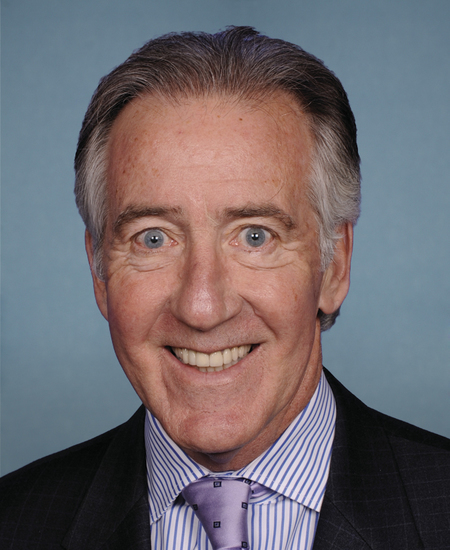
Rep. Richard E. Neal
Sponsored bills
Maddy summaryThe Social Security 2100 Act would significantly enhance Social Security benefits for millions of Americans by increasing monthly payments for retirees, disabled workers, widows/widowers, and children. Key provisions include raising the minimum benefit for long-term low earners, improving cost-of-living adjustments using a more accurate index, eliminating the 5-month waiting period for disability benefits, and extending child benefits to age 26. The bill also changes how Social Security taxes are calculated by applying them to income above $400,000 and establishes a unified Social Security Trust Fund to manage program finances. Most provisions would apply to benefits payable from 2025 through 2034, affecting all current and future Social Security beneficiaries.
Maddy summaryThis bill, the Public Servants Protection and Fairness Act of 2023, amends Social Security to better protect public servants who work in jobs not covered by Social Security (such as certain government positions). It creates a new formula for calculating retirement benefits that combines both covered and noncovered earnings, ensuring public servants receive the higher of two benefit calculations. The bill also provides an additional $150 monthly payment for certain public servants whose benefits were previously reduced by the windfall elimination provision. It improves Social Security account statements to clearly show noncovered earnings and requires a study of how state retirement plans handle these benefits. These changes will apply to benefits starting in 2025.
Maddy summaryThe Elder Justice Reauthorization and Modernization Act of 2023 reauthorizes $400 million annually for 2024-2027 to support nursing home worker training and retention through wage subsidies, tuition assistance, child care support, and transportation assistance for eligible workers. It also provides $8 million annually for adult protective services and $125 million annually for medical-legal partnerships that integrate legal services with health care for older adults. Additionally, the bill allocates $62.5 million annually to address social isolation among seniors through community-based interventions. These provisions aim to strengthen the elder care workforce, improve protections for vulnerable seniors, and enhance coordination between health, human services, and legal systems.
Maddy summary# Summary of Proposed Election Reform Legislation This document outlines a comprehensive federal election reform bill with multiple titles addressing various aspects of voting rights, election administration, and election integrity. ## Key Provisions: ### 1. Democracy Restoration (Title I) - Restores voting rights to citizens with felony convictions who are not serving a felony sentence in a correctional institution - Requires states to notify individuals of restored voting rights upon release from prison, completion of probation, or sentencing - Prohibits states from conditioning voting rights on payment of fines or fees - Requires states to provide notification of voting rights to citizens with criminal convictions ### 2. Voter Identification Requirements (Title II) - Establishes a broad definition of acceptable identification documents (including utility bills, bank statements, student IDs, etc.) - Requires states to provide free identification to voters who lack one - Authorizes $5 million annually for 5 years to cover costs of providing identification - Sets procedures for provisional voting when identification is not presented ### 3. Voter List Maintenance (Title III) - Prohibits "voter caging" (using undeliverable mail to challenge voter registration) - Bans use of unverified match lists to remove voters from registration lists - Sets strict conditions for removing voters from registration lists - Requires states to provide notice to voters removed from registration lists ### 4. Election Integrity Measures (Title V) - Prohibits hindering or interfering with voter registration (Section 2001) - Restricts removal of local election administrators (Section 3001) - Prohibits harassment of election workers (Section 3101) - Bans deceptive practices in elections (Section 3201), including false statements about voting locations, eligibility, or endorsements ### 5. Additional Provisions - Requires states to provide notice of voting rights restoration to citizens - Establishes private rights of action for violations of the law - Sets criminal penalties for violations (up to $100,000 fines and 5 years imprisonment) - Includes provisions for federal funding to be contingent on compliance with voting rights restoration This legislation represents a significant overhaul of voting rights and election administration procedures across the United States, with a focus on expanding voting access, protecting voter rights, and ensuring fair election administration.
Maddy summaryHR 7438 directs the U.S. Treasury to mint commemorative coins for the 2026 FIFA World Cup, including 100,000 $5 gold coins, 500,000 $1 silver coins, and 750,000 half-dollar coins. The coins will be sold to the public at face value plus surcharges ($35, $10, and $5 per coin, respectively), with all surcharge revenue paid to FWC2026 US, Inc. for U.S. soccer programs. These funds must support soccer initiatives, particularly in underserved communities and youth development, as specified in the bill. The coins are legal tender but will only be issued during 2026, with no net cost to the U.S. government.
Maddy summaryThis bill establishes the Southern New England Regional Commission (SERC) to support economic development across specific counties in Rhode Island, Connecticut, and Massachusetts. The commission will distribute federal grants starting in fiscal year 2025 to fund projects like transportation infrastructure, job training programs, healthcare access in distressed areas, renewable energy development, and maritime industry support. It directly affects local governments, tribes, and nonprofits in all Rhode Island counties, Connecticut’s Hartford, New Haven, Windham, Tolland, Middlesex, and New London counties, and Massachusetts’ Hampden, Plymouth, Barnstable, Essex, Worcester, and Bristol counties. The law creates a formal structure for regional collaboration on economic priorities without altering existing federal funding mechanisms.
Maddy summaryHR 6751 authorizes the U.S. Mint to produce commemorative coins honoring Roberto Clemente, a Hall of Fame baseball player and humanitarian, including 50,000 $5 gold coins, 400,000 $1 silver coins, and 750,000 half-dollar coins. The coins must feature Clemente's image and inscriptions like "Roberto Clemente" and "2027," with all sales including a surcharge ($5-$35 per coin) paid to the Roberto Clemente Foundation. The foundation, which supports youth sports, education, and disaster relief programs, will use these funds for its mission, while the U.S. Treasury must recover all production costs. The coins will be sold exclusively in 2027, with no net cost to the government.
Maddy summaryThis bill renames U.S. Route 20 across 12 states (Oregon, Idaho, Montana, Wyoming, Nebraska, Iowa, Illinois, Indiana, Ohio, Pennsylvania, New York, and Massachusetts) as the "National Medal of Honor Highway." It directly affects the highway itself and all official U.S. government references to it, such as maps and documents. The key provision requires that any federal law, record, or document mentioning this highway must now use its new name to honor Medal of Honor recipients' service and valor. The bill makes no changes to highway operations, funding, or policy - only to the official designation.
Maddy summaryThis bill designates the U.S. Postal Service facility at 25 Dorchester Avenue, Room 1, in Boston, Massachusetts, as the "Caroline Chang Post Office." It directly affects the postal service location and its users by officially renaming the facility. The bill requires all federal references in laws, documents, or records to use the new name "Caroline Chang Post Office" instead of the previous designation. This is a procedural naming bill with no policy changes or financial impact.