

Maddy summaryHR 3535, the Advancing America’s Interests Act, amends Section 337 of the Tariff Act of 1930 to clarify how the U.S. International Trade Commission (USITC) handles trade complaints involving patents, copyrights, or trademarks. It requires complainants to prove their licensees' activities directly lead to U.S. sales of covered products, and mandates the USITC to consider public health, consumer impact, and economic effects before excluding imported goods. The bill also adds procedures for expedited review of certain cases and limits the USITC’s ability to terminate investigations without a full determination. This directly affects companies filing trade complaints and the USITC’s decision-making process under Section 337.
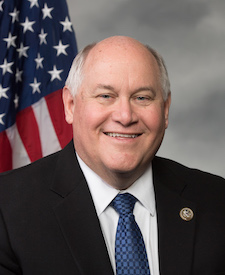
Rep. Ron Estes
Sponsored bills
Maddy summaryHR 3227, the Ensuring Seniors’ Access to Quality Care Act, amends Medicare and Medicaid rules to address nurse aide training programs in nursing facilities. It allows the Secretary of Health and Human Services to disapprove a facility’s nurse aide training program for up to two years if the facility received a $10,697+ civil penalty for substandard care and hasn’t corrected the quality issues. Facilities can have disapproval lifted by proving they fixed the care deficiencies, haven’t had recent patient harm incidents, and the penalty didn’t involve immediate patient jeopardy. The changes apply only to penalties assessed after the bill’s enactment and do not affect facilities already prohibited under prior rules.
Maddy summaryHR 2774, the Accelerating Individuals into the Workforce Act, creates federal grants for states to run demonstration projects providing wage subsidies to help Temporary Assistance for Needy Families (TANF) recipients and low-income adults (unemployed or earning under 200% of the federal poverty line) enter and keep jobs. States must design subsidy programs covering up to 50% of wages for up to 12 months per participant, while ensuring no job displacement and coordinating with other workforce programs. The bill requires states to report monthly on participants, retention rates in unsubsidized jobs after 2-4 quarters, and median earnings, and mandates a rigorous federal evaluation using randomized trials or strong research methods. Funds are reserved at $100 million for fiscal year 2023, with implementation starting October 1, 2023.
Maddy summaryThis bill would require Medicare to cover FDA-approved blood tests that screen for multiple cancers simultaneously (like breast, lung, or colorectal cancer) for beneficiaries. It directly affects Medicare recipients aged 65+ who could access these new screenings once per year, without prior authorization. The key provision adds "multi-cancer early detection screening tests" to Medicare's covered services under Part B, defining them as blood tests analyzing cell-free DNA, while maintaining existing coverage for standard screenings like mammograms. The bill does not change current coverage for individual cancer screenings but ensures Medicare keeps pace with new medical technology.
Maddy summaryThis bill would require employer-sponsored health plans and group health insurance to treat telehealth services as "excepted benefits," meaning they would no longer need to comply with certain federal rules that apply to most health coverage (like pre-authorization requirements). It directly affects employers offering group health plans and insurers providing group coverage, making telehealth services subject to fewer regulatory standards. The key change is adding "Benefits for telehealth services" to the list of exceptions under the Public Health Service Act, ERISA, and tax code. This would take effect for plan years beginning after the bill's enactment.
Maddy summaryHR 407, the "Protect the UNBORN Act," prohibits federal agencies from implementing or enforcing two specific executive orders issued by President Biden in 2022 (Executive Orders 14076 and 14079), which aimed to protect access to reproductive healthcare services. The bill bans the use of federal funds, including those from the 2022 Consolidated Appropriations Act, to carry out, administer, or enforce these executive orders. It directly affects federal agencies and programs that would otherwise comply with the Biden administration's policies on reproductive healthcare access. The bill does not create new healthcare rules but blocks the implementation of existing executive actions.
Maddy summaryThis bill bans federal funding for abortions in most cases, prohibiting the use of taxpayer money for abortion services or health insurance plans covering abortion. Exceptions allow funding for abortions resulting from rape, incest, or when a pregnancy endangers a woman's life. It requires health insurance plans sold through the Affordable Care Act (ACA) marketplaces to clearly disclose any separate costs for abortion coverage and prohibits ACA subsidies from being used for plans that cover abortion (except in the specified exceptions). The law directly affects federal programs like Medicaid, ACA marketplace plans, and insurers offering health coverage to individuals using federal subsidies.
Maddy summaryHR 152, titled the "Hearing Protection Act," actually addresses firearm silencers (suppressors), not hearing protection. The bill removes federal registration requirements for silencers by directing the Attorney General to destroy all existing silencer records within 365 days. It also preempts state laws that tax, register, or impose recordkeeping requirements on silencers, making such state rules unenforceable. Additionally, the bill updates tax codes to include silencers as taxable items and clarifies their definition in firearm laws.
Maddy summaryHJRES 142 is a congressional disapproval resolution targeting a Department of Labor rule issued on April 25, 2024. It seeks to block the "Retirement Security Rule: Definition of an Investment Advice Fiduciary" (89 Fed. Reg. 32122), which defined standards for financial advisors handling retirement accounts. If passed, this resolution would make the Labor Department's rule ineffective, directly affecting retirement plan advisors and financial institutions subject to the regulation. The bill uses a specific procedural mechanism under Title 5, U.S. Code, to nullify the rule without creating new law.
Maddy summaryThis bill requires the Congressional Budget Office (CBO) to provide at least two annual updates to the budget baseline, with one update including the economic data used in its calculations. It also mandates that the President submit technical budget data to Congress by February 1 each year, covering current/prior year estimates and credit reestimates for the upcoming fiscal year. These updates aim to improve the timeliness and transparency of budget information available to Congress. The bill directly affects the CBO and the Executive Branch in their annual budget reporting processes.