

Maddy summaryThis resolution (HRES 1472) symbolically recognizes the heritage, culture, and contributions of Latinas in the United States. It highlights their economic impact (over 2 million Latina-owned businesses), societal roles (48,000+ active-duty Latinas in the military, 18% of women-owned businesses), and ongoing challenges like the pay gap (Latinas earn 57 cents for every dollar earned by White, non-Hispanic men). The resolution notes that Latinas represent 1 in 5 U.S. women and will comprise 25% of the female population by 2060. As a non-binding resolution, it does not create new policies or allocate funds, but formally honors their contributions and acknowledges the need for continued progress.
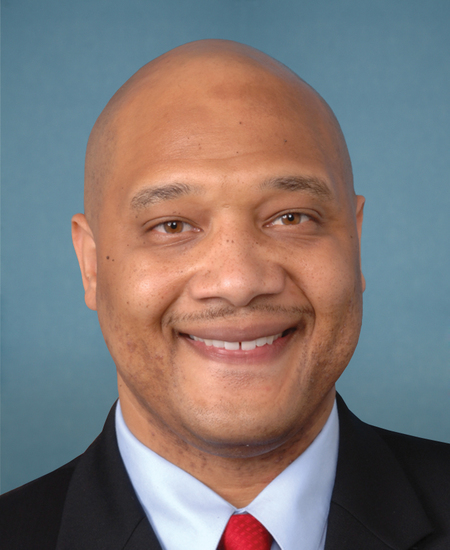
Rep. André Carson
Sponsored bills
Maddy summaryHRES 1473 is a non-binding resolution passed by the U.S. House of Representatives that condemns racism, bigotry, and misinformation targeting Haitian people and their descendants. It celebrates the historical contributions of Haitian Americans to U.S. society, including founding cities (like Chicago via Jean Baptiste Point du Sable), advancing civil rights (W.E.B. Du Bois), and enriching healthcare, education, and culture. The resolution specifically calls on all Americans to reject racist tropes and misinformation, and urges elected officials to promote inclusivity and responsible communication. It was introduced in response to recent false claims that fueled threats against Haitian communities, such as the bomb threats in Springfield, Ohio.
Maddy summaryHRES 1458 is a commemorative resolution designating September 16-20, 2024, as "Medical Research Week" to honor medical research contributions. It recognizes the National Institutes of Health (NIH)’s role in advancing treatments for diseases like cancer, Alzheimer’s, and heart disease, while highlighting how NIH funding supports over 400,000 jobs and $93 billion in economic activity. The resolution has no binding effect - it does not change laws, funding, or policies, but simply urges the House to support the designation and acknowledge medical research’s national impact. It directly affects public awareness, not specific individuals or entities, and serves only as a symbolic observance.
Maddy summaryHR 9675, the Homeward Bound Act, delays and revises federal rules governing dog imports for specific groups. It postpones the application of a 2024 HHS rule for 18 months, directly affecting military personnel stationed abroad, U.S. diplomats/consular staff, their families, and individuals with service animals seeking to import dogs from rabies-low-risk countries. The bill requires the HHS Secretary to revise regulations within 10 days to allow all-age dog imports at any U.S. port of entry from these countries and waive microchipping requirements for dogs born before the law's enactment. These changes aim to simplify import processes for covered individuals while maintaining rabies risk standards.
Maddy summaryHR 9691 establishes the Julius Rosenwald and Rosenwald Schools National Historical Park as a unit of the National Park System. The park will preserve specific sites, including the San Domingo School in Maryland and the St. George Rosenwald School in South Carolina, plus a Chicago headquarters at the former Sears complex. It aims to commemorate Julius Rosenwald's philanthropy - particularly his partnership with Booker T. Washington to build over 5,000 schools for African-American students in the segregated South - and his broader legacy of social justice. The bill directs the Secretary of the Interior to administer the park, develop a management plan, and create a national network connecting related Rosenwald School sites for educational interpretation.
Maddy summaryThis bill makes the Union Station Redevelopment Corporation (USRC) eligible to receive 100% federal funding for infrastructure projects under four existing transportation grant programs: RAISE, National Infrastructure Project Assistance, Consolidated Rail Infrastructure, and Federal-State Partnership for Intercity Rail. It amends each program’s rules to specifically include the USRC as an eligible recipient and eliminates the typical requirement for state or local cost-sharing. The bill directly affects the USRC by providing full federal funding for its projects, such as those related to Union Station redevelopment.
Maddy summaryThis bill creates a new presumption that veterans who served at the Nevada Test and Training Range since January 1, 1972, were exposed to radiation and toxins during their service. It directly affects veterans assigned to duty at this Nevada site, including airspace above it, by establishing that such exposure is assumed without requiring individual proof. Key provisions include adding onsite military work at the Nevada site to the list of "radiation-risk activities" and specifically covering lipomas and tumor-related conditions as service-connected disabilities for these veterans. The change simplifies the process for qualifying veterans to receive VA disability benefits related to these health conditions.
Maddy summaryHR 6319 (the 911 SAVES Act of 2023) requires the Office of Management and Budget to reclassify public safety telecommunicators as "Protective Service Occupations" within 30 days of enactment. This change corrects their current misclassification in the federal Standard Occupational Classification (SOC) system, which is used for statistical data on jobs. The bill directly affects how these professionals - critical in emergency calls involving missing children, active threats, and officer safety - are officially categorized in government workforce data. It does not create new benefits or funding but aims to better recognize their lifesaving role through accurate federal job classification.
Maddy summaryHRES 1468 is a non-binding resolution recognizing the significant pay disparity faced by disabled women in the U.S. workforce. It cites data showing disabled women earn, on average, 50 cents for every dollar earned by nondisabled men, with even starker gaps for disabled women of color (e.g., 44 cents for disabled Latinas). The resolution highlights systemic barriers like occupational segregation, the subminimum wage, and lack of support services contributing to these inequities. It does not create new laws or affect any group directly, but formally acknowledges these disparities and reaffirms the House’s commitment to addressing wage gaps. This is a symbolic recognition, not a policy change.
Maddy summaryThis bill directs the U.S. government to immediately restore funding to the United Nations Relief and Works Agency for Palestine Refugees (UNRWA), reversing a temporary funding pause. It repeals two appropriations acts that halted payments and requires the Secretary of State to resume UNRWA funding under existing authorities. The legislation specifically aims to support UNRWA’s critical humanitarian work - providing shelter, education, healthcare, and aid to Palestinian refugees across Gaza, the West Bank, Syria, Lebanon, and Jordan - during an acute famine risk in Gaza. It also mandates quarterly reports to Congress on UNRWA’s implementation of reforms from an independent review, ensuring accountability for its humanitarian mission.