

Protecting Our Wealth of Energy Resources Act or the POWER Act This bill requires the President and federal agencies to obtain the approval of Congress before prohibiting or substantially delaying certain new energy or mineral leases or permits on federal lands, including oil and gas leases, coal leases, hard rock leases, or critical minerals leases. In addition, the President and agencies must obtain the approval of Congress before withdrawing certain federal lands from mineral and geothermal leasing activities.
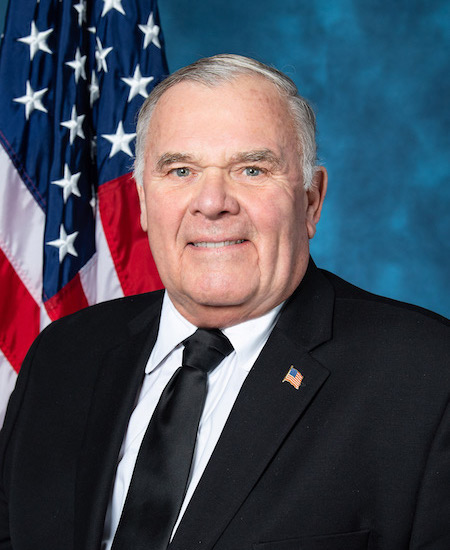
Rep. James R. Baird
Sponsored bills
Saving America's Mines Act This bill bars the President, the Department of the Interior, or the Department of Agriculture from declaring a moratorium on or reversing any existing lease, permit, or claim, for the mining and extraction of any critical mineral or common varieties of sand, stone, and gravel on National Forest System or Bureau of Land Management land unless specifically authorized by statute or upon the lessee, permittee, or claimant's failure to comply with any of the provisions of its agreement.
Saving America's Energy Future Act This bill prohibits the Department of Agriculture and the Department of the Interior from declaring a moratorium on issuing new oil and gas leases and drill permits on certain federal lands. In addition, the bill prohibits the departments from declaring a moratorium on renewals of such permits.
Eliminate Agency Excess Space Act This bill modifies requirements with respect to the disposal of surplus and excess property by federal agencies. Among other things, the bill repeals provisions that require federal agencies to report excess property to the General Services Administration (GSA). Additionally, the GSA must issue regulations that allow federal agencies to dispose of surplus and excess property without first making the property available to other agencies or state or local governments. The bill also requires the GSA to survey all unused or underutilized office spaces held by federal agencies, make recommendations to reduce agency real estate assets, and report on costs associated with property disposal.
Supply Chain Security and Pharmaceutical Authentication Act of 2021 This bill modifies the application of requirements for drug packaging to include certain information, such as the product's lot number and expiration date. Under the bill, the requirements shall apply to the packaging of the smallest or individual solid oral dosage form of the product. Currently, such requirements apply to the smallest container (which might contain multiple dosages) of the product that is intended for individual sale to a dispenser, such as a pharmacy.
This resolution honors the life and legacy of Rush Limbaugh and commends him for his devotion to the United States.
Opposing Business with Chinese Military Companies Act This bill requires the President to exercise certain economic powers, such as investigating or prohibiting payments, with respect to an entity that is engaging in economic activities in the United States and is (1) affiliated with China's government or military, or (2) owned or controlled by an entity affiliated with China's defense industrial base. (The President currently has such powers but is not required to exercise them.) The bill extends to December 31, 2026, a provision requiring the Department to Defense to annually report to Congress an updated list of such entities.
Improving Confidence in Veterans' Care Act This bill prescribes oversight requirements for the Department of Veterans Affairs (VA) regarding health care professionals at VA medical centers. Specifically, the bill requires the VA to ensure each VA medical center consistently compiles, verifies, and reviews specified documentation for each VA health care professional (including contractors). The VA shall ensure that specified health care professionals hold an active Drug Enforcement Administration registration. Each VA medical center must implement (1) monitoring of the performance and quality of the health care delivered by each health care professional at the center, and (2) reviews of such care if an individual notifies the VA of any potential concerns relating to a failure to meet generally accepted standards of clinical practice. The bill imposes notification requirements in situations where the VA substantiates a concern relating to the clinical competency of, or quality of care delivered by, a current or former VA health care professional. The VA is prohibited from entering into a settlement agreement relating to an adverse action against a VA health care professional if such agreement includes terms that require the VA to conceal certain information from the employee's personnel file. Such prohibition does not apply to adverse actions determined to be prohibited personnel practices. The VA must provide mandatory training, at least biannually, to employees of each medical center who are responsible for specified tasks (e.g., those who are responsible for compiling, validating, or reviewing the credentials of VA health care professionals).
This resolution expresses support for the formal resubmission of the United States' withdrawal from the Paris Agreement.
This resolution acknowledges the importance of the U.S.-Egypt partnership and Egypt's role in the fight against terrorism and violent extremism. It also urges the Egyptian government to (1) enact serious and legitimate reforms to ensure that Coptic Christians have the same rights and opportunities as other Egyptian citizens, (2) complete the process of church certification, and (3) take steps to end the culture of impunity for attacks on Christians.