

Plant Biostimulant Act of 2022 This bill excludes plant biostimulants (i.e., a substance, micro-organism, or mixture thereof that supports a plant's natural processes independently of the biostimulant's nutrient content) from regulation under the Federal Insecticide, Fungicide, and Rodenticide Act. The bill also requires the Department of Agriculture to study the types of plant biostimulants and practices of plant biostimulant use that best achieve certain results, such as increasing organic matter content.
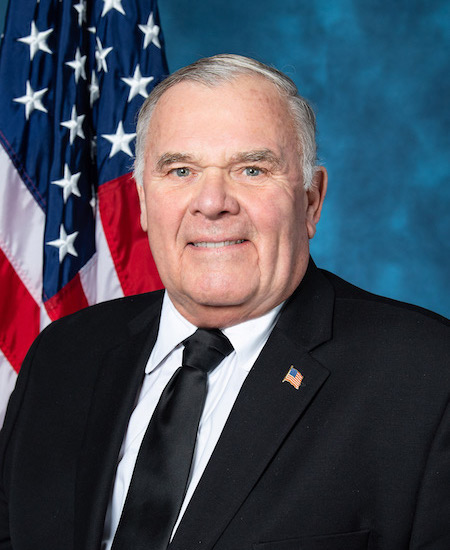
Rep. James R. Baird
Sponsored bills
Sponsoring USDA Sustainability Targets in Agriculture to Incentivize Natural Solutions Act of 2021 or the SUSTAINS Act This bill authorizes the Natural Resources Conservation Service to accept contributions of nonfederal funds to support a broader range of conservation programs. Current law authorizes the service to accept nonfederal contributions of funds to support certain programs, such as the Environmental Quality Incentives Program and the Conservation Stewardship Program. This bill expands the authority to include other conservation programs, including those that address climate change, carbon sequestration, wildlife habitat improvement, and protection of drinking water sources. The bill also makes other changes to the administration of contributed funds, such as by allowing the service to match contributions and permitting contributors to designate funds for use in a specific program or geographic area.
Support Ukraine Through Our Tax Code Act This bill denies the foreign tax credit and the tax deduction for income, war profits, and excess profits taxes paid to Russia and Belarus. The bill also denies certain other tax benefits in connection with the invasion of Ukraine, including any tax treaty benefits and exemptions from withholding requirements. The bill suspends tax information exchanges for Russia and Belarus under a tax treaty or an intergovernmental agreement during the period of the Ukraine invasion.
Prohibition of Agricultural Land for the People's Republic of China Act This bill requires the President to prohibit nonresident aliens, foreign businesses, and agents associated with China's government from (1) purchasing agricultural (including ranching) real estate located in the United States, or (2) participating in Department of Agriculture programs that are unrelated to food and safety regulatory requirements.
Military Spouse Licensing Relief Act of 2021 This bill provides for the portability of professional licenses of service members and their spouses who are relocated, because of military orders, outside of the jurisdiction that issued the license. Specifically, a professional license in good standing of a service member or spouse shall be considered valid at a similar scope of practice and in the discipline applied for in the new jurisdiction for the duration of such military orders. To establish and maintain eligibility, a service member or spouse must (1) provide a copy of the military orders to the licensing authority in the new jurisdiction; (2) remain in good standing with the licensing authority that issued the license; and (3) submit to the authority of the licensing authority in the new jurisdiction for the purposes of standards of practice, discipline, and fulfillment of any continuing education requirements. The bill also provides that if a service member or spouse is licensed to operate in multiple jurisdictions through an interstate licensure compact, the service member or spouse is subject to the requirements of the compact or the applicable provisions of the state law rather than the provisions of this bill.
Building America's Health Care Workforce Act This bill extends certain flexibilities relating to training and competency requirements for nurse aides in Medicare skilled nursing facilities (SNFs) and Medicaid nursing facilities (NFs). Generally, SNFs and NFs may not hire nurse aides for longer than four months unless they meet certain training and certification requirements. The Centers for Medicare & Medicaid Services waived some of these requirements during the COVID-19 emergency period so as to allow facilities to maintain adequate staffing levels; the waiver ends in June 2022. The bill extends these flexibilities for at least two years after the bill's enactment and specifies that (1) any time worked by a nurse aide during the emergency period counts toward the 75 hours required for initial training, and (2) a competency evaluation may be conducted at the SNF or NF where the nurse aide is employed if the state does not offer such an evaluation at least once a week.
Aviator Cancer Examination Study Act or the ACES Act This bill requires the Department of Veterans Affairs to seek to enter into an agreement with the National Academies of Sciences, Engineering, and Medicine to study the incidence and mortality of cancer among individuals who served in the regular or reserve components of the Navy, Air Force, or Marine Corps as air crew members of a fixed-wing aircraft or personnel supporting generation of such an aircraft.
This joint resolution nullifies the rule issued by the Centers for Disease Control and Prevention on February 3, 2021, that requires the use of face masks on planes, trains, buses, and other public conveyances and at transportation hubs to prevent the transmission of COVID-19.
This resolution demands that Russia present credible evidence of wrongdoing against U.S. citizen Paul Whelan or immediately release him. It also demands that Russia provide unrestricted consular access to Whelan and to ensure that he and all other political prisoners are afforded due process and universally recognized human rights.
Amplifying Processing of Livestock in the United States Act or the A-PLUS Act This bill directs the Department of Agriculture to revise federal regulations related to market agencies owning, financing, or participating in the operation of a meat packing entity. Specifically, this bill allows market agencies to have an ownership interest in, finance, or participate in the management or operation of a packing entity if such packing entity has a cumulative slaughter capacity of less than 2,000 animals per day or 700,000 animals per year.