

Maddy summaryThis bill requires the Department of Veterans Affairs to share a veteran's history of opioid prescriptions with their community healthcare providers. The rule applies to veterans receiving care outside the VA system and mandates that this prescription data be sent to both the specific non-VA doctors treating them and any third-party administrators managing their care. By updating existing regulations, the legislation aims to improve coordination between VA medical records and private healthcare providers to ensure comprehensive treatment information is available.
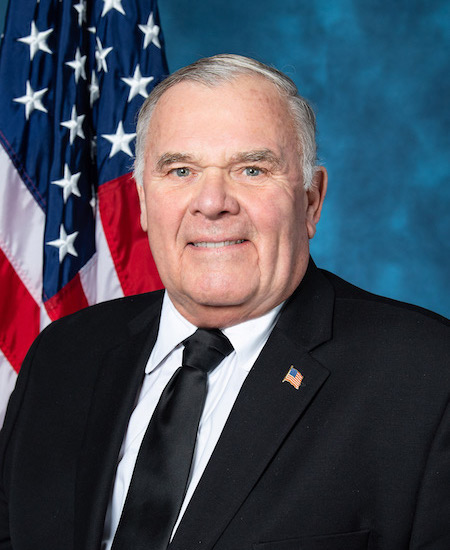
Rep. James R. Baird
Sponsored bills
Maddy summaryThe FORGE Act establishes a new program within the Department of State called FIRST to support the international deployment of small modular nuclear reactors. Managed by the Under Secretary for Arms Control and International Security, this program aims to promote U.S. nuclear technology abroad by facilitating diplomatic efforts, offering safety and regulatory guidance, and providing early-stage project support to help American businesses compete fairly with state-backed rivals. The legislation requires the program to submit regular reports and briefings to Congress detailing its activities, partners, and funding, and it is set to expire in 2034.
Maddy summaryThe Local Law Enforcement Support Act of 2026 expands funding opportunities for local police departments through the Byrne JAG and COPS programs. These funds can be used to recruit and train officers, purchase protective gear, and acquire specific tools like digital forensics equipment, drone technology, and ballistics analysis systems. The bill also allows for investments in software for cyber investigations and victim services. By adding these categories to the list of eligible expenses, the legislation provides law enforcement agencies with more options for addressing modern crime challenges.
Maddy summaryThis bill modifies the Export Control Reform Act of 2018 to require the Under Secretary for Industry and Security to consider whether a license application represents the first export authorization for an item to a specific buyer. It mandates that if an initial license is granted, the agency must promptly process any subsequent applications from other parties seeking to export similar items to the same buyer. The legislation also requires annual reports to Congress detailing the number of initial licenses issued, information about competing applications, and explanations for why initial licenses were granted despite other requests. These changes aim to increase transparency in export licensing procedures while maintaining flexibility for national security and foreign policy decisions.
Maddy summaryThis bill establishes a formal process for interagency coordination in export control rulemaking, requiring the Secretary of State, Defense, or Energy to submit proposals to the Export Administration Review Board for review and voting. It also mandates a comprehensive review by the Secretary of State within 30 days of enactment to assess how China's military-civil fusion strategy impacts U.S. export controls and national security, covering topics such as technology exploitation and end-use reliability. Based on this review, the Secretary must consider policy changes within 90 days, which would then be voted on by the Board before being reported to Congress within 150 days. The legislation directly affects federal agencies responsible for export controls and requires coordination between the State, Defense, and Energy departments.
Maddy summaryThis resolution expresses the sense of the House of Representatives that establishing a "Veterans Appreciation Month" would be a powerful way for the nation to recognize veterans. It suggests this recognition should occur as the United States marks its 250th anniversary of independence.
Maddy summaryThe Equal Treatment for Farmers Act removes references to 'socially disadvantaged farmers and ranchers' from multiple federal agricultural laws and programs. This bill amends various statutes including the Federal Crop Insurance Act, Consolidated Farm and Rural Development Act, and other agricultural legislation to eliminate special preferences or categories based on social disadvantage status. The legislation also prohibits the USDA from providing any preference, priority consideration, or enhanced benefits based on race or gender in its programs. These changes affect how federal agricultural assistance, loans, and benefits are categorized and distributed to farmers and ranchers.
Maddy summaryThe "Taxpayer Protection and Somalia Accountability Act of 2026" aims to prevent the misuse of U.S. funds and foreign assistance in Somalia. It recommends that the President restrict certain money transfers from the U.S. to Somalia, particularly if they originate from government support programs or benefit the Somali government or terrorist organizations. The bill also suspends direct U.S. foreign assistance to the national Government of Somalia unless safeguards are established to prevent diversion. Additionally, it mandates visa restrictions and allows for sanctions against Somali officials and their families involved in corruption or aid diversion, while also authorizing rewards for information on fraud. These provisions primarily affect individuals sending money to Somalia, the national Government of Somalia, and specific Somali officials.
Maddy summaryThis bill, the Artemis Accords Authorization Act, aims to strengthen United States leadership in international civil space exploration and cooperation. It authorizes the Department of State to establish a "Special Coordinator for the Artemis Accords" to lead diplomatic efforts in expanding participation and coordinating U.S. engagement with foreign governments and industry partners. The legislation also requires annual reports to Congress on the progress of the Artemis Accords and international space cooperation. Additionally, it mandates the development of a strategy to integrate U.S. low-earth orbit satellite technologies into foreign policy, including promoting their export and offering financial support to other countries. This bill directly affects the Department of State, NASA, other federal agencies involved in space and foreign policy, and the U.S. space industry.
Maddy summaryThis bill amends the National Quantum Initiative Act to create a new funding program for upgrading quantum research facilities and improving access to specialized equipment. The National Science Foundation would award grants to universities, nonprofit organizations, and industry partners to enhance research resources needed for quantum information science and technology development. These funds specifically support upgrading research capabilities, improving equipment access through better coordination and training programs, and enabling professional staff to maintain research resources. The program aims to address implementation challenges and meet the needs of the scientific community and quantum supply chain.