

Maddy summaryHR 984, the Commitment to Veteran Support and Outreach Act, authorizes $50 million annually (2024-2028) for grants to states and tribes to improve outreach to veterans and their families. The bill provides funding to hire more county/Tribal veterans service officers, expand existing outreach programs, and ensure equitable access to benefits for vulnerable groups like American Indian veterans, elderly veterans, and women veterans. States and tribes must submit detailed plans, track how quickly veterans receive benefits, and report annually on progress toward outcome measures set by the Veterans Affairs Secretary. Grants must supplement, not replace, existing state/local funding and prioritize areas with critical officer shortages or high veteran suicide rates.
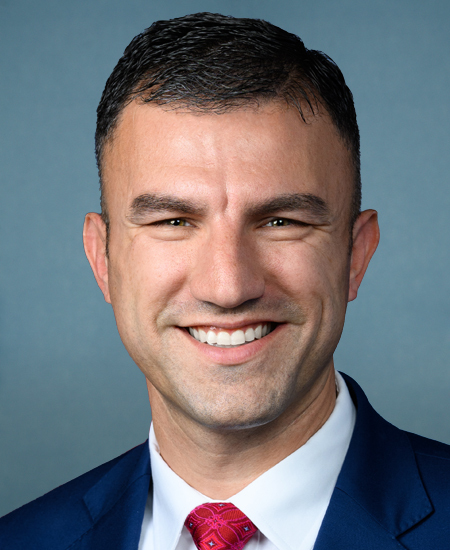
Rep. Rudy Yakym III
Sponsored bills
Migrant Child Safety Act This bill requires actions relating to placing unaccompanied alien children with a sponsor, such as requiring the Department of Health and Human Services (HHS) to collect and share specified information about prospective sponsors. Before placing such a child with a prospective sponsor, HHS must gather and provide to the Department of Homeland Security (DHS) specified information about the prospective sponsor, including (1) proof of address for the residence where the child will be placed; (2) results of background checks for the sponsor and any adult household members, (3) the sponsor's immigration status, if known; and (4) any evidence to prove any claimed relationship between the child and the sponsor. HHS may not waive any part of this requirement. After receiving this information, if DHS determines that the sponsor is unlawfully present in the United States, the sponsor must be placed in removal proceedings. No later than 30 days after placing the child, HHS must also provide this information and any other relevant information to the appropriate state or local health or welfare agency. If HHS cannot contact the sponsor for a follow-up or well-being check during the 120 days after the child's placement, HHS must report the child as missing to the National Center for Missing and Exploited Children. HHS must attempt to contact the child's parents, to the extent practicable.
Maddy summaryHR 4157, the "Not Just a Number Act," requires the Department of Veterans Affairs (VA) to produce annual reports on veteran suicide rates and their connection to VA healthcare and benefits. The reports must break down suicide rates by age, gender, and race, and examine how engagement with VA services (like Vet Centers, healthcare enrollment, benefits claims, and housing loans) correlates with suicide trends. The bill also mandates a VA toolkit for state/local coroners to improve veteran suicide death reporting, and a study on creating a dedicated VA suicide prevention office. These measures aim to standardize data collection and identify effective prevention strategies, directly affecting VA operations, congressional oversight, and veteran care systems.
Maddy summaryHR 4769, the PFAS Alternatives Act, funds research and training to develop PFAS-free turnout gear for firefighters. It authorizes $25 million annually (2024-2028) for grants to eligible organizations to research, develop, and test next-generation gear without per- and polyfluoroalkyl substances (PFAS), which are linked to firefighter cancer risks. The bill requires partnerships with firefighting organizations to ensure research translates into practical training and gear care guidance, including decontamination protocols. It also allocates $2 million yearly for training programs on proper gear use and maintenance, aiming to reduce exposure to hazardous chemicals during fire operations.
Maddy summaryHR 4708, the H-2 Improvements to Relieve Employers Act, streamlines U.S. visa processes for agricultural (H-2A) and non-agricultural (H-2B) workers. It extends the validity of employer certifications and petitions for these visas from one year to three years, reducing administrative burdens. The bill also allows interview waivers for workers renewing status within four years of their previous visa expiration. Additionally, it requires the Department of Labor to publish seasonal employment data on its website at an employer's request, enhancing transparency for seasonal hiring. These changes directly affect U.S. employers seeking temporary foreign workers and the workers themselves.
Maddy summaryHR 4721, the Main Street Tax Certainty Act, makes a permanent the 20% tax deduction for eligible small business owners under Section 199A of the tax code. This provision directly affects pass-through business owners (like S-corps, partnerships, and sole proprietorships) who qualify for the deduction. The bill achieves this by removing the temporary expiration language (subsection (i)) from the existing tax code provision. The key change is ending the need for annual congressional extensions of this deduction, providing long-term tax certainty for small businesses.
Maddy summaryThis bill, the Veteran Care Improvement Act of 2023, establishes new standards for when veterans can receive care from private providers instead of the Department of Veterans Affairs (VA). It requires the VA to allow veterans to seek community care if they cannot get an in-person appointment within 30 days for primary care or 60 days for specialty care at a VA facility within a 30 or 60-minute drive, respectively. The legislation also mandates that the VA notify veterans of their eligibility for community care within two business days, provide information about telehealth options, and explain reasons for denied care requests along with appeal instructions. Additional provisions include requiring the VA to conduct outreach to inform veterans about community care options, mandate the use of value-based reimbursement models for community care, and establish a pilot program to improve care administration through scheduling improvements and provider incentives. The bill also extends the deadline for health care entities to submit claims under the prompt payment standard from 180 days to one year, and requires the VA Inspector General to assess VA medical center performance in implementing community care programs within three years of enactment.
Maddy summaryThis bill, HR 1282 (Major Richard Star Act), expands benefits for certain military retirees by allowing them to receive both veterans' disability compensation and military retirement pay simultaneously. It specifically affects combat-related disabled retirees under Chapter 61 of the military retirement system who have fewer than 20 years of service. The key change removes the automatic reduction of military retirement pay when these retirees also receive disability compensation, as amended in Section 1413a(b)(3) of Title 10. Technical updates to the law’s structure and effective date (starting after enactment) complete the provisions.
Maddy summaryThe Afghan Adjustment Act creates a pathway for certain Afghans who directly supported U.S. missions in Afghanistan during the 20-year U.S. military presence to adjust to lawful permanent resident status (green card holders). It specifically targets Afghans who worked with U.S. forces or agencies, including military personnel, security personnel, and their families, who received "Chief of Mission approval" for special immigrant status. Key provisions include new vetting requirements (in-person interviews and biometric screening), exemption from immigration numerical limits, $20 million annually for implementation, and a task force to develop resettlement strategies. The bill also establishes a new category of special immigrant visas for at-risk Afghan allies and sets a two-year application deadline after guidance is published.
Maddy summaryThis bill prohibits U.S. federal agencies from entering new contracts with companies that boycott Israel after January 1, 2024. Companies must certify they are not boycotting Israel at contract signing, and contracts must include this prohibition. It applies to federal contracts over $100,000 for services or IT with companies employing more than 10 people. If a company violates the boycott prohibition, the agency must terminate the contract after 30 days unless the company ends the boycott. The bill explicitly states it does not infringe on First Amendment rights or take sides on the Israeli-Palestinian conflict.