Maddy summaryThis resolution (HRES 356) expresses the U.S. House of Representatives' condemnation of police brutality worldwide, including excessive force, extrajudicial killings, and disproportionate harm to racial minorities, women, migrants, and LGBTQIA+ communities. It urges the U.S. government to stop arms sales to countries with documented police brutality, end militarized policing tactics domestically and abroad, and redirect funds toward community programs. As a symbolic resolution, it does not create new laws but calls for specific policy actions from the executive branch and businesses.
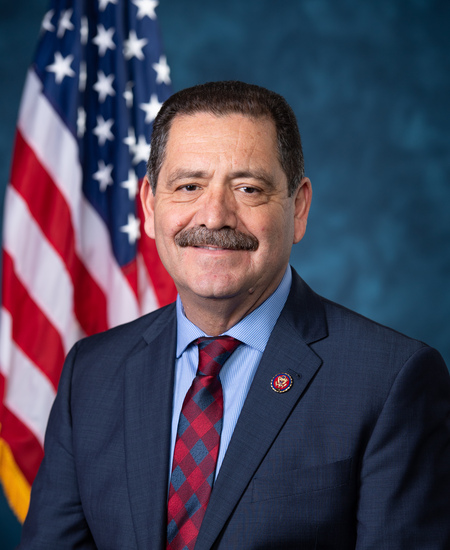
Rep. Jesús G. "Chuy" García
Sponsored bills
This resolution calls for the creation of a Green New Deal with the goals of achieving greenhouse gas and toxic emissions reductions needed to stay under 1.5 degrees Celsius of warming; establishing millions of high-wage union jobs and ensuring economic security for all; investing in infrastructure and industry; securing clean air and water, climate and community resiliency, healthy food, access to nature, and a sustainable environment for all; and promoting justice and equality. The resolution calls for accomplishment of these goals through a 10-year national mobilization effort. The resolution also enumerates the goals and projects of the mobilization effort, including building smart power grids (i.e., power grids that enable customers to reduce their power use during peak demand periods); upgrading all existing buildings and constructing new buildings to achieve maximum energy and water efficiency; removing pollution and greenhouse gas emissions from the transportation and agricultural sectors; cleaning up existing hazardous waste and abandoned sites; ensuring businesspersons are free from unfair competition; and providing higher education, high-quality health care, and affordable, safe, and adequate housing to all.
This resolution rejects the Supreme Court's decisions in the Insular Cases (a series of cases regarding the application of constitutional rights in U.S. territories) and recognizes that constitutional and democratic principles apply throughout the states and territories of the United States.
Maddy summaryHR 2904 grants permanent resident status to a specific individual, Jose Garcia Alarcon, by waiving standard immigration requirements under the Immigration and Nationality Act. It allows him to apply for an immigrant visa or adjust his status without being barred by prior removal orders or inadmissibility records, and requires his application to be filed within two years of the bill's enactment. The bill also reduces the available immigrant visa numbers for his country of origin and denies preferential immigration benefits to his close relatives. This is a personal relief bill affecting only one named individual.
Maddy summaryHR 2905 grants permanent residency to Francisca Burciaga-Amaro by waiving standard immigration requirements under the Immigration and Nationality Act. It allows her to apply for an immigrant visa or adjust her status without being subject to removal grounds or prior denials, and requires the Department of Homeland Security to cancel any existing removal orders against her. The bill mandates that her application must be filed within two years of enactment, with fees paid, and reduces the annual visa quota for her country of birth by one. This is a specific individual relief bill, directly affecting only Francisca Burciaga-Amaro, not a broader policy change.
National Police Misuse of Force Investigation Board Act of 2021 This bill establishes the National Police Misuse of Force Investigation Board as an independent federal entity. Among other duties, the board must investigate deaths that occur in police custody, officer-involved shootings, and uses of force that result in severe bodily injury in police custody. The board must also report periodically to Congress, federal entities, and state and local governments on recommendations to reduce incidents of misuse of force by law enforcement. The bill requires a state or local government that receives funding under the Edward Byrne Memorial Justice Assistance Grant program to (1) allow findings and recommendations of the board to be admissible in court, and (2) report on actions taken to address the recommendations of the board. The Department of Justice may reduce allocations to states and local governments that fail to comply with these requirements.
Protecting the Rights Of Towns against federal Enforcement contrary to Constitutional Tenets for Immigration Act of 2021 or the PROTECT Immigration Act of 2021 This bill establishes that the authority to investigate, apprehend, or detain aliens for the purposes of immigration enforcement is limited to immigration officers and authorized Department of Homeland Security employees, except when such authority is provided to other individuals under specified statutes. Specifically, this restriction does not apply in certain instances involving (1) an actual or imminent mass influx of aliens, (2) persons bringing in and harboring aliens in violation of immigration laws, or (3) an alien illegally present in the United States who had previously left or was deported after being convicted of a felony. The bill repeals the authority allowing the Department of Justice to enter into agreements authorizing state or local government employees to perform immigration enforcement functions.
This bill generally addresses the adverse effects of climate change with a particular focus on immigration. Specifically, the bill establishes an immigration pathway to admit climate-displaced persons into the United States. These are individuals (1) who need durable resettlement because of an environmental change that adversely affects their living conditions, and (2) whose government cannot or will not provide a resettlement solution. Persons admitted to the United States under this pathway are entitled to the same resettlement assistance and benefits available to refugees. Additionally, the bill authorizes the President to provide foreign assistance for promoting resilience and reducing vulnerability among communities facing adverse effects of climate change. It also creates the position of Coordinator of Climate Change Resiliency in the Department of State. Moreover, the State Department must implement, and periodically report on, a strategy to mitigate the impact of climate change on displacement and humanitarian emergencies. The State Department must also provide (1) training on climate displacement to foreign service officers assigned to countries from which climate-displaced persons originated, and (2) guidance on the humanitarian impacts associated with climate change to all U.S. diplomatic missions. The bill also requires the President to report on displacement caused by climate change.
Families Belong Together Act This bill provides various immigration benefits for eligible alien parents (or legal guardians) and minor children who were separated by the Department of Homeland Security (DHS) between January 20, 2017, and January 20, 2021. Generally, to be an eligible parent or minor child under this bill, the alien must not be inadmissible for certain crime- or security-related grounds, though DHS may waive certain grounds for humanitarian or public interest reasons. Furthermore, an eligible child who was separated as a minor remains eligible for the immigration benefits after reaching majority. DHS must grant humanitarian parole into the United States to an eligible alien who requests such parole, regardless of whether the alien is physically present in the United States. An eligible alien in the United States may apply for lawful permanent resident status. U.S. Citizenship and Immigration Services shall grant a qualifying alien's lawful permanent resident status within 30 days of receiving the alien's application. An alien who receives lawful permanent resident status under this bill shall be eligible for benefits and services that are available to an alien who is admitted as a refugee. Certain annual numerical limitations shall not apply to aliens who receive lawful permanent resident status under this bill. If an alien seeks judicial review of a denial of an application for lawful permanent resident status under this bill, the Department of Justice shall appoint counsel to represent that alien upon request.
American Housing and Economic Mobility Act of 2021 This bill addresses housing affordability and availability, makes certain changes to the estate and gift taxes, and contains other related provisions. The Department of Housing and Urban Development shall provide grants to (1) state and local governments that remove unnecessary barriers to building affordable units, (2) states to assist borrowers who have negative equity in their homes, (3) state housing finance agencies to construct or acquire affordable rental housing and prevent tenant displacement and harassment, and (4) eligible individuals (generally, lower income individuals who resided in low-income or historically racially segregated areas) to help them purchase their first homes. The bill provides funding through FY2031 for the first-time homeowner grant program established by the bill, through FY2022 for the affordable rental housing construction program established by the bill, and through FY2022 for specified existing rural housing programs. The bill also expands fair housing protections to prohibit discrimination based on sexual orientation, gender identity, marital status, source of income, veteran status, or an individual's perceived membership in a protected class (e.g., an individual's perceived race or sex). Additionally, the bill modifies the estate tax in various ways, including by reducing the number of brackets to three, increasing the tax rates, and reducing the basic exemption amount. The bill also modifies provisions related to gift taxes and transfer taxes.