

Maddy summaryHR 6567 establishes a new FEMA program to improve disaster recovery in U.S. territories like Puerto Rico, Guam, and the U.S. Virgin Islands. The program will identify and address recurring challenges - such as outdated infrastructure, remote locations, language barriers, and limited staff - that delay recovery after hurricanes and other disasters. FEMA must provide tailored technical assistance, develop training courses, and create best practices for territories applying for federal disaster funding. The bill authorizes $50 million annually (2024-2028) for this program and requires biennial reports to Congress on progress and recommendations for continuation. It directly affects territories struggling with slow recovery due to unique geographic, economic, and administrative hurdles.
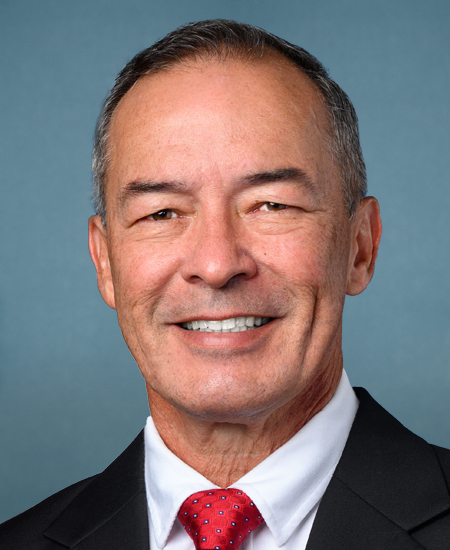
Rep. James C. Moylan
Sponsored bills
Maddy summaryThis bill requires the government to partner with scientific experts to regularly assess health impacts of PFAS chemicals (common "forever chemicals" found in water and products) and develop clinical guidance for doctors. Within two years of enactment, the Agency for Toxic Substances and Disease Registry must complete an initial assessment and clinical recommendations, updating them every five years. The guidance will be posted online and shared with public health officials and healthcare providers to help treat PFAS-related health issues. It directly affects people exposed to PFAS and the medical professionals treating them.
Maddy summaryThis bill authorizes the posthumous presentation of a Congressional Gold Medal to honor Marshall "Major" Taylor, a pioneering Black cyclist who broke racial barriers in the late 19th and early 20th centuries. It recognizes his athletic achievements, including world records and international championship wins, as well as his advocacy for equality in sports. The medal, designed by the Treasury Secretary, will be presented to Taylor's great-granddaughter, Karen Donovan, following the congressional authorization. As a commemorative act with no policy changes, it serves solely to honor Taylor's legacy as a trailblazer and role model.
Maddy summaryThis bill, the Guam Service Academy Equality Act, increases the number of cadet nominations from Guam to the three U.S. service academies. It amends existing law to change the quota from four to five cadets per academy (West Point, Annapolis, and the Air Force Academy) annually. The Delegate from Guam in Congress will now nominate five cadets instead of four for each academy. This directly affects Guam's representation at these institutions by providing one additional nomination slot per academy each year. The change applies uniformly across all three military academies without altering other nomination criteria.
Maddy summaryHR 6641, the Keep America's Waterfronts Working Act, establishes a federal task force to identify and address critical needs of working waterfronts, which are coastal areas used for commercial fishing, boating, aquaculture, and related activities. The bill creates a grant program to help coastal states, Indian Tribes, and Native Hawaiian organizations develop and implement plans to preserve and expand working waterfronts through property acquisition, facility improvements, and climate adaptation measures. It also establishes a loan fund to provide financial assistance for waterfront preservation, with special provisions for disadvantaged communities and requirements for covered entities to develop plans ensuring waterfronts remain available for their intended uses. The legislation authorizes $50 million annually from 2024-2028 for these programs, with reporting requirements to track implementation and effectiveness.
Maddy summaryHR 6625, the Chinese Spy Balloon Assessment Act, requires the Secretary of Defense to submit a report to Congress within 90 days of the bill's enactment. The report must detail the national security effects of surveillance conducted by China via a high-altitude balloon shot down in U.S. airspace in February 2023, including impacts on military installations and an analysis of recovered technology's country of origin. This bill directly affects the Department of Defense and Congress by mandating a specific, time-bound assessment of a single incident. It does not create new policies or funding but establishes a procedural requirement for transparency about the 2023 balloon event. The report must be unclassified, though it may include a classified annex.
Maddy summaryHR 6478, the Typhoon Mawar Reconstruction Act, provides full federal funding for repairing critical infrastructure damaged by Typhoon Mawar in Guam and the Northern Mariana Islands. It directs FEMA to cover 100% of eligible costs for restoring hospitals, power systems, waterways, and communication networks under specific disaster declarations (DR-4715-GU and DR-4716-MP), bypassing standard cost-sharing rules. The bill allows FEMA to use direct federal resources (personnel, equipment, etc.) to assist communities instead of issuing grants. This applies to infrastructure repairs needed to meet safety standards and withstand future disasters.
Maddy summaryHRES 870 is a symbolic House resolution supporting National Rural Health Day, observed annually on the third Thursday of November. It recognizes rural health care providers and the 60+ million people living in rural communities who face challenges like hospital closures, limited access to care, and health disparities. The resolution expresses commitment to improving rural health care accessibility and affordability but includes no new funding, programs, or policy changes - only a formal acknowledgment of existing efforts. It directly affects rural communities by honoring their health care contributions through a non-binding statement.
Maddy summaryHRES 683 is a non-binding resolution expressing the House's support for diplomatic efforts to encourage Mexico to fulfill annual water delivery commitments under the 1944 U.S.-Mexico treaty. The treaty requires Mexico to deliver an average of 350,000 acre-feet of water annually (over a 5-year cycle) to the U.S., but Mexico has historically delayed deliveries until the cycle ends. The resolution specifically acknowledges water shortages faced by South Texas farmers and urges Mexico to meet its annual obligations, while supporting negotiations for more reliable water agreements. It does not create new legal requirements but formally encourages diplomatic action to address the delivery delays.
Maddy summaryHR 6415, the CARE for First Responders Act, creates targeted mental health support for first responders, including law enforcement, firefighters, EMTs, and 911 operators (previously excluded from many services). It establishes a 24/7 confidential mental health hotline integrated with the 988 Suicide Lifeline, funds mobile crisis teams for disaster response, and mandates specialized training to reduce stigma and improve access to culturally competent care. The bill requires the development of peer support programs and education for responders and their families on mental health coping strategies. It authorizes $5 million annually (2024-2028) for grants to states and organizations to implement these services, specifically addressing the higher rates of mental health challenges and suicide among first responders compared to the general population.