

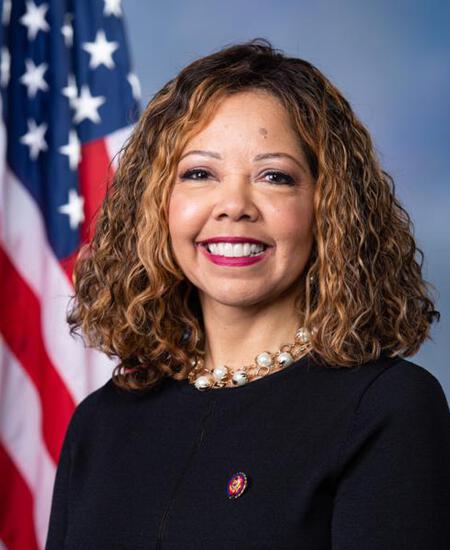
Photo of Lucy McBath
D United States House · District 6 · Georgia On the 2026 ballot

Rep. Lucy McBath

Compare
Total votes
2,837
all sessions
Attendance
98%
66 missed
Lower than 79% of chamber peers
With party
98%
of cast votes
Near the chamber average
Bipartisan score
1%
crosses aisle rarely
Near the chamber average
Sponsored
1,136
bills & resolutions
Near the chamber average
Committees
5
assignments
1,136 bills and resolutions

Sponsored bills

Total
1,136
Primary
61
Co-sponsor
1,075
This page
1,136
matching current filters
Co-sponsor HR 6559
In committee · Indiana House · Co-sponsor
Thiokol Memorial Gold Medal Act

Maddy summaryHR 6559, the Thiokol Memorial Gold Medal Act, authorizes the posthumous award of a Congressional Gold Medal to 30 workers who died in a 1971 industrial explosion at the Thiokol plant in Woodbine, Georgia. The bill specifically recognizes these employees - many African American women - who were manufacturing military supplies during the Vietnam War. The medal, designed by the Treasury Secretary, will be displayed at the Thiokol Memorial Museum, with bronze duplicates sold to offset costs. This is a commemorative measure, not a policy change, building on prior Georgia state honors for the workers' sacrifice.

In committee Dec 10, 2025 1 co-sponsor
Co-sponsor HR 6579
In committee · Indiana House · Co-sponsor
Justice for Breonna Taylor Act

Maddy summaryHR 6579, the Justice for Breonna Taylor Act, requires federal, state, and local law enforcement officers to provide notice of their authority and purpose before entering a premises with a warrant. This applies to all officers serving warrants, including those at the federal level and state/local agencies receiving Department of Justice funding. The law mandates this notice requirement starting in the first fiscal year after enactment, directly affecting law enforcement agencies that receive federal funding for policing. It changes the process for executing warrants by eliminating the ability to conduct no-knock entries without first informing occupants.

In committee Dec 10, 2025 1 co-sponsor
Co-sponsor HR 6429
In committee · Indiana House · Co-sponsor
Expanding Cybersecurity Workforce Act of 2025

Maddy summaryThe Expanding Cybersecurity Workforce Act of 2025 establishes a new program under CISA to promote cybersecurity careers to underrepresented groups, including racial and ethnic minorities, veterans, formerly incarcerated individuals, people with disabilities, older adults (40+), and those from low-income or nontraditional educational backgrounds (like community colleges or HBCUs). The program requires CISA to tailor outreach to regional needs, partner with schools, unions, and community organizations, and report annually on workforce impact. It authorizes $20 million annually for fiscal years 2026-2031 to support these efforts, aiming to diversify the cybersecurity workforce through targeted recruitment and training.

In committee Dec 5, 2025 1 co-sponsor
Co-sponsor HR 5731
In committee · Indiana House · Co-sponsor
School Food Modernization Act

Maddy summaryHR 5731, the School Food Modernization Act, provides funding to help schools upgrade facilities and equipment for healthier meal programs. It authorizes $300 million in loan guarantees (covering up to 80% of costs) and $35 million annually for grants to support kitchen renovations, equipment purchases, and food safety improvements for local schools and tribal organizations. The bill also allocates $10 million yearly to fund training programs for school food service staff, developed by third-party organizations, to meet nutrition standards. These provisions directly affect public school districts, tribal schools, and their food service operations by enabling infrastructure upgrades and staff training.

In committee Dec 2, 2025 1 co-sponsor
Co-sponsor HR 1262
Passed · Indiana House · Co-sponsor
Mikaela Naylon Give Kids a Chance Act

Give Kids a Chance Act of 2025 This bill expands the Food and Drug Administration’s (FDA’s) authority with respect to research on rare pediatric diseases, including by permitting the FDA to take enforcement action against drug sponsors that fail to satisfy pediatric study requirements and by reauthorizing programs that support pediatric research.  Specifically, the bill modifies requirements relating to molecularly targeted pediatric cancer investigations to permit research on new drugs in combination with active ingredients that have already been approved, provided certain conditions are met; permits the FDA to take enforcement action against drug sponsors that fail to comply with pediatric study requirements, if such sponsors demonstrated a lack of due diligence in satisfying the requirement; renews the FDA’s authority to award priority review vouchers to sponsors of new products intended to treat rare pediatric diseases through September 30, 2029; and reauthorizes through FY2027 certain funding for the National Institutes of Health to support priority pediatric research.  The bill also provides statutory authority for the FDA’s interpretation of the orphan drug exclusivity period. The bill specifies, consistent with FDA regulations, that the seven-year market exclusivity period for drugs for rare diseases or conditions (i.e., orphan drugs) prohibits the approval of the same drug for the same approved use or indication with respect to the disease or condition. (In Catalyst Pharmaceuticals, Inc. v. Becerra , a court rejected the FDA’s interpretation and held that orphan drug exclusivity extends to all uses or indications for the disease or condition.)

Passed Dec 2, 2025 1 co-sponsor
Co-sponsor HR 4733
In committee · Indiana House · Co-sponsor
Low-Income Household Water Assistance Program Establishment Act

Maddy summaryThis bill establishes a federal program to help low-income households pay for drinking water and wastewater services. It provides $500 million annually (2026-2030) in grants to states and tribes that already administer energy assistance programs, allowing them to cover past-due bills or other costs for households meeting specific income criteria (e.g., receiving certain federal benefits or earning ≤150% of the poverty level). The program prohibits using these funds to replace existing assistance and requires technical help to streamline eligibility. It directly affects low-income households in participating states and tribes, particularly those facing water affordability challenges.

In committee Dec 1, 2025 1 co-sponsor
Co-sponsor HR 6255
In committee · Indiana House · Co-sponsor
Affordable Insulin Now Act

Maddy summaryHR 6255, the Affordable Insulin Now Act, requires health insurance plans (including employer-sponsored and individual plans) to cover specific insulin products starting in 2026. It caps out-of-pocket costs for these insulin products at $35 per 30-day supply or 25% of the negotiated price, whichever is lower, with no deductibles applied. The bill defines "selected insulin products" to include at least one of each dosage form (like vials or pumps) and type (such as rapid-acting or long-acting) available from the plan. This directly affects people with diabetes who rely on insulin, ensuring more predictable and affordable access to essential medications under their health coverage.

In committee Nov 21, 2025 1 co-sponsor
Co-sponsor HR 6181
In committee · Indiana House · Co-sponsor
John Lewis Every Child Deserves a Family Act

Maddy summaryHR 6181, the John Lewis Every Child Deserves a Family Act, prohibits child welfare agencies receiving federal funds from discriminating against children, youth, or prospective foster/adoptive parents based on religion, sex (including sexual orientation and gender identity), or marital status. It directly affects LGBTQ youth in foster care - overrepresented at 30% of the system - who face higher risks of trauma, group home placements, and suicide attempts compared to non-LGBTQ peers. Key provisions require agencies to collect data on sexual orientation and gender identity, establish a National Resource Center for LGBTQ youth support, provide cultural competency training, and eliminate discriminatory practices. The law aims to improve safety, permanency, and placement stability by expanding access to family-based care and ensuring equitable services for all children in the system.

In committee Nov 20, 2025 1 co-sponsor
Co-sponsor HR 6231
In committee · Indiana House · Co-sponsor
Improve and Enhance the Work Opportunity Tax Credit Act

Maddy summaryHR 6231 extends and enhances the Work Opportunity Tax Credit (WOTC), a federal tax credit for employers hiring from specific target groups like veterans, SNAP recipients, and summer youth workers. The bill extends the program through 2030 (from 2025), increases the credit rate to 50% for certain wages (up from 40%), adds automatic inflation adjustments to the $6,000 wage cap, and expands eligibility to include military spouses and removes age limits for SNAP recipients. Key provisions also modify credit calculations for veterans, agricultural workers, and long-term assistance recipients, while requiring federal agencies to promote hiring from target groups in critical sectors like healthcare and construction. This bill directly affects employers who hire from these designated groups, making the tax credit more valuable and accessible.

In committee Nov 20, 2025 1 co-sponsor
Co-sponsor HR 6138
In committee · Indiana House · Co-sponsor
To direct the Secretary of Defense to establish a pilot program for partnerships between covered basic needs banks and military installations to provide diapers and diapering supplies to military families, and for other purposes.

Maddy summaryThis bill establishes a pilot program requiring the Secretary of Defense to partner with certified nonprofit diaper banks to provide free diapers and diapering supplies to military families in need. Covered diaper banks must be nonprofit members of the National Diaper Bank Network with at least five years of experience distributing diapers at no cost. The program will connect these banks directly with military installations to address diaper access gaps, with the National Diaper Bank Network providing technical support and evaluating the pilot's effectiveness. It directly affects military families facing financial barriers to basic necessities like diapers, creating a new federal partnership mechanism for support.

In committee Nov 19, 2025 1 co-sponsor
Showing 121 to 130 of 1,136 bills
Previous 1 … 12 13 14 … 114 Next