

Maddy summaryHR 4734, the "Hands Off Our Social Security Act," prohibits federal actions that would alter Social Security benefits, data handling, workforce levels, office locations, or communication systems without explicit congressional approval. It directly protects Social Security beneficiaries and the Social Security Administration (SSA) by banning unauthorized changes to benefits, data mining, privatization, staff cuts, office closures, or reduced phone/in-person services. Key provisions require Congress to approve any modifications to benefits, workforce reductions, or office closures, and mandate the SSA to maintain existing communication channels. The bill also mandates annual GAO audits to ensure compliance with these restrictions. This legislation focuses on preserving current Social Security operations and access, not creating new benefits or altering eligibility.
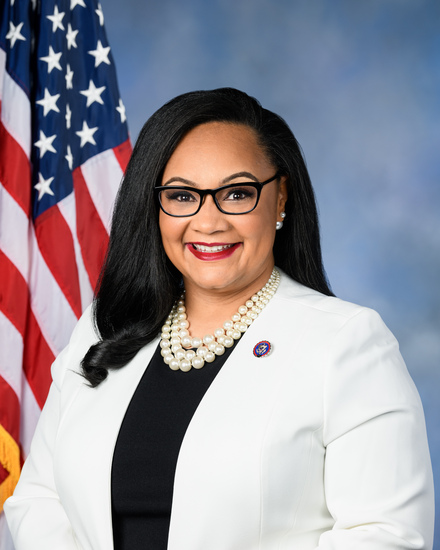
Rep. Nikema Williams
Sponsored bills
Maddy summaryH.J. Res. 108 proposes a constitutional amendment to remove legal immunity for federal officials, including the President, from criminal prosecution for actions taken while performing official duties. It would prohibit the President from granting pardons to themselves and eliminate the defense that "official authority" excuses violations of federal or state law (with limited exceptions for certain congressional actions). If ratified, this amendment would require Congress to pass implementing laws to enforce these changes. The proposal is currently in the House Judiciary Committee and requires approval by three-fourths of state legislatures to become part of the Constitution.
Maddy summaryThis bill prohibits life, disability, and long-term care insurers from denying coverage, canceling policies, or increasing premiums based solely on a person's status as a living organ donor. It directly protects living organ donors by preventing insurance discrimination unrelated to actual health risks. The bill also requires the Health and Human Services Secretary to update public educational materials about organ donation benefits, risks, and insurance impacts within six months of enactment. These materials will include information on the new insurance protections established by the bill. The law relies on state insurance regulators for enforcement of the insurance provisions.
Maddy summaryHR 4623, the Plain Prescription Prices Act, requires drug companies to include the current list price for a typical 30-day supply or treatment course in all direct-to-consumer television ads for prescription drugs covered by Medicare (Part D) or Medicaid. This applies to ads aired on broadcast, cable, streaming, or satellite TV. The bill mandates that the displayed price must be truthful and reflect the list price as of the first day of the quarter the ad runs. The goal is to provide consumers with clear, upfront pricing information when viewing drug advertisements.
Maddy summaryThis bill amends the Family and Medical Leave Act (FMLA) and federal employee leave rules to clarify that recovery from organ donation surgery qualifies as a "serious health condition." It directly affects private-sector workers covered by the FMLA and federal civil service employees. The key change adds "including recovery from surgery related to organ donation" to the definitions of serious health conditions in both the FMLA and federal leave statutes. This ensures eligible employees can use their existing family and medical leave benefits to recover after donating an organ, without requiring new leave entitlements.
Maddy summaryHR 4140, the Burma GAP Act, requires the U.S. to prioritize accountability for genocide and crimes against humanity committed against Rohingya in Myanmar. It establishes a U.S. Special Representative for Burma to coordinate international sanctions, support Rohingya protection efforts, and advance transitional justice, with specific funding authorizations of $5 million annually for atrocity investigations and $4 million for evidence collection. The bill directs the State Department to support Rohingya refugees in Bangladesh through humanitarian aid, gender-based violence prevention, education, and legal assistance, while promoting durable solutions like safe repatriation and citizenship rights. It mandates annual reports to Congress on U.S. efforts to address atrocity risks, document crimes, and advance accountability, directly affecting Rohingya communities, the Burmese military junta, and U.S. foreign assistance programs.
Maddy summaryThe Black Farmers and Socially Disadvantaged Farmers Increased Market Share Act creates a new grant program to support food hubs that increase market access for socially disadvantaged farmers and ranchers. The program provides competitive grants for food hubs to develop infrastructure, equipment, and marketing services, with priority given to projects benefiting underserved communities. The bill also establishes a 25% tax credit for businesses that purchase agricultural products from these food hubs and requires USDA to prioritize purchasing from socially disadvantaged farmers in domestic food assistance programs. These provisions aim to address historical barriers to market access for socially disadvantaged farmers by supporting their participation in food distribution systems.
Maddy summaryHR 4516, the Saving Lives and Taxpayer Dollars Act, prohibits the U.S. government or its aid partners from destroying food, medicine, vaccines, or other foreign assistance commodities before they expire, requiring these items to be redirected to intended beneficiaries instead. The bill mandates that agencies like USAID, State, and Agriculture must make every effort to donate or sell expired aid items to those in need before disposal. It also requires annual reports to Congress detailing any expired, spoiled, or destroyed aid items, including reasons for not redirecting them and associated costs. This directly affects U.S. foreign aid agencies and their global partners, ensuring aid reaches people facing hunger, disease, or health crises rather than being wasted.
Maddy summaryThis bill requires all federal agencies to set specific equity goals in their strategic and performance plans, mandating at least one goal or 20% of total goals focused on improving services for underserved communities and individuals. It establishes an "Agency Equity Advisory Team" with 10+ agency roles (including civil rights, data, and human capital leaders) and creates an "Equity Subcommittee" to coordinate across agencies on equitable practices. The bill also updates data officer responsibilities to prioritize equitable data collection, use, and sharing, including collaboration with community groups and state/local governments. It directly affects all federal agencies and aims to reshape how government services are delivered to populations systematically excluded from economic, social, and civic opportunities.
Maddy summaryThis bill prohibits federal and state governments from restricting access to FDA-approved medicines. It guarantees individuals the right to obtain these medicines without coercion and allows healthcare providers (like doctors and pharmacists) to prescribe or refer for them. The law blocks governments from implementing rules that single out or hinder the sale, provision, or use of FDA-approved drugs, such as bans on specific medicines or barriers to patient access. It does not affect the FDA's drug approval process or existing health insurance coverage requirements.