

Maddy summaryThe College Transparency Act requires the federal government to create a new student data system that collects and shares information about college enrollment, costs, completion rates, and post-graduation outcomes. This system will directly affect colleges and universities (which must submit data), students (whose information is collected with privacy protections), and families (who will access the data to make informed education decisions). The bill mandates the development of a public website providing customizable, aggregate data on student demographics, costs, and outcomes, while prohibiting the collection of sensitive information like health records or political affiliation. The system aims to reduce reporting burdens on institutions by consolidating data collection and making information more transparent for prospective students. It includes strong privacy and security requirements to protect student information, with the data system to be developed within four years of the bill's enactment.
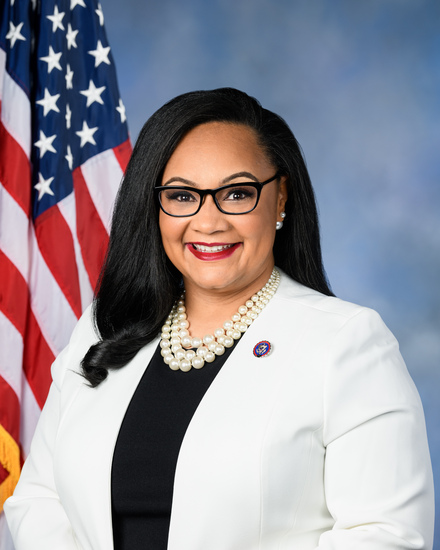
Rep. Nikema Williams
Sponsored bills
Maddy summaryThis bill removes a barrier preventing most low-income students from accessing SNAP benefits. It amends the Food and Nutrition Act to explicitly allow students enrolled at least half-time in recognized higher education programs to qualify for SNAP, reversing a prior exclusion. The key change eliminates the previous requirement that students meet specific exceptions (now deleted) and adds a new eligibility category under Section 3(m)(5). This directly affects low-income undergraduate and graduate students at colleges and training programs who were previously ineligible. The changes take effect January 2, 2026.
Maddy summaryThis bill authorizes $50 million annually for the Centers for Disease Control and Prevention (CDC) to conduct research on firearms safety and gun violence prevention, beginning in fiscal year 2026 through 2031. The funding is in addition to existing CDC appropriations and would support studies under the Public Health Service Act. It does not create new regulations or directly affect individuals, but aims to expand research into causes and prevention strategies for gun violence. The bill focuses solely on enabling CDC research, without proposing policy changes or restrictions.
Maddy summaryHR 4796, the Restoring Essential Healthcare Act, repeals a provision that blocked Medicaid payments to certain healthcare providers during a specific period. It directly affects Medicaid beneficiaries who received care from these providers between the enactment of the prior law (Public Law 119-21) and this bill's enactment. The key provision retroactively restores Medicaid payments for services already provided during that blocked period, treating the payment restriction as if it never existed. This change ensures eligible individuals and providers receive reimbursement for covered care delivered during the prohibited timeframe.
Maddy summaryHR 4763, the PTO Act, requires most employers to provide employees with at least 1 hour of paid annual leave for every 25 hours worked, with a maximum of 80 hours per year. It applies to private-sector workers and certain government employees, protecting their right to use paid leave for any purpose without disclosing the reason. The bill mandates employers to maintain health benefits during leave, allow carryover of up to 40 hours of unused leave, and pay out unused leave upon separation. It also prohibits employers from discriminating against employees for using paid leave or requiring them to find replacements while on leave. The law includes enforcement mechanisms, allowing employees to file complaints with the Department of Labor or pursue private lawsuits.
Maddy summaryThe Foster Youth Mentoring Act of 2025 authorizes federal grants to fund structured mentoring programs for children in foster care (under 18) and youth with foster care experience (up to age 26). It requires grantees to provide trained mentors (adult or peer), ensure cultural competence, conduct background checks, and match mentors with mentees for at least one year to support academic, social, and emotional needs. Programs must prioritize input from youth, recruit diverse mentors reflecting foster youth demographics, and coordinate with child welfare and education systems. The bill allocates $50 million annually for fiscal years 2026-2027, mandating annual reports on program reach, mentor demographics, and outcomes like school attendance and college enrollment. This directly affects over 390,000 foster youth annually by expanding access to evidence-based mentoring.
Maddy summaryHR 4719, the Freedom to Move Act, would create $5 billion in federal grants to help cities, counties, and transit agencies make public transportation free and improve service quality. Local governments applying for these grants must demonstrate how they will redesign bus routes to prioritize low-income and minority neighborhoods, eliminate criminal penalties for fare evasion, and address transit gaps in underserved communities. The grants cover lost fare revenue and fund specific improvements like safer bus stops, dedicated bus lanes, and better service frequency. This directly affects transit agencies and riders in communities currently lacking reliable, affordable transportation options.
Maddy summaryThis bill would prohibit the detention of pregnant women, lactating women, and postpartum mothers (within one year of childbirth) in immigration custody, requiring their immediate release except in rare circumstances involving public safety threats. It bans the use of physical restraints on these individuals during pregnancy, labor, delivery, and postpartum recovery, with only extremely limited exceptions. The bill mandates that facilities provide comprehensive reproductive health care including prenatal care, labor and delivery services, postpartum care, and access to abortion services. It requires facilities to maintain medical records, obtain informed consent for medical procedures, and conduct weekly reviews of any detained individuals under exceptional circumstances. The bill also establishes reporting requirements for facilities and creates transparency through public reporting of detention practices.
Maddy summaryThis bill requires a 3-business-day waiting period before someone can receive a handgun from another person who isn't a licensed gun seller. It applies to most private handgun transfers but includes exceptions for law enforcement, family loans (like between spouses or parents and children), temporary transfers to prevent imminent harm, and transfers for shooting or hunting under specific conditions. The waiting period begins when the recipient first offers to take possession of the gun. The law would take effect 90 days after enactment.
Maddy summaryThe RAP Act of 2025 amends federal evidence rules to generally prohibit the use of a defendant's creative or artistic expression (such as music, poetry, or visual art) as evidence in criminal or civil trials. It directly affects defendants whose artistic works might otherwise be presented against them, making such evidence inadmissible unless the government proves specific conditions by "clear and convincing evidence." These conditions require showing the expression was intended literally, directly relates to the specific facts of the case, is uniquely relevant, and has distinct probative value not available through other admissible evidence. If admitted under the exception, courts must redact the evidence and provide special jury instructions. The law aims to protect artistic expression from being misused in legal proceedings.