

Vote Outcome Transparency in Elections Act or the VOTE Act This bill establishes certain requirements for counting ballots in federal elections. Specifically, the bill requires the appropriate state or local election official, within one hour after the closure of a polling place on election day, to submit a report to the chief state election official. The report must document (1) the total number of voted ballots in the possession of the state or local official, and (2) the total number of voted ballots that have been tabulated for the election. Within one hour after the closure of polling places on election day, the chief state election official must (1) submit a final report to the chief executive of the state, and (2) make the final report publicly available on a government website. The bill also requires each state and local jurisdiction to ensure that voted ballots delivered by postal mail are postmarked, signed, or otherwise indicated as delivered by the U.S. Postal Service.
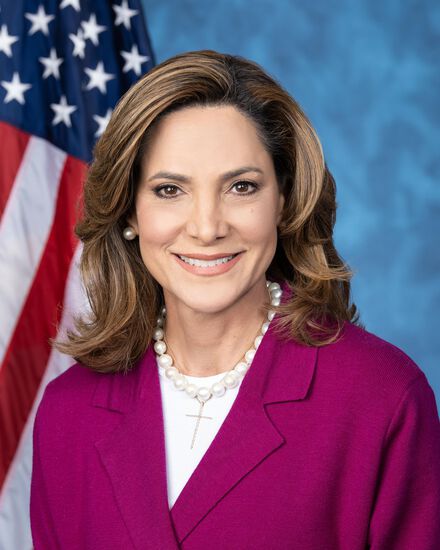
Rep. Maria Elvira Salazar
Sponsored bills
This bill requires the Department of Veterans Affairs to ensure that, if it creates a presumption of service-connection between the occurrence of a disease and exposure to an herbicide agent while serving in the Armed Forces between January 9, 1962, and June 30, 1976, at a military base in Thailand, such presumption must also apply to exposure at any military base in Thailand, regardless of where on the base the veteran was located or what military job specialty the veteran performed.
Continuous Improvement and Accountability in Organic Standards Act This bill requires the Department of Agriculture (USDA) to undertake rulemaking and other activities to implement certain recommendations of the National Organic Standards Board (a federal advisory board that considers and makes recommendations concerning the production, handling, and processing of organic products). Specifically, USDA must issue within a specified time line final rules for implementing recommendations approved (1) by the board between December 31, 2000, and the date of the bill's enactment; and (2) with at least two-thirds of the votes cast at a meeting where a quorum was present. If USDA determines issuing rules for such recommendations is not practicable, it must identify and report to Congress about the specific constraints that preclude rulemaking. In addition, the bill sets out a process and time line for USDA to implement through rulemaking future recommendations of the board that are approved by at least two-thirds of the votes cast at a meeting where a quorum was present. The bill also requires state officials or entities that certify organic farms or handling operations to report annually concerning the implementation of and compliance with any new rule or guidance.
Puppy Protection Act of 2021 This bill requires the Department of Agriculture to expand standards that govern the humane handling, care, treatment, and transportation of animals to include new requirements for commercial dog dealers. Specifically, the standards must require dog dealers to provide to dogs adequate housing, exercise, and veterinary care; appropriate and nutritious food; continuous access to potable water; and meaningful socialization with humans and compatible dogs for at least 30 minutes each day. The standards must also include requirements for breeders to use safe breeding practices and make all reasonable efforts to find humane placement for retired breeding dogs.
Traditional Cigar Manufacturing and Small Business Jobs Preservation Act of 2021 This bill exempts traditional large and premium cigars from Food and Drug Administration (FDA) regulation and FDA-assessed user fees.
No Student Exchanges with North Korean Schools Act This bill prohibits an institution of higher education (IHE) from receiving certain federal education funds if the IHE has an agreement in effect with an IHE or other organization that is directly funded by the North Korean government.
This bill prohibits the United States from rejoining the Joint Comprehensive Plan of Action (JCPOA) until the President makes specified certifications regarding Iran, including actions taken by Iran relating to its nuclear program. The JCPOA is an agreement, signed by Iran and several other world powers (including the United States), that places restrictions on Iran's nuclear program in exchange for certain sanctions relief. The United States withdrew from the JCPOA in 2018.
Nicaragua Free Trade Review Act of 2021 This bill requires the U.S. Trade Representative to submit a report on the manner and extent to which Nicaragua is in compliance with the Dominican Republic-Central America-United States Free Trade Agreement.
Defending Domestic Produce Protection Act This bill establishes a process by which a core seasonal industry may petition for countervailing and antidumping duties. A core seasonal industry means the producers (1) of a domestic like product that is a raw agricultural product, (2) whose collective output constitutes a majority of the total production in any state or group of states that accounts for a major portion of the total production during a discrete season or cyclical period of time, and (3) that make substantially all of their sales during that season or time period. The bill also provides that this process shall apply with respect to goods from Canada and Mexico.
Informed Electorate Act This bill reauthorizes through FY2027 and otherwise revises the American History for Freedom grant program. In particular, the bill allows eligible institutions of higher education to use grant funds to establish academic centers or programs that promote the importance of civic engagement and the First Amendment to the Constitution. The bill prohibits the use of grant funds to promote, endorse, teach, or distribute material related to (1) the 1619 Project, which is an initiative that addresses the beginning of slavery in the United States; or (2) critical race theory.