

Preventing Terrorist Sympathizers from Appeasing Terrorists Act This bill prohibits the revocation of the designation of the Islamic Revolutionary Guard Corps as a foreign terrorist organization except by a joint resolution of Congress. Currently, the Department of State may revoke such a designation. Such a designation carries various legal effects. For example, it is unlawful to knowingly provide material support to such an organization. Furthermore, a member of such an organization is barred from entering the United States if the member is a non-U.S. national (an alien under federal law).
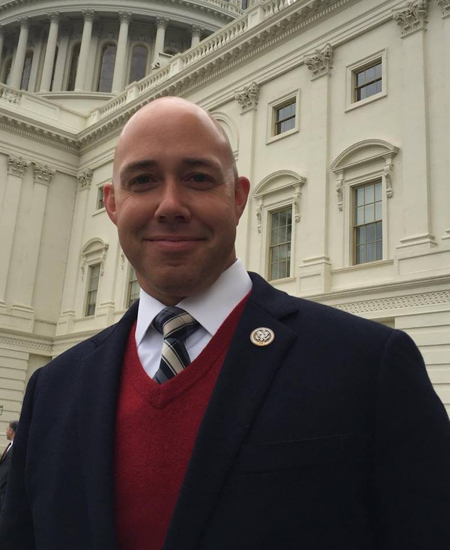
Rep. Brian J. Mast
Sponsored bills
Open App Markets Act This bill establishes rules related to the operation of an app store by a covered company (i.e., the owner or controller of an app store with more than 50 million U.S. users). An app is a software application or electronic service that may be run or directed by a user on a computer or mobile device. An app store is a publicly available website, software application, or other electronic service that distributes apps from third-party developers to users. The bill prohibits a covered company from (1) requiring developers to use an in-app payment system owned or controlled by the company as a condition of distribution or accessibility, (2) requiring that pricing or conditions of sale be equal to or more favorable on its app store than another app store, or (3) taking punitive action against a developer for using or offering different pricing terms or conditions of sale through another in-app payment system or on another app store. A covered company may not interfere with legitimate business communications between developers and users, use non-public business information from a third-party app to compete with the app, or unreasonably prefer or rank its own apps (or those of its business partners) over other apps. The bill provides for enforcement of its provisions by the Federal Trade Commission and the Department of Justice, as well as through suits brought by developers that are injured by reason of anything prohibited by this bill.
No Retaining Every Gun In a System That Restricts Your Rights Act This bill modifies the retention requirements for firearm transaction records of federal firearms licensees (FFLs) that go out of business. Current law generally requires FFLs that go out of business to deliver their firearm transaction records to the Bureau of Alcohol, Tobacco, Firearms and Explosives (ATF). This bill removes the requirement for FFLs that go out of business to deliver their firearm transaction records to the ATF. Further, the bill requires the ATF to destroy all out-of-business records it has collected from FFLs.
No Backdoor Gun Control Act of 2022 This bill removes the category of any other weapon from the definition of firearm under the National Firearms Act. The bill treats persons who acquire or possess any other weapon as meeting registration or licensing requirements under the National Firearms Act. The bill requires the Department of Justice to destroy any records relating to the registration of any other weapon not later than one year after the enactment of this bill.
Protecting Higher Education from the Chinese Communist Party Act of 2022 This bill prohibits certain members of the Chinese Communist Party (CCP) from receiving an F (academic student) or J (exchange visitor) visa. Specifically, this prohibition shall apply to any CCP member who has served in any position in the CCP since this bill's enactment. The prohibition shall also apply to a spouse, child, parent, sibling, or grandchild of such an individual. The President may waive these prohibitions by certifying to Congress that the waiver is in the U.S. national interest.
Guaranteeing Enemy Nations Omit from Criminalizing, Impeding, or Detaining Exceptional Global Athletes Magnifying Exploitation during Sporting events Act or the GENOCIDE GAMES Act This bill requires the President to impose sanctions on certain foreign individuals who materially supported a gross violation of internationally recognized human rights against a 2022 Olympic and Paralympic Winter Games participant. Upon receiving credible evidence of such a human rights violation, the President must impose property- and visa-blocking sanctions on any foreign individual associated with the International Olympic Committee (IOC), including the president of the IOC, who the President determines materially supported the violation of human rights, including by providing to participants false, reckless, or negligent assurances of human rights assurances by the government of China. This bill's requirements shall terminate on March 13, 2023.
Immigration Transparency and Transit Notification Act of 2022 This bill requires notifications to certain officials before an unaccompanied alien child or a non-U.S. national ( alien under federal law) without lawful immigration status may be placed in or transported to a state or local jurisdiction. The bill also authorizes the office of the governor of the relevant state to prohibit the placement or transportation. At least seven calendar days before taking such an action, the Department of Homeland Security (DHS) or the Department of Health and Human Services (HHS) must notify (1) the relevant state governor's office, (2) the state attorney general's office, (3) the county or municipal government, (4) local law enforcement, and (5) federal and state legislators representing the relevant jurisdiction. The action may not take place if the state governor's office objects no later than three calendar days after receiving the notification. This authority to object shall not apply if the action is to place an unaccompanied child with, or transport the child to, a family member.
Securing Enfranchisement and the Rights of Voters regardless of Inoculation Status Act or the SERVIS Act This bill prohibits requiring voters to present vaccine passports or other information regarding their COVID-19 vaccination status, and also restricts masking requirements, for voting in federal elections. Specifically, the bill makes it unlawful for any state or political subdivision to require a voter to present a vaccine passport or other information regarding the voter's COVID-19 vaccination status. Further, a state or political subdivision may require a voter to wear a mask in order to enter a polling location only under certain circumstances. In particular, the state or political subdivision must (1) make masks readily available and at no cost to the voter and to an individual who accompanies the voter, and (2) provide reasonable accommodation from such masking requirement to an individual with a disability.
Stop the Betrayal Act of 2022 This bill prohibits using federal funds to transport an unlawfully present non-U.S. national ( alien under federal law) into a U.S. region that is not within the border jurisdiction of U.S. Customs and Border Protection, unless such transportation is for (1) enforcing immigration laws, or (2) bringing an unaccompanied alien child to a Department of Health and Human Services facility.
Transparency in Government Officials Trading Act This bill advances the deadline for certain public employees and officials who must file a report of a securities transaction from 30 days after receiving notification of the transaction to within 24 hours after conducting the transaction. The bill requires that these reports be filed electronically. The bill also sets a penalty for failing to file a timely report—a fee in the amount of the transaction for which a report was not timely filed. Under existing law, the securities transaction reporting requirement applies to the President, Vice President, Members of Congress, and certain executive and legislative branch officers and employees.