

Trillion Trees Act This bills establishes a variety of requirements and incentives to plant trees and conduct other land management practices for the purposes of capturing and storing carbon in domestic and international trees and forests. Additionally, the bill provides incentives to research or develop other carbon sequestration tools. Specifically, the bill directs the Department of Agriculture (USDA) to set targets to increase forest carbon stock through January 1, 2100, for the purposes of sequestering and storing carbon in U.S. forests. It also establishes and provides funding for the Trillion Trees Challenge Fund to provide grants to nonfederal entities for activities related to reforestation efforts on public or private lands. In addition, it raises the cap on the Reforestation Trust Fund to enhance forest health in the National Forest System and requires the USDA to establish a Tree City USA Grant Program. The bill also allows the U.S. Agency for International Development to enter into an agreement with a nonprofit organization to establish an International Forest Foundation to promote reforestation and prevent deforestation. Additionally, it establishes requirements and incentives to address seedling shortages and support nurseries. Finally, the bill provides market incentives to research or develop other carbon sequestration tools relating to biochar, sustainable building practices, biochemical and bioplastic products, and biomass energy.
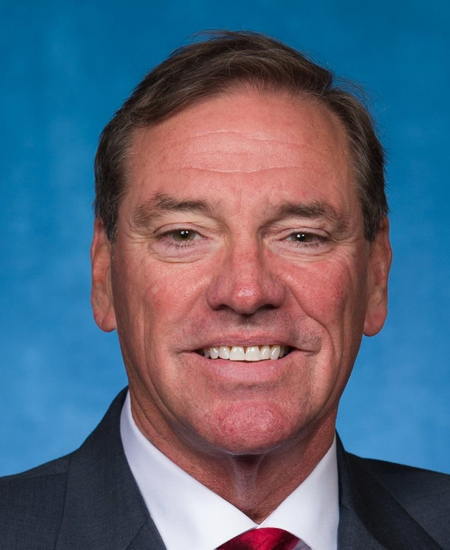
Rep. Neal P. Dunn
Sponsored bills
Flexible Financing for Rural America Act This bill allows rural utility service providers to submit to the Department of Agriculture (USDA) a request to adjust the interest rate or modify the terms of certain loans. The request shall include a report summarizing how the adjustment or modification will assist the borrower in providing critical utility services to a rural community. Specifically, on receipt of a request, USDA or the Department of the Treasury (in the case of a loan owned by the Federal Financing Bank) must adjust the interest rate on the loan to match certain interest rates for obligations of comparable maturity to the term remaining on the loan (or a higher rate requested by the borrower), and make modifications to the loan terms as necessary to address changes in the financial position of the borrower due to the COVID-19 public health emergency and to promote the financial sustainability of the borrower. In carrying out the adjustments or modifications, USDA or Treasury shall not impose or collect any fee from, or impose any penalty on, a borrower. The bill also provides funding to implement the adjustments and modifications and for the liquidation of residual intragovernmental amounts owed by the Federal Financing Bank in connection with certain loans.
This resolution condemns Representative Alexandria Ocasio-Cortez of New York, Representative Rashida Tlaib of Michigan, Representative Ilhan Omar of Minnesota, and Representative Ayanna Pressley of Massachusetts for certain comments regarding Israel. It also expresses that Representative Ocasio-Cortez, Representative Tlaib, Representative Omar, and Representative Pressley each be censured.
Accountable Care in Rural America Act This bill requires the Centers for Medicare & Medicaid Services (CMS) to exclude certain components from a methodology used under the Medicare Shared Savings Program. The program enables accountable care organizations (ACOs) to receive payments for savings stemming from care coordination and management. Specifically, the bill requires the CMS to exclude an ACO's assigned Medicare fee-for-service beneficiaries from certain regional adjustments to the ACO's benchmark for savings determinations, and to otherwise ensure that an ACO is not in a less favorable financial position due to its share of assigned beneficiaries in the region.
This joint resolution recognizes and affirms the sovereign and unilateral authority of states to defend themselves against invasion.
Patient Access to Urgent-Use Pharmacy Compounding Act of 2021 This bill relaxes certain requirements for compounding drugs that are facing shortages. Drug compounding is the process of mixing or otherwise altering drugs to create a medication. Currently, the Food and Drug Administration (FDA) allows for drug compounding subject to certain requirements. Generally a licensed pharmacist or physician not registered with the FDA may only compound drugs in limited quantities for prescriptions for a specific individual patient. On the other hand, an FDA-registered outsourcing facility may compound drugs in bulk for use in medical facilities but is subject to additional requirements. This bill allows a compounder not registered with the FDA to compound drugs in limited quantities for urgent medical need not involving a specific patient if, among other things, (1) the prescriber certifies that they are unable to obtain, despite reasonable attempts, certain related drugs with the same active ingredient and route of administration; (2) the compounded drug meets certain labeling requirements, including an indication that the compounded drug is provided only for urgent administration to a patient; and (3) the compounder requests and maintains certain records about patients receiving the compounded drug. Furthermore, a restriction against an unregistered compounder regularly compounding (or compounding inordinate amounts of) what is essentially a copy of a commercially available drug shall not apply if the drug is on a shortage list maintained by the FDA or the American Society of Hospital Pharmacists.
This resolution calls on the people of the United States to observe Memorial Day to honor the men and women who died in the pursuit of freedom and peace.
This resolution expresses support for Israel's efforts of self-determination and collective security against external forces, recognizes Jerusalem as the legitimate capital city of Israel, and condemns actions by Hamas against the people of Israel.
United States Army Rangers Veterans of World War II Congressional Gold Medal Act This bill provides for the award of a single Congressional Gold Medal to the U.S. Army Rangers Veterans of World War II in recognition of their dedicated service during World War II.
Veteran Education Empowerment Act This bill reauthorizes through FY2029 and otherwise revises a Department of Education (ED) grant program for student veteran centers. Specifically, ED must make grants to institutions of higher education (IHEs) or consortia of IHEs to establish, maintain, improve, or operate a student veteran center. A student veteran center is a dedicated space on a campus that provides students who are veterans or members of the Armed Forces with (1) a lounge or meeting space for themselves, their spouses or partners, their children, and veterans in the community; and (2) a centralized office for student veteran services that serves as a single point of contact to coordinate comprehensive support services for student veterans.