

Maddy summaryHR 404, the "Hearing Protection Act," reclassifies firearm silencers (devices that reduce gunfire noise) as firearms for federal tax and regulatory purposes. It imposes a 10% federal tax on silencers, requires the destruction of all existing federal silencer registration records within one year, and preempts state laws that tax or regulate silencers. The bill clarifies that silencers are treated as firearms under federal law, including for licensing and marking requirements, and defines "firearm silencer" to include specific components. Note: The bill’s title is misleading - it addresses firearm silencer regulation, not hearing protection for people.
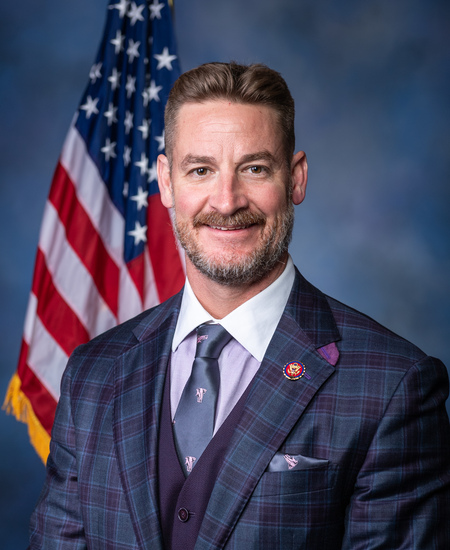
Rep. W. Gregory Steube
Sponsored bills
Maddy summaryHR 460, the CCP Visa Disclosure Act of 2025, requires international students (F/M visas) and exchange visitors (J visas) to disclose if they received or plan to receive funds from the Chinese government, the Chinese Communist Party, or entities controlled by either. This applies to both new applicants and current visa holders, mandating disclosure of fund amounts and sources via updated visa forms (I-20 or DS-2019) within 180 days of enactment. Applicants must also report any subsequent receipt of such funds within 90 days. Failure to comply may result in visa revocation, regardless of when the visa was issued. The bill directly affects individuals seeking or holding these specific nonimmigrant visas who receive funding from the specified Chinese entities.
Maddy summaryHR 461, the "Eliminate DEI in the Military Act," prohibits federal funding for diversity, equity, and inclusion (DEI) activities across all military branches, national service academies (like West Point and Annapolis), and the Department of Defense. The bill bans the use of any federal funds for DEI-related training, programs, educational materials, positions, or appointments. It directly affects military personnel, academy students, and staff by eliminating federal support for these initiatives. The key mechanism is a strict funding prohibition, not a requirement for military leaders to take specific actions.
Maddy summaryHR 458, the Protecting our Land Act, prohibits foreign adversaries and state sponsors of terrorism from purchasing any real estate (public or private) in the United States. It directly affects foreign governments, entities designated as state sponsors of terrorism, and their agents or affiliates. The bill requires the President to direct federal agencies to create rules banning these purchases, covering all U.S. states, territories, and possessions. This is a concrete policy change that restricts specific foreign ownership of U.S. land based on security designations.
Maddy summaryThis bill expands U.S. entry restrictions for immigrants suspected of security-related activities. It denies entry to anyone who engages in, or is suspected of engaging in, activities violating U.S. espionage/sabotage laws (even if done abroad), evading export controls, or seeking to oppose the U.S. government by force. It also bars spouses or children of such individuals if the security-related activity occurred within the last five years. The law applies to all potential immigrants, including those seeking visas or entry, without changing existing waiver processes.
Maddy summaryHR 453, the Religious Insignia on Dog Tags Act, requires the Secretary of Defense to update Department of Defense regulations within 90 days to permit religious symbols to be combined with official military trademarks on commercially sold dog tags. This change, effective retroactively from September 13, 2013, directly affects service members who wish to wear religious insignia on their commercial dog tags and the commercial vendors authorized to sell them. The bill’s key mechanism is amending DoD Directive 5535.12 to allow this combination, making it permissible for licensees to sell such tags. It does not change military-issued dog tags but modifies rules for commercial products.
Maddy summaryThe Protecting Dogs Subjected to Experiments Act prohibits the National Institutes of Health (NIH) from using federal funds for biological, medical, or behavioral research involving the testing of dogs. This bill directly affects NIH-funded research projects that currently use dogs for experimentation, requiring them to seek non-federal funding sources. The key provision bans the use of taxpayer money for such studies, shifting funding responsibility to private or non-governmental entities. The law does not apply to research using other animals or to non-NIH federal agencies.
Maddy summaryThe FAIR PREP Act of 2025 prohibits the IRS from preparing individual tax returns or refund claims, except for the existing IRS Free File Program and certain qualified return preparation services. It clarifies that the IRS may still provide fillable tax forms with automated calculations and correct mathematical or clerical errors without violating the prohibition. The bill also bans the IRS from developing or operating new electronic tax preparation services after enactment without explicit new congressional authorization. This directly affects how the IRS delivers tax filing assistance, preserving current free options while restricting new government-run tools.
Maddy summaryThe Safe Bases Act of 2025 requires the Department of Defense to create a single office that issues concealed firearm permits to eligible active-duty military members on all military installations. It directly affects active-duty service members who are not barred from firearm ownership under federal law (18 U.S.C. §922). The permit system must be operational within one year of the bill's enactment, allowing these members to carry concealed firearms on base without additional restrictions. The law specifically applies to military installations and does not change firearm access for civilians or non-active-duty personnel.
Maddy summaryHR 28, the *Protection of Women and Girls in Sports Act of 2025*, amends Title IX to prohibit federally funded schools from allowing male-identified individuals (based on biological sex at birth) to compete on women’s or girls’ sports teams. It explicitly states that such participation would violate federal civil rights law, with exceptions only for training/practice that doesn’t displace female athletes from roster spots, competitions, scholarships, or other benefits. The bill mandates a Comptroller General study to define "other benefits" lost by girls when males compete in single-sex sports, including impacts on psychological well-being, scholarship access, and safe participation environments. This bill directly affects all athletic programs receiving federal funding, requiring compliance with its biological-sex-based eligibility rules.