

Maddy summaryHRES 285 is a symbolic House resolution condemning multiple recent attacks on Tesla vehicles and facilities across the U.S. It specifically references at least 80 incidents of vandalism or arson involving Tesla cars and 10+ attacks on dealerships or charging stations in 9 states between February and March 2025, including Molotov cocktails, gunfire, and hate speech. The resolution does not create new laws or policies but formally expresses the House’s condemnation of these acts as domestic terrorism. It directly addresses the targeted destruction of Tesla property but has no legal effect on preventing future incidents or altering Tesla’s operations.
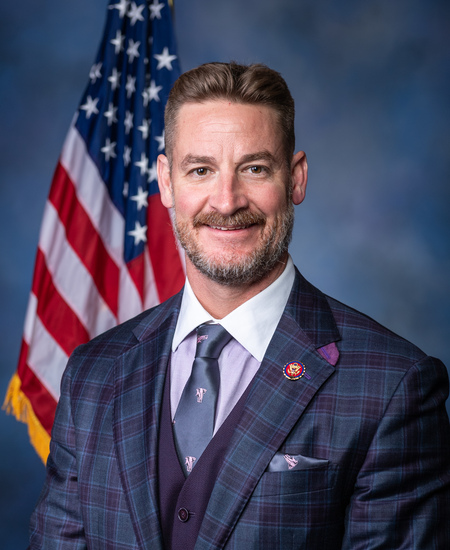
Rep. W. Gregory Steube
Sponsored bills
Maddy summaryThis bill codifies a "maximum pressure" policy toward Iran, requiring the U.S. to maintain all sanctions until Iran meets specific conditions related to its nuclear program, missile development, support for terrorism, and human rights violations. It expands sanctions on Iran's Revolutionary Guard Corps (IRGC) and entities supporting Iran's ballistic missile program, while prohibiting waivers of sanctions on these entities. The bill mandates regular reports to Congress on Iran's nuclear activities, support for terrorist groups like Hamas and Hezbollah, and human rights abuses within Iran. It also directs the use of frozen Iranian assets to support victims of state-sponsored terrorism and prevents the release of funds that could benefit Iran's terrorist proxies. The bill aims to maintain economic and diplomatic pressure on Iran until it changes its behavior across multiple fronts.
Maddy summaryHR 2581, the Iranian Terror Prevention Act, requires the U.S. government to designate 29 specific Iranian-backed militant groups as terrorist organizations within 90 days of the bill’s passage. The President must then decide within 60 days whether to impose sanctions on these groups, blocking their U.S. assets and transactions under existing law. The bill also mandates regular reports to Congress on these designations and sanctions, including for any new groups meeting the criteria. This law directly affects the 29 named groups (such as the Badr Organization and Houthis) and any entities controlled by Iran’s Islamic Revolutionary Guard Corps.
Maddy summaryHR 2499 would make Executive Order 14248 - titled "Preserving and Protecting the Integrity of American Elections" - legally binding by codifying it into law. This bill directly affects federal agencies responsible for implementing election policies, requiring them to follow the order as if it were a statute. The key mechanism is converting an existing executive directive (published in the Federal Register) into enforceable law, eliminating the need for future administrations to reissue the same guidance. It does not change election rules or procedures but ensures the order’s provisions have permanent legal standing.
Maddy summaryThe Free Speech Fairness Act (HR 2501) would amend tax law to allow 501(c)(3) organizations, such as charities and educational nonprofits, to make political campaign statements as part of their regular activities without risking their tax-exempt status. The bill specifies that these statements must be made in the ordinary course of the organization's exempt purpose and result in only minimal additional costs. This change clarifies that routine political commentary by these groups does not violate their tax-exempt status under current rules. The provision would apply to tax years beginning after the bill's enactment.
Maddy summaryThe ABC Act (HR 2491) requires the Centers for Medicare & Medicaid Services and the Social Security Administration to review and simplify eligibility processes, forms, and communications for Medicare, Medicaid, CHIP, and Social Security programs. It specifically aims to reduce duplicate paperwork for family caregivers - defined as individuals supporting people with disabilities or health needs - and improve accessibility through features like ADA-compliant websites, translation services, and reduced call wait times. The agencies must gather input from caregivers and organizations, then implement changes to streamline interactions. Within two years, they must report findings and proposed actions to Congress, with follow-up reports every two years. This procedural bill focuses on administrative improvements, not new benefits.
Save America's Forgotten Equines Act of 2025 or the SAFE Act of 2025 This bill permanently prohibits the slaughter of equines (e.g., horses and mules) for human consumption. (Current law prohibits the slaughter of dogs and cats for human consumption. This bill extends the prohibition to equines.) Specifically, this bill prohibits a person from knowingly (1) slaughtering an equine for human consumption; or (2) shipping, transporting, possessing, purchasing, selling, or donating an equine to be slaughtered for human consumption or equine parts for human consumption. The bill subjects a violator to a fine. The bill applies to conduct in or affecting interstate or foreign commerce or within the special maritime and territorial jurisdiction of the United States. However, it does not apply to an activity carried out by an Indian for a religious ceremony. As background, in recent years, the appropriations acts have prohibited the Department of Agriculture (USDA) from using federal funds to inspect horses before they are slaughtered for human consumption. Therefore, there are currently no USDA-inspected horse slaughter facilities in the United States.
Maddy summaryHR 1417 establishes a new program within the U.S. Department of Agriculture to provide tailored technical assistance to rural health care facilities. The program directly supports facilities like hospitals, clinics, and health centers in rural areas by helping them identify operational needs, improve financial management, and access USDA loan and grant programs. Key provisions include prioritizing facilities in medically underserved areas or facing financial vulnerability, with a $2 million annual funding limit for fiscal years 2026-2030. The program requires annual reports on outcomes and effectiveness to Congress, focusing on preventing facility closures and strengthening rural health care delivery.
Maddy summaryThis bill amends the tax code to allow health savings account (HSA) funds to be used tax-free for funeral expenses of the account holder. It defines covered expenses broadly - including burial, cremation, caskets, funeral services, and related costs - and sets a $5,000 annual limit per person. Expenses incurred within 90 days of the account holder’s death can be treated as if paid before death. The change applies to distributions after the bill’s enactment for eligible taxable years.
Maddy summaryThe SHORT Act (HR 2395) redefines federal firearm definitions to exclude antique and collector firearms from being classified as firearms, and removes distinctions between short-barreled rifles and shotguns in federal regulations. It prevents state laws from imposing taxes or registration requirements on short-barreled rifles and shotguns, requiring state rules to align with federal compliance instead. The bill also mandates the federal government to destroy specific records related to these firearms within one year of enactment.