

Emergency Security Supplemental Appropriations Act, 2021 This bill provides FY2021 supplemental appropriations for federal agencies to respond to the events at the U.S. Capitol Complex on January 6, 2021, and assist Afghan refugees. It also provides supplemental appropriations for the legislative branch to address COVID-19 and modifies requirements for certain programs that provide special immigrant status to eligible nationals of Afghanistan or Iraq, TITLE I--DEPARTMENT OF DEFENSE This title provides appropriations for the National Guard to respond to the events at the U.S. Capitol Complex on January 6, 2021, and for related purposes. The title also provides appropriations to the Department of Defense for overseas humanitarian, disaster, and civic aid. TITLE II--DEPARTMENT OF HEALTH AND HUMAN SERVICES This title provides appropriations to the Administration for Children and Families for refugee and entrance assistance activities. The funding must be used for activities for Afghan individuals within the United States who have been granted special immigrant status. TITLE III--LEGISLATIVE BRANCH This title provides appropriations for the legislative branch to respond to the events at the U.S. Capitol Complex on January 6, 2021, and address COVID-19. Specifically, the title provides appropriations for the Senate, the House of Representatives, the U.S. Capitol Police, U.S. Capitol Police Mutual Aid Reimbursements, and the Architect of the Capitol (AOC). The title also provides appropriations for payments to the widows and heirs of deceased Members of Congress, including (1) Susan M. Wright, widow of the late Representative Ronald Wright; and (2) the heirs of the late Representative Alcee Hastings. (Sec. 301) This section designates the wellness program of the U.S. Capitol Police as the Howard C. Liebengood Center for Wellness. (Sec. 302) This section modifies the salary cap for the U.S. Capitol Police during 2021. (Sec. 310) This section prohibits funds from being used to install permanent, above-ground fencing around the perimeter, or any portion thereof, of the U.S. Capitol Grounds. (Sec. 311) With congressional approval, the AOC may accept contributions of, and incur obligations and make expenditures out of available appropriations for, supplies, products, and services necessary to respond to an emergency involving the safety of human life or the protection of property, as determined or declared by the Capitol Police Board. TITLE IV--BILATERAL ECONOMIC ASSISTANCE This title provides appropriations to the Department of State for migration and refugee assistance to address humanitarian needs in Afghanistan and to assist Afghan refugees. The title also provides appropriations to the State Department for the United States Emergency Refugee and Migration Assistance Fund. (Sec. 401) This section increases the number of special immigrant visas available to qualified Afghan nationals who worked for the U.S. government or a North Atlantic Treaty Organization (NATO) mission in Afghanistan, extends the deadline for applying for such visas, and relaxes certain qualifications. All applicants for such a visa must establish that the applicant was employed with the U.S. government or a NATO mission for one year, where currently some applicants must prove two years of employment. This section also eliminates a requirement that the applicant faces an ongoing serious threat in Afghanistan due to such employment. Furthermore, for an applicant qualifying for a visa by performing duties for U.S. military personnel stationed with a NATO mission, this section eliminates a requirement that the duties performed qualify as sensitive and trusted duties. This section also relaxes limits to appealing rejections for applications for such visas. (Sec. 402) This bill authorizes the State Department and the Department of Homeland Security (DHS) to jointly postpone the medical exam requirement for individuals seeking entry into the United States under the program described in Section 401. If an individual receives such a postponement, DHS shall ensure to the greatest extent possible that individual undergoes a medical exam no later than 30 days after admission into the United States. Such an individual's status as a lawful permanent resident shall be conditional until the individual undergoes the required medical exam. (Sec. 403) This section modifies the immigration benefits of the surviving family members of certain deceased individuals. The surviving spouse or child of a U.S. government employee abroad shall qualify as a special immigrant if that employee performed at least 15 years of faithful service or was killed in the line of duty. This section also expands surviving family member benefits for certain programs that provide special immigrant status to eligible nationals of Afghanistan or Iraq, including the program described in Section 401. Specifically, if an individual submitted an application to the Chief of Mission that included an accompanying spouse or child and that application would have been approved but for the individual's death, the surviving spouse or child shall remain eligible to receive a visa under the respective program. Currently, such survivor rights only apply if the deceased individual's petition was approved. (Sec. 404) If an individual has an approved petition under a program that provided special immigrant status to translators who worked for the Armed Forces in Afghanistan or Iraq but a visa is not immediately available, the State Department or DHS may convert that petition to an approved petition under another program which provides special immigrant status to certain Iraqi nationals, if there are visas available under that second program. (DHS and the State Department currently only have the authority to convert petitions filed before October 1, 2008.) TITLE V--DEPARTMENT OF JUSTICE This title provides appropriations to the Department of Justice (DOJ) for state and local law enforcement assistance. DOJ must use the funds for restoring funds that were used for extraordinary law enforcement and related costs directly associated with protection of the President-elect from November 4, 2020, until the inauguration of the President-elect as President. TITLE VI--GENERAL PROVISIONS--THIS ACT (Sec. 601) This section specifies that the funds provided by this bill are in addition to funds otherwise appropriated for the fiscal year involved. (Sec. 602) Funds provided by this bill may not remain available beyond the current fiscal year, unless this bill provides otherwise. (Sec. 603) Unless otherwise specified by this bill, the funds provided by this bill are subject to the authorities and conditions that apply to the applicable appropriations account for FY2021. (Sec. 604) This section specifies that funding provided by this bill may only be used for the purposes specifically described in the bill. The section includes an exception for funds used to restore amounts for obligations incurred prior to the date of the enactment of this bill. (Sec. 605) This section specifies that the term coronavirus in this bill means SARS-CoV-2 or another coronavirus with pandemic potential. (Sec. 606) This section provides that amounts designated by this bill as emergency requirements are only available (or rescinded or transferred, if applicable) if the President subsequently designates the amounts and transmits the designations to Congress. (Sec. 607) This section specifies that the emergency funds that are transferred pursuant to this bill retain the emergency designation.
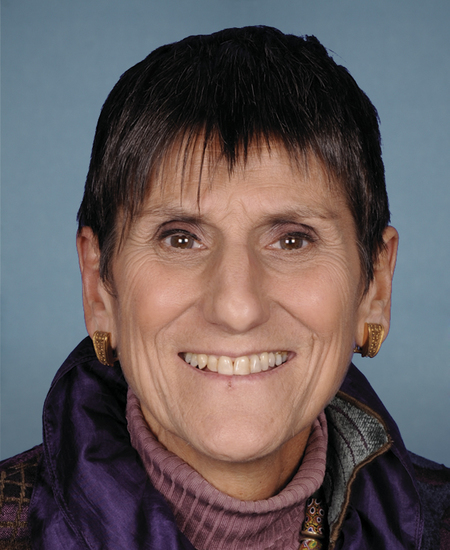
Rep. Rosa L. DeLauro
Sponsored bills
Closing the Meal Gap Act of 202 1 This bill revises the requirements for calculating Supplemental Nutrition Assistance Program (SNAP) benefits. The bill increases the minimum SNAP benefit and requires benefits to be calculated using the value of a low-cost food plan. The Department of Agriculture (USDA) must determine the requirements for the low-cost food plan, which is the diet required to feed a family of four, consisting of a man and a woman 19-50 years of age, a child 6-8 years of age, and a child 9-11 years of age. USDA must (1) reevaluate and publish the market baskets of the plan by January 1, 2027, and every five years thereafter, based on current food prices, food composition data, consumption patterns, and dietary guidance; and (2) make adjustments to the plan to account for household size, changes in the cost of the diet, and the costs of food in specified areas. The bill modifies the requirements for calculating household income to determine SNAP eligibility by (1) authorizing a standard medical expense deduction for households containing an elderly or disabled member, and (2) eliminating the cap on the excess shelter expense deduction. The bill eliminates certain work requirements for SNAP. The requirements apply to able-bodied adults who are ages 18-49 and have no dependent children. The bill allows Puerto Rico, American Samoa, and the Northern Mariana Islands to participate in SNAP. Currently, the three territories receive block grants instead of participating in SNAP.
Food Chemical Reassessment Act of 2021 This bill establishes the Office of Food Safety Reassessment within the Center for Food Safety and Applied Nutrition and addresses related issues. The office must conduct reassessments of additives, food contact substances, and other related substances to ensure that such substances are safe. Specifically, every three years, the office must reassess the safety of at least 10 substances or classes of substances, including those that are generally recognized as safe for use in food. The office must issue final regulations relating to the safety of each reassessed substance. The bill also specifies 10 substances that the office must assess in its first review. The Food and Drug Administration (FDA) must reestablish the Food Advisory Committee to advise the FDA on issues related to the substance assessments required by this bill.
Close the Medigap Act of 2021 This bill (1) expands guaranteed issue rights with respect to Medigap policies (Medicare supplemental health insurance policies), (2) eliminates certain limitations on Medigap policies for newly eligible Medicare beneficiaries, and (3) modifies other provisions related to Medigap policies. (Guaranteed issue rights require that a policy be offered to any eligible applicant without regard to health status.)
United States Call Center Worker and Consumer Protection Act of 2021 This bill establishes restrictions on businesses that relocate call centers or redirect customer service calls to locations outside the United States. Specifically, a business must notify the Department of Labor that it intends to move its customer service call center overseas and Labor must maintain a publicly available list of such businesses. Subject to narrow exceptions, a business appearing on such list is ineligible to receive federal grants or guaranteed loans for five years after the business is added to the list. Further, agencies must condition the awarding of government contracts on the requirement that any call center activity pursuant to the contract must be performed in the United States. Additionally, the bill requires call center employees to disclose their physical location at the beginning of each call initiated or received, unless all employees of the business participating in the communication are located in the United States, among other exceptions.
This resolution expresses the sense of the House of Representatives that the U.S. Women's National Soccer Team and the U.S. Men's National Soccer Team should receive equal pay.
Supporting Medicaid in the U.S. Territories Act of 2021 This bill extends, increases, and otherwise modifies Medicaid funding for U.S. territories. Specifically, the bill extends (1) the temporarily increased Federal Medical Assistance Percentage (i.e., federal matching rate), and (2) a higher cap on Medicaid funding. Such provisions apply to Puerto Rico through FY2026 and to other territories through FY2029. The bill also requires Puerto Rico to implement an asset verification program and to report on its ability to comply with certain reporting requirements, procurement standards, and other Medicaid program integrity measures.
Comprehensive Paid Leave for Federal Employees Act This bill provides paid family and medical leave to federal employees. Currently, federal employees are entitled to 12 weeks of administrative leave for one or more of the following reasons: (1) the birth of a child, (2) the adoption or foster care of a child, (3) the care of an immediate family member with a serious health condition, (4) inability to work due to a serious health condition, and (5) exigencies relating to an immediate family member's active duty service in the Armed Forces. However, of these reasons, employees are entitled to paid administrative leave only in connection with the birth, adoption, or foster care of a child (i.e., parental leave). The bill provides 12 weeks of paid administrative leave for any of these reasons, and specifies that this leave is in addition to any annual or sick leave to which employees are entitled.
National Infrastructure Development Bank Act of 2021 This bill establishes the National Infrastructure Development Bank as a government corporation to finance energy, environmental (e.g., drinking water or waste facilities), telecommunications, and transportation infrastructure projects. The bill establishes the National Infrastructure Development Bank Board, which must oversee the infrastructure projects. The board may make loans and loan guarantees to assist in financing infrastructure projects. Further, the board must establish an executive committee, a risk management committee, an audit committee, and a compliance office. To be eligible for financial assistance from the bank, an infrastructure project (1) must have a public benefit, as determined by the board; and (2) may not have a sole use or purpose that is private. An infrastructure project must use iron, steel, and manufactured products that are made in the United States. The bill also establishes accounting and reporting requirements. In particular, the Government Accountability Office must, within five years of this bill's enactment, submit a report to Congress evaluating the bank's activities.
This bill reauthorizes through FY2022 and otherwise revises the Centers for Disease Control and Prevention (CDC) national awareness campaign regarding gynecologic cancers. The CDC must target specified populations of women at higher risk for gynecologic cancers in the campaign. Additionally, the CDC may establish a grant program to evaluate different strategies to increase knowledge and awareness of gynecologic cancers among women and health care providers. In awarding these grants, the CDC must give preference to (1) grantees with expertise in gynecologic cancer education or treatment or expertise in working with groups of women at increased risk of such cancers; and (2) projects that will establish links between health care providers, hospitals, insurance companies, and state health departments.