This resolution expresses the sense of the House of Representatives that policies concerning medication abortions should be grounded in science, be based on a review of medical evidence, and ensure equitable access for patients.
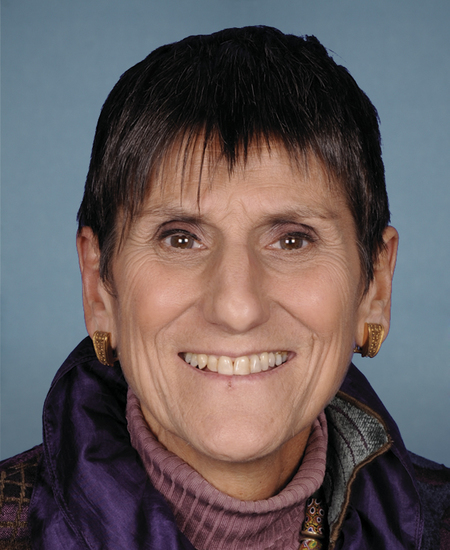
Rep. Rosa L. DeLauro
Sponsored bills
This resolution supports the designation of National Health Care Awareness Month.
Creative Economy Revitalization Act This bill requires the Department of Labor to award grants to government and nonprofit agencies to provide programs that employ individuals and provide public access to art or arts programming.
Affordable Pricing for Taxpayer-Funded Prescription Drugs Act of 2021 This bill requires companies that receive federal funding for research (or a license of the rights to a patent or regulatory test data) for a biomedical product or service to agree to set reasonable prices for the resulting biomedical product or service. The Department of Health and Human Services (HHS) must determine a reasonable price based on a formula that ensures the U.S. price for the product or service is not more than the median price for the product or service in Canada and six other reference countries with, based on specified criteria, large economies and high incomes. Companies entering these agreements also must report to HHS certain financial information related to the biomedical product or service involved.
9/11 Responder and Survivor Health Funding Correction Act This bill increases funding for and otherwise modifies a federal program that provides medical monitoring and treatment to responders and survivors who suffer from health conditions related to the September 11, 2001, attacks on the World Trade Center. Among the changes, the bill allows certain health care providers other than physicians to determine whether an individual's health condition is related to the attacks, and it establishes a research program to study the impacts of the attacks on health and educational outcomes of individuals who were 21 years of age or younger when the attacks occurred.
Food Labeling Modernization Act of 2021 This bill imposes additional labeling requirements for food and addresses related issues. A food intended for human consumption must include on its principal display panel a summary of nutritional information using a system that (1) clearly distinguishes between products of greater or lesser nutritional value; and (2) uses standardized symbols to provide warning about products that are high in certain substances, such as trans fats. The Food and Drug Administration (FDA) must promulgate regulations establishing the requirements for such a system. Labels that use certain terms, such as whole wheat , fruit , or vegetable , must include additional information, such as the amount or quantity of that item in the food. The FDA must promulgate certain regulations relating to the use of the terms natural or healthy on food labels. The bill also imposes labeling requirements for certain foods that contain added coloring, added flavoring, phosphorus, caffeine, gluten, allulose, polydextrose, sugar alcohols, or isolated fibers. The FDA may, by regulation, deem a food ingredient to be a major food allergen. The FDA must also impose certain restrictions on the types of beverages that may be identified as infant formula or formula. The FDA must require food manufacturers to submit all information on the label of a food offered for sale in package form and update such submissions as necessary. The information must be made available in a public database on the FDA's website.
This concurrent resolution recognizes the disparity in wages paid to Black women and its impact on women, families, and the nation, and reaffirms Congress' support for ensuring equal pay and closing the gender wage gap.
Labor, Health and Human Services, Education, Agriculture, Rural Development, Energy and Water Development, Financial Services and General Government, Interior, Environment, Military Construction, Veterans Affairs, Transportation, and Housing and Urban Development Appropriations Act, 2022 This bill provides FY2022 appropriations for several federal departments and agencies. It includes 7 of the 12 regular FY2022 appropriations bills: the Departments of Labor, Health and Human Services, and Education, and Related Agencies Appropriations Act, 2022; the Agriculture, Rural Development, Food and Drug Administration, and Related Agencies Appropriations Act, 2022; the Energy and Water Development and Related Agencies Appropriations Act, 2022; the Financial Services and General Government Appropriations Act, 2022; the Department of the Interior, Environment, and Related Agencies Appropriations Act, 2022; the Military Construction, Veterans Affairs, and Related Agencies Appropriations Act, 2022; and the Transportation, Housing and Urban Development, and Related Agencies Appropriations Act, 2022. The departments, agencies, and activities funded in the bill include the Department of Labor, the Department of Health and Human Services, the Department of Education, the Department of Agriculture, the Food and Drug Administration, the civil works projects of the U.S. Army Corps of Engineers, the Department of Energy, the Bureau of Reclamation, the Department of the Treasury, the Executive Office of the President, the judiciary, the District of Columbia, the Department of the Interior, the Environmental Protection Agency, the Forest Service, Department of Defense military construction and family housing activities, the Department of Veterans Affairs, the Department of Transportation, the Department of Housing and Urban Development, and several related and independent agencies.

Domestic Workers Bill of Rights Act This bill provides rights and protections for domestic workers (e.g., housekeepers, nannies, caretakers, personal assistants, and chauffeurs), including pay and leave rights, and health and safety protections. Specifically, the bill repeals the exemption of domestic live-in employees from certain minimum wage and maximum hour requirements. Employers must provide written notice of termination and provide at least 30 days of lodging and two weeks of severance pay to terminated live-in employees. Live-in employees also must be provided with reasonable access to telephone and internet service during their employment. The bill requires employers to provide domestic workers with a written agreement covering wages, sick leave, benefits, and other matters. Further, domestic workers may request and be granted changes to work schedules due to personal events. The bill also provides domestic workers with certain privacy rights, extends to domestic workers protections against discrimination in employment, and increases the federal medical assistance percentage (FMAP) for certain Medicaid-funded medical services provided by domestic workers. The Department of Labor must (1) award grants for a domestic worker national hotline for reporting emergencies, training on hazards facing domestic workers, and workforce investment activities for domestic workers; and (2) establish a Domestic Worker Wage and Standards Board to investigate standards in the domestic workers industry. Labor must publish online a document that describes the rights and protections for domestic workers under this bill.
Protecting Renters from Evictions Act of 2021 This bill extends through December 31, 2021, the order issued by the Centers for Disease Control and Prevention titled Temporary Halt in Residential Evictions To Prevent the Further Spread of COVID–19 and published on September 4, 2020.