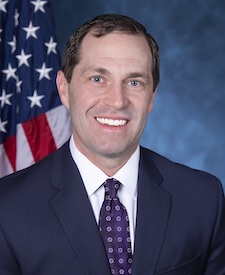
Photo of Jason Crow
D United States House · District 6 · Colorado On the 2026 ballot

Rep. Jason Crow

Compare
Total votes
2,837
all sessions
Attendance
98%
63 missed
Higher than 85% of chamber peers
With party
98%
of cast votes
Near the chamber average
Bipartisan score
1%
crosses aisle rarely
Near the chamber average
Sponsored
1,327
bills & resolutions
Near the chamber average
Committees
6
assignments
1,327 bills and resolutions

Sponsored bills

Total
1,327
Primary
129
Co-sponsor
1,198
This page
1,327
matching current filters
Co-sponsor HR 746
In committee · Indiana House · Co-sponsor
Ensuring Survivor Benefits during COVID–19 Act of 2021

Ensuring Survivor Benefits during COVID-19 Act of 2021 This bill requires the Department of Veterans Affairs to get a medical opinion to determine if a service-connected disability was the principal or contributory cause of death in situations where a veteran's death certificate identifies COVID-19 (i.e., coronavirus disease 2019) as the principal or contributory cause of death, the certificate does not clearly identify any of the veteran's service-connected disabilities as the principal or contributory cause of death, and a claim for dependency and indemnity compensation is filed with respect to the veteran.

In committee Mar 16, 2021 1 co-sponsor
Co-sponsor HR 492
In committee Mar 16, 2021 1 co-sponsor
Co-sponsor HR 1813
In committee · Indiana House · Co-sponsor
FASTER Act

Funding for Aviation Screeners and Threat Elimination Restoration Act or the FASTER Act This bill repeals the requirement that a portion of aviation security service fees collected from passengers be credited as offsetting receipts and deposited in the general fund of the Treasury. It requires such fees to be deposited into a separate account in the Treasury for expenditure to pay only the costs of activities and services for which the fee is imposed (i.e., aviation security screening).

In committee Mar 12, 2021 1 co-sponsor
Co-sponsor HR 1854
In committee · Indiana House · Co-sponsor
RECRUIT Act of 2021

Reserve Employers Comprehensive Relief and Uniform Incentives on Taxes Act of 2021 or the RECRUIT Act of 2021 This bill allows employers with less than 500 employees a new tax credit for 40% of the wages paid to a member of the National Guard or a reserve component of the Armed Forces. The employer may elect to claim a payroll tax credit for wages paid to such service members.

In committee Mar 11, 2021 1 co-sponsor
Co-sponsor HR 1785
In committee · Indiana House · Co-sponsor
No Tax Breaks for Outsourcing Act

No Tax Breaks for Outsourcing Act This bill modifies the tax treatment of the foreign source income of domestic corporations. The bill includes provisions that modify calculations of the gross income of U.S. shareholders to include net CFC tested income in the current taxable year, apply limitations on the foreign tax credit on a country-by-country basis, limit the tax deduction for the interest expense of a U.S. corporation that is a member of a financial reporting group (i.e., a group that prepares consolidated financial statements according to generally accepted accounting principles or international financial reporting standards), modify the rules for the taxation of inverted corporations (i.e., U.S. corporations that acquire foreign companies to reincorporate in a foreign jurisdiction with income tax rates lower than the United States), and treat certain foreign corporations managed and controlled primarily in the United States as domestic corporations for tax purposes.

In committee Mar 11, 2021 1 co-sponsor
Co-sponsor HR 842
Passed · Indiana House · Co-sponsor
Protecting the Right to Organize Act of 2021

Protecting the Right to Organize Act of 20 21 This bill expands various labor protections related to employees' rights to organize and collectively bargain in the workplace. Among other things, it (1) revises the definitions of employee , supervisor , and employer to broaden the scope of individuals covered by the fair labor standards; (2) permits labor organizations to encourage participation of union members in strikes initiated by employees represented by a different labor organization (i.e., secondary strikes); and (3) prohibits employers from bringing claims against unions that conduct such secondary strikes. The bill also allows collective bargaining agreements to require all employees represented by the bargaining unit to contribute fees to the labor organization for the cost of such representation, notwithstanding a state law to the contrary; and expands unfair labor practices to include prohibitions against replacement of, or discrimination against, workers who participate in strikes. The bill makes it an unfair labor practice to require or coerce employees to attend employer meetings designed to discourage union membership and prohibits employers from entering into agreements with employees under which employees waive the right to pursue or a join collective or class-action litigation. The bill further prohibits employers from taking adverse actions against an employee, including employees with management responsibilities, in response to that employee participating in protected activities related to the enforcement of the prohibitions against unfair labor practices (i.e., whistleblower protections). Such protected activities include providing information about a potential violation to an enforcement agency, participating in an enforcement proceeding, initiating a proceeding concerning an alleged violation or assisting in such a proceeding, or refusing to participate in an activity the employee reasonably believes is a violation of labor laws. Finally, the bill addresses the procedures for union representation elections, provides employees with the ability to vote in such elections remotely by telephone or the internet, modifies the protections against unfair labor practices that result in serious economic harm, and establishes penalties and permits injunctive relief against entities that fail to comply with National Labor Relations Board orders.

Passed Mar 11, 2021 1 co-sponsor
Co-sponsor HR 1
Passed · Indiana House · Co-sponsor
For the People Act of 2021

For the People Act of 2021 This bill addresses voter access, election integrity and security, campaign finance, and ethics for the three branches of government. Specifically, the bill expands voter registration (e.g., automatic and same-day registration) and voting access (e.g., vote-by-mail and early voting). It also limits removing voters from voter rolls. The bill requires states to establish independent redistricting commissions to carry out congressional redistricting. Additionally, the bill sets forth provisions related to election security, including sharing intelligence information with state election officials, supporting states in securing their election systems, developing a national strategy to protect U.S. democratic institutions, establishing in the legislative branch the National Commission to Protect United States Democratic Institutions, and other provisions to improve the cybersecurity of election systems. Further, the bill addresses campaign finance, including by expanding the prohibition on campaign spending by foreign nationals, requiring additional disclosure of campaign-related fundraising and spending, requiring additional disclaimers regarding certain political advertising, and establishing an alternative campaign funding system for certain federal offices. The bill addresses ethics in all three branches of government, including by requiring a code of conduct for Supreme Court Justices, prohibiting Members of the House from serving on the board of a for-profit entity, and establishing additional conflict-of-interest and ethics provisions for federal employees and the White House. The bill requires the President, the Vice President, and certain candidates for those offices to disclose 10 years of tax returns.


Passed Mar 11, 2021 1 co-sponsor
Co-sponsor HR 1730
In committee · Indiana House · Co-sponsor
Speeding Therapy Access Today Act of 2021

Speeding Therapy Access Today Act of 2021 This bill requires and authorizes various actions to accelerate the development of therapies for rare diseases. The Food and Drug Administration (FDA) shall establish the Intercenter Institute on Rare Diseases and Conditions. The institute shall (1) coordinate engagement with relevant stakeholders, (2) build the FDA's expertise in the review of medical products to treat rare diseases, (3) coordinate regulatory science initiatives related to rare diseases, (4) establish and implement a program to make recommendations to address challenges associated with developing medical products to treat rare diseases in an individual or in very small populations, (5) convene a stakeholder meeting to consider potential amendments to labels for medical products to treat rare diseases, and (6) establish and carry out a program to facilitate voluntary communication between the sponsors of such medical products and third-party payers (e.g., insurance companies). The bill also authorizes the FDA to make grants to assist in developing practices related to the development and production of individualized therapies or therapies to treat very small populations. The bill also establishes an advisory committee to advise the FDA on issues related to the development of therapies to treat rare diseases.

In committee Mar 10, 2021 1 co-sponsor
Co-sponsor HR 1677
In committee · Indiana House · Co-sponsor
KEEP Telehealth Options Act of 2021

Knowing the Efficiency and Efficacy of Permanent Telehealth Options Act of 2021 or the KEEP Telehealth Options Act of 2021 This bill requires certain agencies to report on the availability and effects of expanded telehealth services under Medicare, Medicaid, and the Children's Health Insurance Program (CHIP) during the public health emergency relating to COVID-19. Among other information, the Department of Health and Human Services must detail its actions during the emergency to expand access to telehealth services and must analyze telehealth usage by certain demographic groups. The Medicare Payment Advisory Commission and the Medicaid and CHIP Payment and Access Commission must report on the improvements and barriers to telehealth access during the emergency and the risks of fraudulent activity associated with expanded access.

In committee Mar 10, 2021 1 co-sponsor
Showing 1,251 to 1,260 of 1,327 bills