

Maddy summaryHRES 471, the "Restoring Integrity in Democracy Resolution," would amend House rules to prohibit current and future House members (including delegates and resident commissioners) from serving on the boards of for-profit companies. The key provision adds a new rule to the House's procedural rules, explicitly banning such board positions to address potential conflicts of interest. This change would directly affect all House members by restricting their outside business activities while in office. The resolution is a procedural rule change, not a law affecting the public, and aims to strengthen ethical standards within the House.
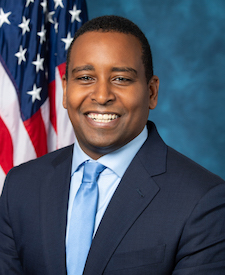
Rep. Joe Neguse
Sponsored bills
Maddy summaryHR 3734, the Stop MUSK Act, amends federal ethics law to require high-level government officials to recuse themselves from decisions involving entities with which they had financial ties in the past four years. It directly affects executive branch leaders (including those in the Executive Schedule) and special government employees who previously worked for or had financial relationships with organizations like corporations, nonprofits, or consulting firms. The key provision expands the recusal requirement to cover any former employer or financial interest held during the preceding four years, including roles as an employee, contractor, consultant, or competitor. This aims to prevent conflicts of interest by mandating transparency when officials engage with entities tied to their prior careers.
Maddy summaryHR 3707, the NSF and USDA Interagency Research Act, requires the U.S. Department of Agriculture (USDA) and the National Science Foundation (NSF) to coordinate research efforts through formal agreements. It directs them to jointly fund collaborative projects focused on agricultural challenges, food security, rural economic development, and emerging technologies like AI and precision agriculture. The bill establishes mechanisms for awarding grants to universities, community colleges, and nonprofits to create centers for agricultural research and workforce development, while mandating annual reports to Congress on coordination progress. This legislation directly affects USDA, NSF, and institutions seeking federal research funding in agricultural science.
Maddy summaryThis bill repeals key provisions of the Protection of Lawful Commerce in Arms Act (PLCAA), which previously shielded gun manufacturers and dealers from civil lawsuits. It allows gun trace data from the federal Firearms Trace System to be used as evidence in civil court cases involving gun violence. Victims of gun violence (or their families) who sue gun manufacturers, dealers, or distributors in state or federal court can now access and rely on this trace information. The bill directly changes the legal landscape by removing a major barrier to holding gun industry entities accountable in civil cases. It does not alter criminal proceedings or affect gun ownership rights.
Maddy summaryHR 3735, the IG Act of 2025, creates a new Inspector General (IG) position for the Executive Office of the President and strengthens protections for existing federal IGs. The bill requires the President to appoint an IG for the White House office within 90 days and prohibits removing any IG except for "inefficiency, malfeasance of office, or neglect of duty." It applies to IGs across most federal agencies but allows agency heads to remove IGs for independent agencies (like the Nuclear Regulatory Commission or Federal Trade Commission) under the same strict standards. The law aims to ensure IG independence by limiting political interference in their oversight roles.
Maddy summaryThis resolution (HRES 457) is a symbolic measure expressing congressional support for designating June 6, 2025, as "National Gun Violence Awareness Day" and June 2025 as "National Gun Violence Awareness Month." It does not create new laws or policies but encourages public awareness through specific actions: wearing orange on June 6, focusing on gun safety during summer months, and holding community discussions. The resolution references statistics on gun violence deaths and honors Hadiya Pendleton, a teen victim killed in 2013. It directly affects the public by calling for voluntary observance and community engagement, not government mandates.
Maddy summaryHR 3694, the VALID Act of 2025, requires lenders to include specific information about VA loans in mortgage disclosures. It amends the National Housing Act to mandate that disclosures state the loan-to-value ratio and clarify that VA loans are available under Chapter 37 of Title 38 (veterans' benefits law), assuming prevailing interest rates. The bill also requires the Federal Housing Finance Agency to add a military service question to the Uniform Residential Loan Application form, placing it above the signature line within six months of enactment. This directly affects veterans and active-duty service members applying for VA-guaranteed mortgages, as well as the lenders processing those applications.
Maddy summaryThis bill aims to stabilize rural hospitals by modifying Medicare payment policies. It eliminates sequestration for rural hospitals, reverses bad debt reimbursement cuts for critical access hospitals, and permanently extends payment levels for low-volume and Medicare-dependent hospitals. The bill also makes permanent telehealth enhancements for rural health clinics, restores state authority to waive the 35-mile rule for hospital designations, and creates flexibility grants for rural hospitals to transform services. These changes directly affect rural hospitals, critical access hospitals, and Medicare beneficiaries who face significant barriers to accessing care in rural areas. The bill addresses the closure of 151 rural hospitals since 2010 and the vulnerability of 432 more hospitals, aiming to prevent further loss of critical health care access.
Maddy summaryHR 3680, the "No Corporate Crooks Act," prohibits individuals convicted of specific serious financial crimes from serving in the U.S. executive branch. It directly affects corporate executives (like CEOs) who have been finally convicted of offenses including bribery, fraud, embezzlement, tax evasion, or wage theft. The bill makes such individuals ineligible for appointment to any executive branch position. The key provision is a mandatory ineligibility requirement triggered by a final conviction for any listed covered crime.
Maddy summaryThe SAFE Sunscreen Standards Act (HR 3686) requires the FDA to update its approval process for sunscreen ingredients by establishing new standards that allow real-world evidence and non-animal testing methods to demonstrate safety and effectiveness. It directs the FDA to incorporate historical safety data from previously approved ingredients into pending applications and issue guidance on non-animal testing within 180 days. The bill also mandates annual reports to Congress on the implementation of these standards and the FDA’s progress in adopting alternative testing methods. This legislation aims to modernize a regulatory system that has not approved new sunscreen ingredients since 1999, potentially accelerating access to safer, more effective products.