

Maddy summaryHR 1729, the Bolts Ditch Act, adds two Colorado water authorities to the list of entities permitted to maintain Bolts Ditch and its headgate under existing law. Specifically, it authorizes the Eagle River Water and Sanitation District and the Upper Eagle Regional Water Authority to manage these water infrastructure components. This is a technical amendment with no new policy changes, directly affecting these two Colorado water management entities.
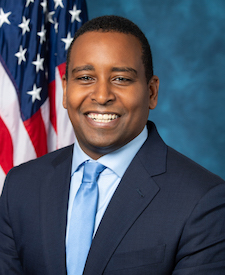
Rep. Joe Neguse
Sponsored bills
Maddy summaryThis non-binding House resolution (HRES 577) demands that the current administration immediately release all unclassified federal documents related to Jeffrey Epstein, including flight logs, correspondence, and evidence. It specifically requires the release of materials involving Epstein, Ghislaine Maxwell, and known associates, with redactions only to protect minor victims' identities and ongoing prosecutions. The resolution also calls for the Department of Justice and FBI to submit a report on any delays or evidence suppression related to the case. As a resolution, it does not create new law but serves as a formal congressional demand for transparency regarding Epstein-related investigations.
Maddy summaryThe Tribal Access to Clean Water Act of 2025 provides federal funding to address the lack of clean water and sanitation on Tribal lands and for the Native Hawaiian Community. The bill authorizes $100 million annually for USDA water infrastructure loans and grants, $500 million annually for Indian Health Service sanitation facilities, $100 million annually for operation and maintenance of water systems, and $30 million annually for technical assistance to help Tribal communities access and manage water infrastructure funding. It specifically expands eligibility to include Native Hawaiian organizations, addresses gaps in previous infrastructure funding, and requires no matching contributions from Tribal communities. The bill targets the situation where nearly half of households on Tribal lands lack reliable water sources and basic sanitation.
Maddy summaryHCONRES 42 is a symbolic congressional resolution recognizing the persistent wage gap between Black women and White, non-Hispanic men in the U.S. It highlights that Black women earn 66 cents for every dollar earned by White, non-Hispanic men working full-time year-round, with the gap taking over 200 years to close at current rates. The resolution emphasizes how this disparity - rooted in both racial and gender discrimination - impacts Black women’s ability to afford essentials like education, childcare, and housing. It does not create new laws or policies but formally acknowledges the issue on Black Women’s Equal Pay Day (July 10, 2025) and reaffirms support for equal pay.
Maddy summaryHRES 575 is a symbolic resolution designating July 10th as "Journeyman Lineworkers Recognition Day." It honors lineworkers who face significant risks daily - working at heights near live wires and responding to disasters like hurricanes and wildfires. The resolution specifically references Henry Miller, an early leader of the International Brotherhood of Electrical Workers, who died on July 10, 1896, while troubleshooting an outage. It encourages the public to recognize these workers' contributions but does not create new laws or allocate funding.
Maddy summaryHR 4329, the Building Civic Bridges Act, creates an Office of Civic Bridgebuilding within the Corporation for National and Community Service to support projects reducing community divisions. It establishes a 3-year pilot grant program funding nonprofits, community groups, and schools to run projects that foster respect across diverse communities, address unmet needs like health or safety concerns, and improve social cohesion. Grants require projects to use research-based approaches, engage polarized communities, ensure participant safety, and track outcomes using standardized criteria. The program is funded exclusively through existing donations (not new federal funds) and mandates consultation with diverse community leaders and researchers. The Office will also compile research on civic bridgebuilding best practices for public access.
Maddy summaryHR 4296, the CROP for Farming Act, amends existing federal conservation programs to expand eligible practices for farmers. It updates the Food Security Act of 1985 to explicitly include reducing greenhouse gas emissions (like nitrous oxide or methane) and increasing carbon storage in plants or soil as qualifying conservation activities under incentive contracts. This directly affects farmers enrolled in these programs by broadening the types of environmental practices they can pursue for program benefits. The key change modifies two specific sections of the law to add these new criteria to the existing conservation requirements.
Maddy summaryHR 4268, the "Remembering Our Local Heroes Act," creates a federal grant program to fund memorials honoring veterans, fallen service members, law enforcement officers, and firefighters. The program, authorized for $2 million annually (2026-2030), provides grants up to $100,000 per project to local governments or nonprofits for constructing, restoring, or maintaining eligible memorials - such as statues, plaques, or gardens - commemorating individuals who served since 1917 or performed acts of bravery. Applicants must provide at least 50% local matching funds (including in-kind support), and grants prioritize community-supported projects honoring those with exemplary public service or bravery. The bill directly affects local communities seeking to preserve memorials for specific service groups, with no funding for interior displays or non-commemorative structures.
Maddy summaryThis bill expands the requirement for federal firearm licensees (FFLs) to report multiple firearm sales. It modifies existing law to require reporting on all firearms, not just handguns (pistols or revolvers), when a single transaction involves two or more firearms. This change directly affects FFLs who sell multiple firearms at once, such as in dealer-to-dealer transfers or large retail sales. The key mechanism is updating the legal definition in the statute to include every type of firearm, streamlining the reporting process under current federal law.
Maddy summaryHRES 550 is a non-binding House resolution recognizing June 2025 as LGBTQIA+ Pride Month. It formally encourages all U.S. citizens to celebrate Pride Month to learn about LGBTQIA+ history, including the Stonewall Inn and Compton's Cafeteria uprisings. The resolution affirms that LGBTQIA+ rights are human rights and emphasizes the ongoing struggle for equality. It has no legal effect but serves as a symbolic statement of support for the LGBTQIA+ community and its history.