

Right to Read Act of 2025 This bill expands access to school libraries and literacy skills support for elementary and secondary school students. It also outlines certain constitutional rights and liability protections related to school libraries. Specifically, the bill reauthorizes through FY2030 (1) the Comprehensive Literacy State Development Program, which provides grants to ensure high-quality instruction and effective strategies in reading and writing for children through 12th grade; and (2) the Innovative Approaches to Literacy Program, which provides grants to support the development of literacy skills in low-income communities. Additionally, the bill allows Supporting Effective Instruction State Grants to be used to assist local educational agencies (LEAs) and schools in recruiting, hiring, and retaining state-certified school librarians. Further, the bill authorizes states and LEAs to use Student Support and Academic Enrichment grants for programs and activities that promote the development of digital literacy and information literacy skills. The Department of Education (ED) must direct the National Center for Education Statistics to biennially collect data on school libraries. ED must require an assurance from each state and LEA receiving certain funds confirming that it will (1) protect the First Amendment rights of students in school libraries, and (2) provide equal protection in the conduct of school libraries in compliance with the requirements of the Fourteenth Amendment and nondiscrimination laws. The bill also provides liability protection to teachers, school librarians, school leaders, paraprofessionals, and other staff for actions that conform with state or local policies regarding the right to read.
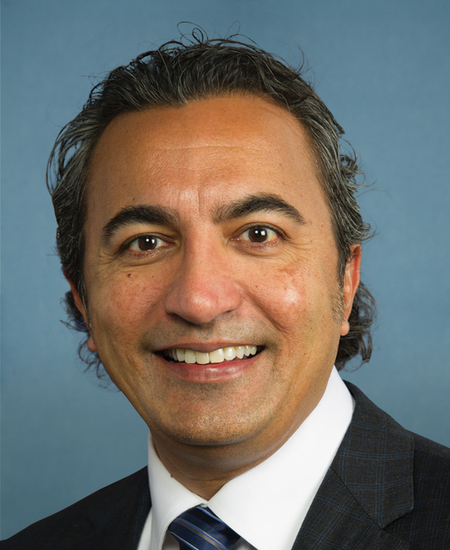
Rep. Ami Bera
Sponsored bills
Give Kids a Chance Act of 2025 This bill expands the Food and Drug Administration’s (FDA’s) authority with respect to research on rare pediatric diseases, including by permitting the FDA to take enforcement action against drug sponsors that fail to satisfy pediatric study requirements and by reauthorizing programs that support pediatric research. Specifically, the bill modifies requirements relating to molecularly targeted pediatric cancer investigations to permit research on new drugs in combination with active ingredients that have already been approved, provided certain conditions are met; permits the FDA to take enforcement action against drug sponsors that fail to comply with pediatric study requirements, if such sponsors demonstrated a lack of due diligence in satisfying the requirement; renews the FDA’s authority to award priority review vouchers to sponsors of new products intended to treat rare pediatric diseases through September 30, 2029; and reauthorizes through FY2027 certain funding for the National Institutes of Health to support priority pediatric research. The bill also provides statutory authority for the FDA’s interpretation of the orphan drug exclusivity period. The bill specifies, consistent with FDA regulations, that the seven-year market exclusivity period for drugs for rare diseases or conditions (i.e., orphan drugs) prohibits the approval of the same drug for the same approved use or indication with respect to the disease or condition. (In Catalyst Pharmaceuticals, Inc. v. Becerra , a court rejected the FDA’s interpretation and held that orphan drug exclusivity extends to all uses or indications for the disease or condition.)
Maddy summaryHR 6345, the Point-Access Housing Guidelines Act of 2025, requires the Department of Housing and Urban Development (HUD) to create federal guidelines for permitting residential buildings with a single internal stairway serving all units (up to five stories). These guidelines will cover fire safety, construction costs, accessibility, and include examples from existing jurisdictions and expert input. Local governments, developers, and housing authorities would use these model codes to more easily adopt such buildings, potentially increasing housing supply in high-cost areas without overriding local building codes. HUD may also fund pilot projects to test the safety and feasibility of these designs.
Maddy summaryThe CAT Act requires public housing agencies to publicly disclose key details about their contracts on agency websites within one year of the law's enactment. It mandates posting specific information for each contract, including the goods or services provided, vendor name, solicitation date, bids received, and the official who initiated the request. This applies directly to all public housing agencies receiving federal funding through the Department of Housing and Urban Development (HUD). The law aims to increase transparency in how public housing funds are spent by making contract details accessible to the public.
Maddy summaryHR 6327, the Rural Housing Regulatory Relief Act, exempts certain rural housing projects from requiring environmental reviews under the National Environmental Policy Act (NEPA). It applies specifically to construction or modifications on "infill sites" (defined as sites with existing water, sewer, and road infrastructure, excluding greenfield areas or high-risk flood/fire zones) using USDA housing programs like Section 502 or 515. The bill removes the need for NEPA reviews for these projects, aiming to speed up housing development. It also requires the USDA Secretary to report to Congress within five years on whether the exemption reduced review times, costs, and impacts on rural affordable housing. This change directly affects rural housing providers and applicants under the specified USDA programs.
Maddy summaryHR 6293, the Housing Supply Expansion Act of 2025, updates federal definitions to include manufactured homes built without a permanent chassis under the same regulatory framework as traditional manufactured homes. It requires the Secretary of Housing and Urban Development to establish new labeling standards (including distinct data plates and invoice notations) for these homes and mandates that states certify they treat them equally to homes on permanent chassis in areas like financing, installation, and sales. States must submit initial certification within one year (or two years for biennial legislatures) and annual recertifications to confirm compliance, with non-compliant states prohibited from allowing the sale or installation of these homes. The bill directly affects manufacturers, state regulators, and homebuyers purchasing manufactured homes without permanent chassis, ensuring consistent federal and state treatment.
Maddy summaryHRES 906 would change House rules to require a 60% vote of members present and voting to censure, disapprove, or remove any House member, delegate, or resident commissioner from committee assignments. Currently, a simple majority (50%+1) could trigger these actions, but this bill raises the threshold to a supermajority. The change applies directly to all voting members of the House and affects disciplinary procedures for members. This is a procedural rule change that makes it harder to take formal disciplinary actions against House members.
Maddy summaryThis bill expands eligibility for federal TIFIA loans to include most airport infrastructure projects, such as new terminals, security systems, or surface transportation links, regardless of revenue generation or public access. It raises the maximum loan amount from $75 million to $100 million and removes certain eligibility barriers for airport projects seeking loan waivers. The changes directly affect airport authorities and developers seeking federal financing for aviation facility construction or upgrades. Key provisions clarify that projects enhancing air transportation safety, passenger movement, or airport operations qualify under TIFIA. The bill modifies existing transportation law to simplify access to federal credit for airport infrastructure.
Maddy summaryHR 6181, the John Lewis Every Child Deserves a Family Act, prohibits child welfare agencies receiving federal funds from discriminating against children, youth, or prospective foster/adoptive parents based on religion, sex (including sexual orientation and gender identity), or marital status. It directly affects LGBTQ youth in foster care - overrepresented at 30% of the system - who face higher risks of trauma, group home placements, and suicide attempts compared to non-LGBTQ peers. Key provisions require agencies to collect data on sexual orientation and gender identity, establish a National Resource Center for LGBTQ youth support, provide cultural competency training, and eliminate discriminatory practices. The law aims to improve safety, permanency, and placement stability by expanding access to family-based care and ensuring equitable services for all children in the system.
Maddy summaryHR 6126 authorizes the minting of commemorative coins to mark the 100th anniversary of the U.S. Foreign Service (established in 1924). It specifies three coin types: up to 50,000 $5 gold coins (90% gold), 400,000 $1 silver coins (90% silver), and 750,000 half-dollar coins, all to be sold during 2029. A surcharge of $35 per gold coin, $10 per silver coin, and $5 per half-dollar is added to the sale price, with all surcharge funds directed to the Association for Diplomatic Studies and Training to support its diplomatic history preservation work. The coins must include standard inscriptions (e.g., "Liberty," "United States of America") and will be legal tender, but the bill does not create new policy or affect government operations.