

This resolution expresses support for legislation to provide child care assistance to all working families that need it; make childcare affordable and available to meet various job schedules; guarantee that all families eligible for childcare will receive it; improve the quality of childcare; expand access to Head Start and preschool services; and provide sufficient federal, state, and local investment to ensure resources for both high-quality jobs and affordable childcare.
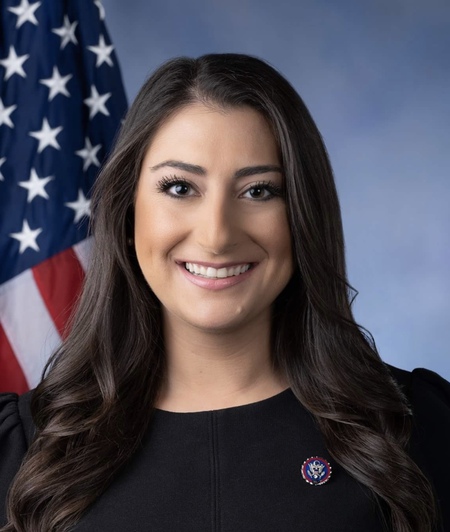
Rep. Sara Jacobs
Sponsored bills
Ensuring Lasting Smiles Act This bill requires private health insurance plans to cover diagnosis and treatment of congenital anomalies and birth defects, such as reconstructive services and items. Coverage must include services and items that functionally improve, repair, or restore any body part that is medically necessary for normal bodily functions or appearance, as determined by the treating physician. Coverage limits and cost-sharing requirements for such services and items may not be more restrictive than those applicable to all medical and surgical benefits under the plan.
Supply Chain Disruptions Relief Act This bill modifies the treatment of liquidations of new motor vehicle inventory as qualified LIFO (last in first out accounting method) inventory. It allows new motor vehicle dealers to elect to wait until the end of 2025 to replace their inventory for purposes of determining income attributable to the sale of such inventory during 2020 and 2021.
Energy Conservation Opportunities on Campus Act or the ECO Campus Act This bill directs the Department of Energy to establish a grant program to support energy efficiency, renewable energy, and climate resilience improvements at certain public institutions of higher education.
Values in Arms Export Act of 2022 This bill restricts transferring defense articles and services to countries that violate human rights, imposes such restrictions on Saudi Arabia and the United Arab Emirates (UAE), and addresses related issues. The bill establishes the Human Rights and Law of War Oversight Board. The board's duties shall include (1) reviewing countries that receive U.S. defense articles for strict adherence to human rights and the law of armed conflict principles, and (2) ensuring that such principles are appropriately considered in arms transfers. The President, the Department of State, the Department of Defense, the board, or Congress may designate a country (except for certain exempted countries such as NATO member countries) as a country of concern. Such a designation shall last for three years, during which the country shall be barred from receiving the defense articles that led to the designation. The bill also imposes additional restrictions on a designated country that fails to improve its adherence to human rights principles. The Department of the Treasury must impose sanctions on the appropriate government officials of a country subject to such additional restrictions. The bill designates Saudi Arabia and the UAE as countries of concern. Before certain defense articles transfers, the President must provide Congress an assessment of the risk of the defense articles being used to violate human rights. The bill also requires various government agencies to monitor and report information concerning human rights violations involving U.S. defense articles.
This resolution recognizes the accomplishments and example of Cesar Estrada Chavez. The resolution also encourages the people of the United States to commemorate his legacy and to always remember his rallying cry, "Si, se puede!" (which means "Yes, we can!").
Anna Westin Legacy Act of 2022 This bill requires the Substance Abuse and Mental Health Services Administration to maintain the National Center of Excellence for Eating Disorders (NCEED). The bill specifies required activities for NCEED, including providing training for frontline health care providers and other professionals.
Honoring the Oath Act of 2021 This bill establishes the Military Family Immigration Advisory Committee and modifies the naturalization procedures for a noncitizen in the Armed Forces. U.S. Immigration and Customs Enforcement shall notify the committee when any individual in removal proceedings is a (1) member of the Armed Forces, (2) veteran, or (3) noncitizen spouse or minor child of such an Armed Forces member or veteran. The committee shall review the case of any such individual and make recommendations to the Department of Homeland Security (DHS) and the Department of Justice as to how the case should be resolved. Such an individual shall not be removed until the committee has provided its recommendations. DHS and the Department of Defense shall jointly carry out a program allowing a noncitizen individual who serves on active duty in the Armed Forces (and any noncitizen spouse or minor children of the individual) to become a U.S. citizen if the individual is not otherwise ineligible for citizenship. The Armed Forces member shall be given the opportunity to apply for citizenship during the accession process into the Armed Forces. DHS shall adjudicate such an individual's application by the last day of the individual's active service in the Armed Forces.
Veteran Deportation Prevention and Reform Act This bill provides protections from deportation for noncitizen veterans and contains other related provisions. U.S. Immigration and Customs Enforcement (ICE) must identify each individual in removal proceedings who is a member of the Armed Forces, a veteran, or a noncitizen spouse or minor child of such an individual. That individual may not be removed until (1) ICE has transferred that individual's case files to an advisory committee created under this bill, and (2) that committee has provided recommendations as to the outcome of the case. The Department of Homeland Security (DHS) shall create a system to share information across various agencies about noncitizen veterans who may be subject to removal to ensure that such a veteran's military service is taken into consideration in immigration-related cases. DHS shall also create a system for (1) identifying noncitizens who are or may be veterans, and (2) collecting data relating to such noncitizens who are in removal proceedings or may have been removed. DHS and the Department of Defense must jointly carry out a program to naturalize a noncitizen (and the noncitizen's spouse and minor children) who serves on active duty in the Armed Forces and is not otherwise ineligible for citizenship if that noncitizen submits an application. DHS shall also establish a program for eligible noncitizen veterans (generally those not convicted for certain serious crimes) to obtain permanent resident status. Similarly, the Department of Justice shall provide permanent resident status to such an eligible veteran in removal proceedings or subject to a final order of removal.
Emmett Till Antilynching Act This bill makes lynching a federal hate crime offense. Specifically, the bill imposes criminal penalties—a fine, a prison term of up to 30 years, or both—on an individual who conspires to commit a hate crime offense that results in death or serious bodily injury or that includes kidnapping or an attempt to kidnap, aggravated sexual abuse or an attempt to commit aggravated sexual abuse, or an attempt to kill.