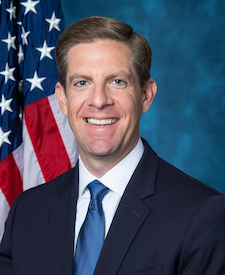
Photo of Mike Levin
D United States House · District 49 · California On the 2026 ballot

Rep. Mike Levin

Compare
Total votes
2,837
all sessions
Attendance
100%
5 missed
Higher than 82% of chamber peers
With party
97%
of cast votes
Near the chamber average
Bipartisan score
2%
crosses aisle rarely
Near the chamber average
Sponsored
1,568
bills & resolutions
Higher than 75% of chamber peers
Committees
3
assignments
1,568 bills and resolutions

Sponsored bills

Total
1,568
Primary
91
Co-sponsor
1,477
This page
1,568
matching current filters
Co-sponsor HR 1657
In committee · Indiana House · Co-sponsor
Humane Cosmetics Act of 2025

Maddy summaryHR 1657, the Humane Cosmetics Act of 2025, prohibits cosmetic companies from conducting or contracting animal testing for products sold in the U.S. beginning one year after the law takes effect. It also bans the sale or transport of cosmetics developed using such testing after that date, with limited exemptions (e.g., for foreign regulatory requirements or when no non-animal safety alternatives exist). The bill directly affects cosmetic manufacturers, retailers, and distributors by requiring them to shift to non-animal testing methods. The Food and Drug Administration (FDA) will enforce the law, including reviewing records and imposing civil penalties for violations.

In committee Feb 27, 2025 1 co-sponsor
Co-sponsor HR 1684
In committee · Indiana House · Co-sponsor
PAST Act of 2025

Maddy summaryThe PAST Act of 2025 amends the Horse Protection Act to ban harmful practices known as "soring," which deliberately cause pain to horses to exaggerate their gait for shows. It specifically prohibits devices like action devices (e.g., boots causing friction) and weighted shoes on Tennessee Walking Horses, Racking Horses, and Spotted Saddle Horses at events. The bill increases penalties, including escalating disqualifications for repeat offenses (180 days → 1 year → 3 years) and raises fines for violations to $5,000 per offense. It also requires stricter licensing for inspectors and mandates public posting of violation records to help event organizers enforce rules.

In committee Feb 27, 2025 1 co-sponsor
Co-sponsor HR 1745
In committee · Indiana House · Co-sponsor
HOPE for Homeownership Act

Maddy summaryHR 1745, the HOPE for Homeownership Act, imposes new taxes on hedge funds and certain investment entities that own excessive single-family residences. It directly affects hedge funds with $50 million or more in assets under management, requiring them to pay a 15% tax (or $10,000) on new home acquisitions and an annual tax of $5,000 per excess property beyond allowable limits. The tax rate gradually decreases over nine years (from 90% to 0% of prior holdings) to encourage selling properties. Owners liable for this tax lose deductions for mortgage interest and depreciation on affected properties, creating a direct financial consequence for non-compliance.

In committee Feb 27, 2025 1 co-sponsor
Co-sponsor HR 1589
In committee · Indiana House · Co-sponsor
American Dream and Promise Act of 2025

Maddy summaryThe American Dream and Promise Act of 2025 would create pathways to permanent residency for certain immigrant youth who entered the U.S. as children (Dream Act component) and for individuals from countries with Temporary Protected Status or Deferred Enforced Departure (American Promise Act component). To qualify, applicants must meet continuous physical presence requirements (since January 1, 2021 for Dream Act applicants, and for 3+ years for American Promise applicants), pass background checks, and satisfy educational or employment criteria. Conditional permanent resident status would be granted initially, with the option to convert to full permanent residency after meeting additional requirements like earning a degree, serving in the military for two years, or demonstrating three years of earned income. The bill includes fee exemptions for low-income applicants, establishes a grant program to assist applicants with legal help, and creates specific procedures for background checks and appeals.

In committee Feb 27, 2025 1 co-sponsor
Co-sponsor HR 1637
In committee · Indiana House · Co-sponsor
Protect Veteran Jobs Act

Maddy summaryHR 1637, the Protect Veteran Jobs Act, allows veterans who were involuntarily dismissed without cause from federal civil service positions between January 20, 2025, and the bill’s enactment date to seek reinstatement to their former role or a qualified position. It directly affects eligible veterans dismissed during this period and requires federal agencies to report quarterly on veteran removals, including the number and reasons for each dismissal. Agencies must submit these reports to specified congressional committees until January 20, 2029, when the reporting requirement ends. The bill aims to restore employment opportunities for affected veterans while increasing transparency around federal hiring and dismissal practices.

In committee Feb 26, 2025 1 co-sponsor
Co-sponsor HR 1564
In committee · Indiana House · Co-sponsor
Ethan's Law

Maddy summaryEthan's Law requires gun owners to store firearms securely in homes where minors live or where residents are legally prohibited from owning guns. It makes it unlawful to leave firearms unsecured if a minor or ineligible person could access them, with fines of $500 per violation and harsher penalties if injury or death occurs. The bill creates a federal grant program to help states implement similar secure storage laws and treats unsafe storage as negligence in legal cases. It directly affects households with children or residents who cannot legally possess firearms, aiming to reduce accidental shootings and unauthorized access.

In committee Feb 25, 2025 1 co-sponsor
Co-sponsor HR 1518
In committee · Indiana House · Co-sponsor
New Era of Preventing End-Stage Kidney Disease Act

New Era of Preventing End-Stage Kidney Disease Act This bill establishes regional centers of excellence, postgraduate fellowships, and training for health professionals relating to the diagnosis and treatment of rare kidney disease. It also requires the Department of Health and Human Services (HHS) to conduct various studies on rare kidney disease. Specifically, it authorizes the National Institute of Diabetes and Digestive and Kidney Diseases to award funding to public and private nonprofit entities for establishing regional centers of excellence that will increase public awareness, conduct research, and develop resources for diagnosing and treating rare kidney diseases. A center may receive such funding for up to five years, unless extended by the institute.  The bill also requires health professions schools receiving a grant from the Health Resources and Services Administration (HRSA) Centers of Excellence program to award fellowships for training on preventing, diagnosing, and treating rare kidney disease in disproportionately impacted populations. Also, the bill expands the priorities of HRSA’s Primary Care Training and Enhancement program to include training for health care workers to care for individuals with kidney disease. Additionally, HHS must conduct several studies and report to Congress on topics such as treating rare kidney disease in disproportionately affected populations, eliminating the need for dialysis or kidney transplants, and increasing public awareness of rare kidney disease.

In committee Feb 24, 2025 1 co-sponsor
Co-sponsor HR 1530
In committee · Indiana House · Co-sponsor
American Victims of Terrorism Compensation Act

Maddy summaryThe American Victims of Terrorism Compensation Act amends the Justice for United States Victims of State Sponsored Terrorism Act to increase funding for victims of terrorism. It directs the transfer of approximately $1.5 billion from the Binance Holdings Limited case, plus 50% of excess unobligated balances from Department of Justice and Treasury forfeiture funds, into the Victims Fund. The bill establishes deadlines for agencies to deposit funds (within 30 days of receipt or 15 days after enactment), requires annual reports on fund activity, and authorizes annual payments to eligible claimants starting in 2026. This legislation directly affects terrorism victims who receive compensation from the fund and federal agencies that handle forfeited assets from terrorism-related cases.

In committee Feb 24, 2025 1 co-sponsor
Co-sponsor HR 1464
In committee · Indiana House · Co-sponsor
MODERN WIC Act of 2025

More Options to Develop and Enhance Remote Nutrition in WIC Act of 2025 or the MODERN WIC Act of 2025 This bill permanently allows individuals to remotely certify their eligibility for, and receive benefits through, the Special Supplemental Nutrition Program for Women, Infants, and Children (WIC). Specifically, the bill requires that a state agency allow an individual seeking a WIC certification, recertification, or a nutritional risk evaluation to do so by phone or through video teleconference, in addition to the in-person option. A state agency has 90 days to collect data for a nutritional risk evaluation for a remotely certified individual. Further, a state agency may consider an applicant who meets the income eligibility standards to be temporarily eligible on an interim basis to participate in the program and may certify the individual for immediate participation without waiting for a nutritional risk evaluation. The bill also allows states to provide benefits on WIC electronic benefit transfer cards through mail or remote issuance instead of requiring participants to pick up or reload benefits in person at a WIC office. Further, the Department of Agriculture must report to Congress about the use of remote technologies and other digital tools in the WIC program. Currently, individuals are generally required to be physically present to certify their WIC eligibility and receive benefits, with exceptions. The Food and Nutrition Service  has temporarily waived these requirements and allowed remote certification and benefits using authorities that were provided by laws that were enacted to address COVID-19.

In committee Feb 21, 2025 1 co-sponsor
Co-sponsor HR 1505
In committee · Indiana House · Co-sponsor
Public Safety Employer-Employee Cooperation Act

Maddy summaryHR 1505, the Public Safety Employer-Employee Cooperation Act, establishes federal standards for collective bargaining rights for public safety officers (including police, firefighters, and emergency medical personnel) in states that do not meet minimum requirements. The Federal Labor Relations Authority (FLRA) will determine after 180 days whether a state law "substantially provides" key rights, such as forming unions, negotiating wages/hours, and using binding arbitration to resolve disputes. If a state fails this assessment, federal bargaining rules apply within two years, but existing state laws with stronger protections remain valid. The bill explicitly respects state laws that exceed its standards and exempts small jurisdictions (under 5,000 population or 25 full-time employees).

In committee Feb 21, 2025 1 co-sponsor
Showing 381 to 390 of 1,568 bills
Previous 1 … 38 39 40 … 157 Next