Plastic Pellet Free Waters Act This bill requires the Environmental Protection Agency to issue a final rule that prohibits certain discharges of plastic pellets and other preproduction plastic into waters of the United States.
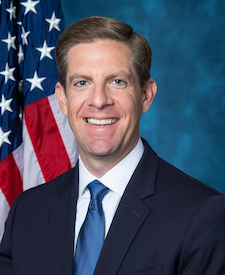
Rep. Mike Levin
Sponsored bills
Aviation-Impacted Communities Act This bill addresses noise mitigation for aviation-impacted communities. ( Aviation-impacted community is defined as a community that is located not more than one mile from any point at which a commercial or cargo jet route is 3,000 feet or less above ground level.) Specifically, the bill expands Airport Improvement Program noise mitigation program funding for aviation-impacted communities that are not currently within the 65 day-night average sound level (DNL) standard; requires the Federal Aviation Administration (FAA) to enter into an agreement with the National Academy of Sciences to conduct a study that summarizes the relevant literature and studies done on aviation impacts worldwide and focuses on large hub commercial airports and surrounding communities, including communities currently outside of the 65 DNL contour; directs the FAA to conduct outreach to aviation-impacted communities to inform them of the opportunity to be a designated community; requires the FAA to devise an action plan that alleviates or addresses the concerns of a designated community; and provides grants for necessary noise mitigation in a designated community for residences, hospitals, nursing homes, adult or child day care centers, schools, and places of worship.
Water Efficiency, Conservation, and Sustainability Act of 2022 This bill establishes multiple grants that support activities to incentivize efficient water use by customers of public water systems, reduce water losses and leaks in water systems, and promote the adoption of water-efficient plumbing codes.
Cattle Price Discovery and Transparency Act of 2022 This bill requires the Department of Agriculture (USDA) to take various actions to address transparency in contract terms and pricing in the cattle industry. Among these requirements, USDA must maintain a publicly available library or catalog of contracts entered into between meat packers and livestock producers for the purchase of cattle, including any schedules of premiums or discounts associated with the contracts and other specific details. USDA must make this information available to producers and other interested parties in a monthly report. The bill further requires USDA to establish five to seven regions encompassing the entire continental United States that reasonably reflect similar fed cattle purchase practices for processing plants and establish mandatory minimums for each region (i.e., the minimum percentage of cattle purchases that are required to be made through approved pricing mechanisms from producers that are not packers). Under the bill, approved pricing mechanisms are generally purchases of fed cattle made through a negotiated purchase, through a negotiated grid purchase, at a stockyard, or through trading systems or platforms where multiple buyers and sellers can regularly make and accept bids and offers. The bill also establishes a maximum penalty for mandatory minimum violations by covered packers. Under the bill, a covered packer is a packer that has slaughtered an average of 5% or more of the number of fed cattle slaughtered nationally during the immediately preceding five calendar years.
Health Care Providers Safety Act of 2022 This bill authorizes the Department of Health and Human Services to award grants to health care providers for security services and other expenses related to physical security and cybersecurity.
Transportation Fuel Market Transparency Act This bill expands prohibitions against manipulating fuel markets, establishes a body within the Federal Trade Commission (FTC) to monitor fuel markets to ensure competitiveness, and addresses related issues. Prohibitions against the manipulation of wholesale fuel markets or reporting false (or misleading) information shall apply to actions related to crude oil and transportation fuel, defined in this bill to include gasoline, distillate fuels, jet fuel, aviation gasoline, and biofuel. Currently, such prohibitions only apply to crude oil, gasoline, and petroleum distillates. The bill further expands the prohibition on reporting false information to include such information that (1) concerns the supply of, operational actions related to, or output related to wholesale fuel markets; (2) is not required to be reported by law; or (3) affects the analyses or data compiled by a private sector price-reporting agency. The bill also increases the maximum civil penalty for violating these prohibitions from $1 million to $2 million for each day of the violation. Furthermore, the bill establishes within the FTC the Transportation Fuel Monitoring and Enforcement Unit. The unit must continuously and comprehensively collect and analyze fuel market data to support competitive market practices, identify market manipulation and other unfair methods of competition, and facilitate enforcement of competition-related statutes. The Energy Information Administration within the Department of Energy must collect data to facilitate transparent and competitive transportation fuel markets, determine adherence to sanctions, and protect consumers.

Community Services Block Grant Modernization Act of 2022 This bill reauthorizes the Community Services Block Grant program through FY2032 and otherwise modifies the program. The program supports various antipoverty activities, primarily through formula-based allotments to states, Indian tribes, and territories. In particular, the bill makes changes to the program's administration and leadership; performance measurement; and allotments to states and territories. The bill also expands eligibility for services and activities funded by the program to 200% of the federal poverty line (FPL). Under current law, eligibility is generally set at the FPL.
Rights for the Transportation Security Administration Workforce Act of 2022 or the Rights for the TSA Workforce Act of 2022 This bill modifies the workplace rights, protections, and benefits applicable to Transportation Security Administration (TSA) personnel. Specifically, the bill by December 31, 2022, eliminates personnel authorities of the Department of Homeland Security (DHS) and the Department of Transportation governing the conditions of employment for TSA employees, thus making TSA employees subject to the personnel management system applicable to other federal employees; sets forth transition rules that protect the pay rates, leave rights, and other rights of TSA employees; and requires DHS to consult with the exclusive representative of TSA screening employees to carry out the conversion of those positions. The bill also permits the TSA to consult with organizations representing federal air marshals to address concerns, including mental health and suicide rates; directs the TSA to ensure its employees are provided proper guidance regarding prevention and protections against COVID-19; requires the TSA to provide a one-time bonus payment of $3,000 to each TSA employee carrying out duties that require substantial contact with the public during the COVID-19 national emergency; and requires the Government Accountability Office to report on implementation of the bill, TSA recruitment efforts, and specified TSA personnel policies.
This resolution expresses that the House of Representatives views the actions of the Russian government, at the direction of President Vladimir Putin, as acts of terrorism; and calls on the Department of State to designate Russia as a state sponsor of terrorism.
Desalination Research Advancement Act This bill reauthorizes through FY2026 the Desalination and Water Purification Research Program at the Bureau of Reclamation and increases the amount of funding available to institutions of higher education. The bill also expands the program's research priorities to include minimizing the impacts of seawater desalination on aquatic life and coastal ecosystems.