

Maddy summaryHR 899 would end the U.S. Department of Education by requiring its termination on December 31, 2023. This bill directly affects the Department of Education itself, eliminating its federal structure and operations. The key provision is a specific termination date, ending the agency's existence as a standalone cabinet-level department. No other mechanisms or affected groups are specified in the bill text.
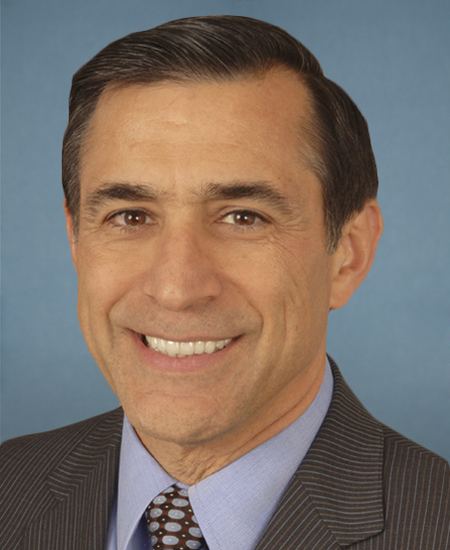
Rep. Darrell Issa
Sponsored bills
Maddy summaryHR 925, the Protect Camp Lejeune VETS Act, caps attorney fees for legal claims related to contaminated water at Camp Lejeune, North Carolina. It limits fees to 12% of administrative claim payments or 17% of court judgments/settlements, prohibits additional costs, and requires attorneys to certify fee amounts. The bill also mandates the Secretary of the Navy to issue claim documentation guidance within 30 days and a compensation schedule within 180 days. These provisions apply to all pending and future cases under the Camp Lejeune Justice Act of 2022, ensuring transparency through annual fee reporting to Congress.
Maddy summaryHR 29, the Border Safety and Security Act of 2023, grants the Secretary of Homeland Security authority to restrict entry at U.S. land or maritime borders for certain immigrants deemed "covered aliens" (those inadmissible under immigration law due to lack of proper documentation). The bill requires the Secretary to suspend entry if they cannot detain or process these individuals as required by existing immigration law. It also allows state attorneys general to sue the Secretary in federal court if they believe border policies harm their state's residents. The law defines "operational control" using terms from the Secure Fence Act of 2006. This bill directly affects immigrants seeking entry who fall under the specified inadmissibility category.
Maddy summaryHCONRES 9 is a symbolic resolution passed by the U.S. House of Representatives that formally denounces socialism as incompatible with American values, citing historical examples of socialist regimes causing widespread suffering and authoritarian rule. It states Congress opposes the implementation of socialist policies in the United States. This resolution has no legal effect, does not change any laws, and serves solely as a non-binding statement of congressional opinion. It directly affects no individuals or policies, as it is purely a declarative position.
This resolution condemns Iranian state-sponsored terrorist attacks against U.S. citizens and officials and Iranian dissidents. The resolution also expresses support for the people of Iran who are legitimately defending their rights for freedom against repression and condemns the killing of Iranian protesters by the Iranian regime.
Maddy summaryHR 855 establishes an independent Office of the Special Inspector General to oversee U.S. military, economic, and humanitarian aid to Ukraine. This office will conduct audits, investigate waste or fraud, and issue quarterly public reports detailing every dollar spent on projects, including contract costs, project-by-project spending, and how funds were allocated. The oversight office reports directly to Congress and has authority to investigate aid programs without interference from agencies like Defense or State, while requiring transparency in spending details. The bill authorizes $20 million in funding for this oversight from existing aid budgets.
Maddy summaryHR 558 amends the Defense Production Act to prohibit China, Iran, North Korea, and Russia (and entities they control) from purchasing or leasing property within 10 miles of designated sensitive sites. These sites include U.S. military bases, ports, government facilities, and other locations where foreign access could threaten national security through intelligence collection or surveillance. The bill requires the Committee to notify Congress of any violations and applies to transactions occurring after its enactment. It directly affects foreign entities from the listed countries seeking real estate near critical U.S. infrastructure.
Maddy summaryHR 791, the American Music Fairness Act of 2023, requires terrestrial radio stations (AM/FM) to pay royalties for playing music, aligning their payment obligations with those of internet streaming services. It directly affects small local radio stations by establishing low annual fees: $10 for stations with under $100,000 annual revenue, $100 for public broadcasters with $100k-$1.5M revenue, and $500 for other stations in that revenue range. The bill ensures songwriters’ existing royalty rights remain unaffected (Section 6) and mandates that royalty rates for radio be set using economic data, including how radio promotion might impact music sales. This creates a new statutory royalty structure while protecting small broadcasters through tiered, low-cost payment tiers.
Maddy summaryThis bill creates a new federal crime for assaulting law enforcement officers causing serious injury or death, with penalties up to 10 years in prison for serious injury and up to life for aggravated cases involving death, kidnapping, or attempted killing. It applies when offenses involve interstate travel, commerce, or target officers engaged in law enforcement duties. Federal prosecution requires Attorney General certification that state authorities cannot or will not handle the case, or that federal action is necessary for public safety. The law covers all law enforcement officers (state, local, and federal) who enforce criminal laws or detain individuals.
Maddy summaryHR 582, the Credit Union Board Modernization Act, changes the required meeting frequency for boards of directors at federal credit unions. It replaces a simple "monthly" requirement with tiered schedules based on each credit union's performance rating under the Uniform Financial Institutions Rating System. Top-rated credit unions (ratings 1 or 2) must meet at least six times yearly, with one meeting per fiscal quarter. Lower-rated credit unions (ratings 3, 4, or 5) must meet monthly, and new credit unions must meet monthly for their first five years. This directly affects all federal credit unions by adjusting their board meeting obligations based on their regulatory rating.