

Maddy summaryThis bill designates the U.S. Postal Service facility at 7911 Imperial Highway in Downey, California, as the "Lucille Roybal-Allard Post Office Building." It updates all official references in federal laws, documents, and records to use this new name for the specific post office location. The change affects the facility's official identification but does not alter its operations or services.
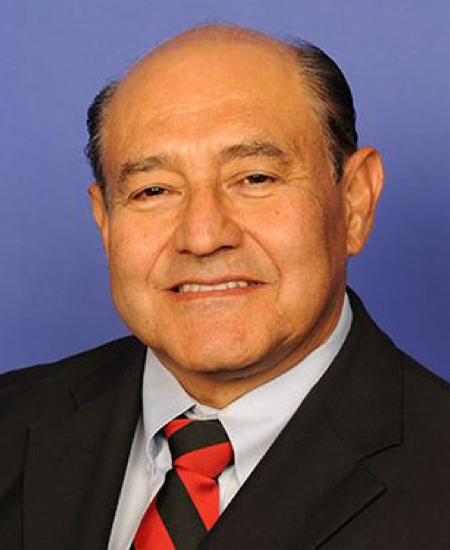
Rep. J. Luis Correa
Sponsored bills
This resolution expresses support for the designation of DIPG Awareness Day. DIPG is diffuse intrinsic pontine glioma, a terminal childhood brain cancer.
Maddy summaryThis bill requires that AM radio receivers be included as standard equipment in all new motor vehicles (such as cars and trucks) sold in the United States, with a rule to be issued by the Department of Transportation within one year. The rule must ensure AM radio is easily accessible on the dashboard and allows manufacturers to use digital AM radio technology instead of traditional AM. During the one-year period between the bill's enactment and the rule's effective date, manufacturers must clearly label vehicles without AM radio. The bill also directs a study to evaluate whether an alternative system could deliver emergency alerts as reliably as AM radio across the country, especially during crises.
Maddy summaryHR 3544, the Remote Naturalization Act, allows immigrants with approved naturalization applications to complete their oath ceremony remotely via video call if they cannot attend in person due to specific emergencies (like pandemics, disasters, or public health crises) or personal inability to travel. It requires the Department of Homeland Security to establish remote ceremony procedures within 30 days, notify eligible applicants, and hold these ceremonies within 30 days of their request. The bill mandates annual reports to Congress tracking how many people used remote ceremonies versus in-person ones, and clarifies that missing a remote ceremony does not count as abandoning naturalization. This directly affects immigrants whose in-person ceremonies were canceled or who face barriers to attending.
Maddy summaryHR 3537 authorizes the minting of commemorative coins to mark the 100th anniversary of the U.S. Foreign Service, established by the 1924 Rogers Act. The bill specifies three coin types ($5 gold, $1 silver, and half-dollar clad) with limited mintage (50,000 gold, 400,000 silver, 750,000 half-dollars) to be issued in 2025, featuring designs honoring diplomatic history. A surcharge on each coin sale ($35 for gold, $10 for silver, $5 for half-dollars) will fund the Association for Diplomatic Studies and Training (ADST) to support its oral history program and diplomatic preservation efforts. The coins will be legal tender, sold at cost-plus-surcharge, with all revenue directed to ADST per the bill's provisions.
Maddy summaryHRES 372 is a non-binding House resolution expressing support for designating May 2023 as "Mental Health Awareness Month." It does not create new laws or allocate funds but formally urges the nation to recognize mental health as a priority. The resolution supports reducing stigma around mental illness, expanding access to mental health services, and emphasizing that mental well-being is as important as physical health. It highlights the need for greater awareness and resources, particularly for youth, veterans, and communities of color facing mental health disparities, but does not mandate any specific policy changes.
Maddy summaryHR 3249, the Protecting Circuit Boards and Substrates Act, creates a 25% tax credit for businesses purchasing U.S.-manufactured printed circuit boards and establishes a federal program providing financial assistance for domestic manufacturing and research of these components. The bill directly affects U.S. businesses, particularly small, minority-owned, women-owned, and veteran-owned companies, by offering incentives to build or expand facilities within the United States. Key provisions include workforce training requirements for recipients, preferences for projects that increase domestic production capacity or relocate from foreign-controlled areas, and strict restrictions on foreign entities of concern. The program is authorized with $3 billion for 2024-2025 and includes clawback provisions if projects aren't completed on schedule or if recipients collaborate with foreign entities on national security concerns.
Maddy summaryThe PAST Act of 2023 amends the Horse Protection Act to ban specific devices used to cause pain (soring) in horses at shows, particularly affecting Tennessee Walking Horses, Racking Horses, and Spotted Saddle Horses. It defines prohibited "action devices" (like boots or chains causing friction) and requires licensed, conflict-free inspectors at events to enforce rules. The bill increases penalties for violations to up to $5,000 fines or 3 years in jail, and mandates longer disqualifications for repeat offenses (180 days → 1 year → 3 years). Horse show organizers, exhibitors, and participants must comply with these new inspection and penalty requirements.
Maddy summaryHR 3238, the Affordable Housing Credit Improvement Act of 2023, updates the Low-Income Housing Tax Credit (LIHTC) program to increase the availability of affordable housing across the United States. The bill makes several key changes including increasing state funding formulas, modifying tenant eligibility rules to better serve vulnerable populations (such as domestic violence victims and students), and expanding credit eligibility for projects in rural and Native American communities. Specific provisions raise the credit for properties serving extremely low-income households, clarify rules around tenant income increases, and require housing providers to protect victims of domestic violence. The bill also updates terminology from "low-income" to "affordable" throughout the tax code and enhances program transparency through data sharing requirements. These changes aim to make the LIHTC program more effective at creating and preserving affordable housing units for low-income households nationwide.
Vietnam Human Rights Act This bill requires actions related to human rights in Vietnam and addresses related issues. The Department of State must assist eligible individuals and entities working to secure the release of political and religious prisoners in Vietnam. The Office of Internet Freedom within the U.S. Agency for Global Media and the Bureau of Democracy, Human Rights, and Labor within the State Department shall prioritize (1) the immediate distribution of censorship circumvention tools for computers and smartphones in Vietnam; and (2) projects to ensure the safety and privacy of bloggers, journalists, and human rights defenders in Vietnam. Foreign assistance may not be used to assist any unit of the Vietnamese government engaged in cyberespionage activities. The State Department may establish programs to (1) monitor and halt sex trafficking of women from Vietnam and other Asian countries, and (2) address Vietnam's growing sex-ratio disparity. The bill also requires various reports to Congress, including reports on (1) persons subject to U.S. sanctions for human rights violations in Vietnam, (2) a strategy to promote internet freedom in Vietnam, and (3) cyberespionage activities sanctioned by the Vietnamese government targeting Vietnamese dissidents and human rights advocates living outside of Vietnam.