Building Civic Bridges Act This bill establishes an office and pilot grant program within the Corporation for National and Community Service to support civic bridge building, which aims to address local issues and polarization within communities.
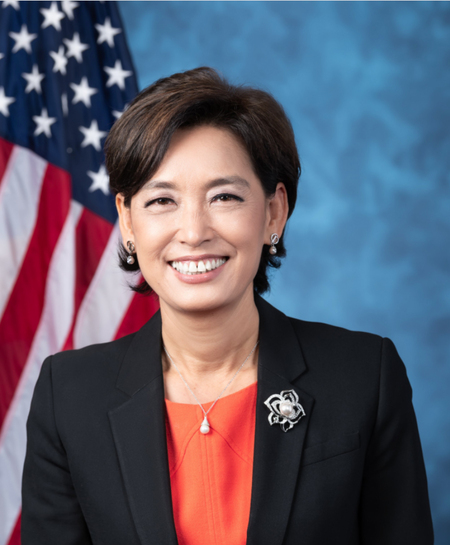
Rep. Young Kim
Sponsored bills
Promoting Ties with Taiwan Act This bill requires the Department of State to submit to Congress a strategy to (1) work with allies and partners to support the expansion of Taiwan's relations and engagement with countries around the world, (2) promote the establishment of Taiwan's presence in countries and partners where Taiwan does not have a permanent presence, and (3) strengthen economic relations and supply chain resilience among Taiwan and like-minded partners to counter threats and malign influences from authoritarian regimes. Within one year of submitting the strategy, the State Department must report to Congress on actions taken to carry out the strategy.
Upholding the 1995 Jerusalem Embassy Law Act of 2021 This bill prohibits using federal funds to establish any diplomatic facility in Jerusalem other than the U.S. Embassy to Israel.
Preventing Racial Profiling in Lending Act This bill prohibits a federal agency from requiring any person or entity to estimate a borrower's race or ethnicity through visual observation or surname when extending credit.
National Institute of Standards and Technology for the Future Act of 2021 This bill reauthorizes the National Institute of Standards and Technology (NIST) through FY2026 and establishes programs and activities. The bill sets forth requirements for supporting basic measurement science, technology research for engineering biology, biomanufacturing, and biometrology; developing standards to measure greenhouse gas emissions; carrying out research on identity management, cybersecurity, biometric identification, and communications measurement; assessing identified vulnerabilities with open-source software; operating the National Advanced Spectrum and Communications Test Network; a strategic plan concerning the Center for Neutron Research; establishing in NIST an organization to facilitate the development of forensic science standards; activities in support of green and sustainable chemistry (i.e., clean, safe, and economic alternatives, technologies, and methodologies to traditional chemical products and processes); information exchange and coordination among federal agencies and with the private sector to ensure federal engagement in the development and use of international technical standards; and establishing a five-year pilot program to award grants to support increased participation by small business and academic interests in international standards organizations. The Government Accountability Office must conduct a study of NIST's policies and protocols to protect its research and combat undue foreign influence. NIST shall establish, as a part of the Hollings Manufacturing Extension Partnership, a pilot program of expansion awards among manufacturing extension centers or a consortium of centers to develop and support training and job placement services. NIST shall establish a National Supply Chain Database to assist the federal government and industry sectors in minimizing disruptions to the United States' supply chain.
Small Lenders Exempt from New Data and Excessive Reporting Act or the Small LENDER Act This bill exempts certain financial institutions and transactions from the Consumer Financial Protection Bureau (CFPB) reporting requirements with respect to data about small business credit applications. Under the bill, the requirements apply only to financial institutions that originate at least 500 credit transactions to small businesses in each of the preceding two years. The bill further defines small businesses as those with annual revenue of $1 million or less. Currently, the CFPB has proposed a rule that the requirements apply only to financial institutions that originate at least 25 annual credit transactions to small businesses in each of the preceding two years. The rule further defines small businesses as those with annual revenue of $5 million or less.
Spent Fuel Prioritization Act of 2022 This bill requires the Department of Energy to prioritize the acceptance of high-level radioactive waste or spent nuclear fuel from decommissioned or decommissioning nuclear power reactors located in areas (1) with large populations, (2) with high earthquake hazards, and (3) where the continued storage of high-level radioactive waste or spent nuclear fuel poses a significant national security concern.
This resolution condemns the military coup that took place in Burma (Myanmar) on February 1, 2021. The resolution denounces the Tatmadaw (the military of Burma) for perpetrating gross violations of human rights as part of its brutal campaign to suppress the democratic aspirations of the people of Burma and calls on the Tatmadaw to cease all violence against prodemocracy activists and reach a cease-fire with ethnic armed organizations, release all political prisoners, and engage in constructive dialogue with all parties to negotiate a pathway toward a government that reflects the will of the Burmese people. The resolution also calls on the President to enact new targeted sanctions on individuals and entities affiliated with the Tatmadaw, including an international arms embargo and a prohibition on the sale of aviation fuel.
Health Care for Burn Pit Veterans Act This bill updates policies and procedures related to Department of Veterans Affairs (VA) health care and benefits for veterans who have been exposed to toxic substances. Specifically, the bill extends the eligibility period for VA hospital care, medical services, and nursing home care for combat veterans who served after September 11, 2001, and were exposed to toxic substances, radiation, or other conditions, including those who did not enroll to receive VA care during the eligibility period. The VA must incorporate into its existing health care screening a screening to help determine potential exposures to toxic substances during military service. Among other requirements, the VA must also provide annual training to health care and benefits personnel with respect to veterans who were exposed to toxic substances; analyze total and respiratory disease mortality in veterans who served in specified locations on specified dates; conduct an epidemiological study on the health trends of veterans who served in the Armed Forces after September 11, 2001; conduct a study to determine trends in the rates of the incidence of cancer in veterans; publish a list of VA resources for veterans who were exposed to toxic substances, families and caregivers of such veterans, and survivors of such veterans who are receiving death benefits; and report on the data quality of the Individual Longitudinal Exposure Record and its usefulness in supporting veterans in receiving VA health care and benefits.

Designates the facility of the United States Postal Service located at 120 4th Street in Petaluma, California, as the "Lynn C. Woolsey Post Office Building."