Reach Every Mother and Child Act of 2022 This bill authorizes the President to provide assistance to implement a comprehensive five-year strategy to contribute toward the global goal of ending preventable child and maternal deaths by 2030.
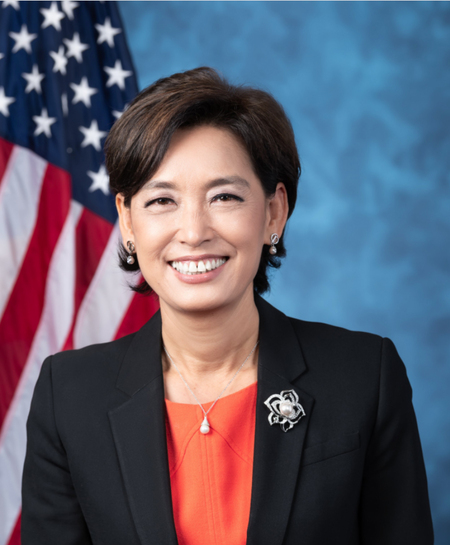
Rep. Young Kim
Sponsored bills
Fallen Heroes Flag Reauthorization Act of 2022 This bill reauthorizes through FY2027 a program through which a Member of Congress may provide, at no cost, a Capitol-flown flag to commemorate a firefighter, law enforcement officer, or other public safety officer who died in the line of duty if an immediate family member of the deceased requests such a flag.
Ukraine Invasion War Crimes Deterrence and Accountability Act This bill requires the President to report to Congress on atrocities committed during Russia's invasion of Ukraine since February 24, 2022. Specifically, the report must describe in detail (1) U.S. government efforts to collect, analyze, and preserve evidence related to war crimes and other atrocities committed during the invasion; (2) media, public diplomacy, and information operations to make the Russian people, including their military and political leaders, aware of efforts to identify and prosecute those responsible for such atrocities; and (3) the process for a domestic, foreign, or international court or tribunal to obtain information from the U.S. government related to such atrocities.
Dignity for People with Disabilities in the Foreign Service Act This bill replaces several references to handicapping condition with disability in the Foreign Service Act of 1980. For example, an existing provision requiring the Department of State to prescribe regulations to ensure that Foreign Service members and applicants are free from discrimination on the basis of a handicapping condition is amended to require regulations to ensure that Foreign Service members and individuals are free from discrimination on the basis of a disability.
Supporting Small Business and Career and Technical Education Act of 2022 This bill includes within the responsibilities of Small Business Development Centers and Women's Business Centers the provision of assistance to small businesses in hiring graduates from career and technical education programs and to graduates of such programs in starting small businesses.
Stop Iranian Drones Act This bill expands existing provisions requiring sanctions against individuals or entities that provide certain types of weapons to Iran. Specifically, the bill modifies the provisions by adding unmanned combat aerial vehicles to the list of weapons covered by the sanctions. The bill also requires the Department of State to periodically report to Congress on the identities of any Iranian entity that has attacked a U.S. citizen using an unmanned combat aerial vehicle. The President must designate any such entity as a foreign terrorist organization.
Keeping Russia's Energy and Military Liable for Invading its Neighbors Act or the KREMLIN Act This bill temporarily prohibits federal agencies from contracting with persons that have business operations with the government of Russia or with fossil fuel companies that operate there, with exceptions where necessary to provide humanitarian assistance or disaster relief or where vital to U.S. national security interests. The bill terminates the prohibition when the President submits to specified congressional committees a written certification determining that Russia has reached an agreement relating to the withdrawal of Russian forces and cessation of military hostilities that is accepted by the Ukrainian government, poses no immediate military threat of aggression to any North Atlantic Treaty Organization member, and recognizes the right of the people of Ukraine to independently and freely choose their own government.
Access to Baby Formula Act of 2022 This bill authorizes the Department of Agriculture (USDA) to take certain actions to address emergencies, disasters, and supply chain disruptions (particularly the shortage of infant formula in the United States) affecting participants of the Special Supplemental Nutrition Program for Women, Infants, and Children (WIC). The bill directs USDA to require each infant formula cost containment contract to include remedies in the event of an infant formula recall, including how an infant formula manufacturer would protect against disruption to WIC participants in the state. USDA must, within 30 days, ensure there is a memorandum of understanding with the Department of Health and Human Services that includes procedures for coordination and information sharing regarding any supply chain disruption, including a supplemental food recall. The bill also authorizes USDA to waive or modify any WIC qualified administrative requirement during emergencies, disasters, and supply chain disruptions. Specifically, USDA may waive or modify such a requirement for one or more state agencies if (1) the requirement cannot be met by state agencies during the emergency, disaster, or disruption; and (2) the modification or waiver is necessary to provide assistance to WIC participants and does not substantially weaken the nutritional quality of supplemental foods. For example, USDA may waive the maximum monthly allowance for infant formula. The bill establishes notification requirements for USDA and state agencies related to supply chain disruptions.

Financial Freedom Act of 2022 This bill prohibits the Department of Labor from limiting the type or range of investments that fiduciaries may offer participants and beneficiaries in certain employer-sponsored retirement plans. The bill applies to certain defined contribution plans that permit participants or beneficiaries to exercise control over the assets in the account, such as a 401(k) plan that allows participants or beneficiaries to select additional investment options through a self-directed brokerage window.
Babies Need More Formula Now Act of 2022 This bill addresses the regulation of infant formula, including by authorizing the Food and Drug Administration (FDA) to waive certain requirements related to importation. The FDA may waive labeling requirements related to the importation (or distribution or sale) of infant formula from a country with requirements that provide a similar assurance of safety as U.S. requirements. The FDA must, when appropriate, enter into arrangements to harmonize U.S. regulatory requirements pertaining to infant formula with the requirements of other nations. The bill imposes time lines for the FDA to respond to submissions for market approval for new infant formula. The FDA must also issue guidance as to what types of changes in the ingredients of infant formula, if any, may not require a new growth study to meet FDA requirements. The bill also authorizes a person to import, without prior notice to the FDA, up to a three-month supply of infant formula for personal use from a country with formula safety standards similar to U.S. standards, such as Canada. Before recommending or requiring a recall of infant formula due exclusively to a labeling deficiency, the FDA must ensure that the recall will not negatively affect the supply of formula in the United States. The bill also requires the FDA to (1) notify Congress no later than 24 hours after initiating a formula recall, and (2) provide certain information to formula manufacturers about restarting production after an inspection of a manufacturing facility impacted by a recall.