

Post-9/11 Veteran Business Acceleration Act This bill requires the Department of Veterans Affairs to collaborate with the Small Business Administration to implement a pilot program to provide financial assistance (in lieu of educational assistance) to eligible individuals under the Post-9/11 Educational Assistance Program for the purpose of (1) establishing and operating a new qualified business enterprise, or (2) operating an existing qualified business enterprise. Eligible individuals are those who (1) are entitled to 36 months of educational assistance under the Post-9/11 Educational Assistance Program, (2) are not in bankruptcy proceedings at the time of application, and (3) meet credit score requirements.
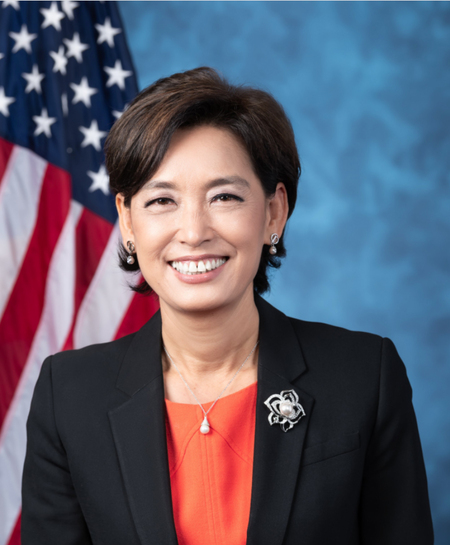
Rep. Young Kim
Sponsored bills
Save Our Sequoias Act This bill provides for the conservation of giant sequoia trees ( Sequoiadendron giganteum ) in California, including by providing statutory authority for the Giant Sequoia Lands Coalition; directing the coalition to submit a Giant Sequoia Health and Resiliency Assessment; declaring an emergency on certain public lands and allowing officials to carry out protection plans during the emergency to respond to the threat of wildfires, insects, and drought; directing the Department of the Interior to develop and implement a Giant Sequoia Reforestation and Rehabilitation Strategy; and establishing a variety of programs and funds to support the conservation of giant sequoias.
Harriet Tubman Bicentennial Commemorative Coin Act This bill directs the Department of the Treasury to mint and issue 50,000 $5 gold coins, 400,000 $1 silver coins, and 750,000 half-dollar clad coins emblematic of the legacy of Harriet Tubman as an abolitionist. The Secretary may issue coins under this bill only during the period of January 1, 2024, through December 31, 2024. All surcharges received by Treasury from the sale of such coins must be paid equally to the National Underground Railroad Freedom Center in Cincinnati, Ohio, and The Harriet Tubman Home, Inc. in Auburn, New York, for the purpose of accomplishing and advancing their missions.
National World War II Memorial Commemorative Coin Act This bill directs the Department of the Treasury to mint and issue up to 50,000 $5 coins, 400,000 $1 silver coins, and 750,000 half-dollar clad coins in commemoration of the National World War II Memorial in the District of Columbia. The design of the coins shall be emblematic of the memorial and the service and sacrifice of American soldiers and civilians during World War II. All surcharges received from the sale of such coins shall be paid to the Friends of the National World War II Memorial to support the National Park Service in maintaining and repairing the memorial, and for educational and commemorative programs.
Banning Oil Exports to Foreign Adversaries Act This bill requires the Department of Energy (DOE) to prohibit the export or sale of petroleum products (e.g., crude oil) from the Strategic Petroleum Reserve to (1) China, North Korea, Russia, and Iran; (2) any other country the government of which is subject to sanctions imposed by the United States; and (3) any entity owned, controlled, or influenced by such countries or the Chinese Communist Party. However, DOE may issue a waiver of the prohibition if the export or sale of petroleum products is in the national security interests of the United States.
This resolution expresses the sense of the House of Representatives that the United States should negotiate and enforce rules on digital trade and the digital economy with like-minded countries as part of its broader trade and economic strategy.
National Plan to End Parkinson's Act This bill requires the Department of Health and Human Services (HHS) to carry out a project to prevent and cure Parkinson's disease (a progressive brain disorder that causes unintended or uncontrollable movements) and related conditions. Among other components of the project, HHS must (1) implement and periodically update a national plan to coordinate and guide efforts to prevent and cure the disease; (2) improve diagnosis, treatment, and care of those with the disease; and (3) address health and other disparities related to the disease. HHS must also conduct annual assessments on the preparation for and response to the increased burden of Parkinson's disease. In addition, the bill establishes a council, comprised of federal and nonfederal stakeholders, to advise HHS on and make recommendations concerning the prevention and cure of Parkinson's disease. The bill's provisions terminate at the end of calendar year 2035.
Arms Exports Delivery Solutions Act This bill requires the Department of State and the Department of Defense to report to Congress on certain transfers of defense articles or defense services since October 1, 2017. The report must include a list of approved transfers to Taiwan, Japan, South Korea, Australia, or New Zealand that are above a certain value threshold and that have not been fully delivered by the start of the fiscal year in which the report is being submitted.
Keeping Girls in School Act This bill authorizes the U.S. Agency for International Development (USAID) to enter into agreements to address social, cultural, health, and other barriers that adolescent girls face in accessing quality secondary education. The USAID shall seek to ensure that such activities meet various requirements related to monitoring and evaluating outcomes, collecting data, and using specified indicators and methodologies for international basic education. The Department of State shall periodically update and report to Congress a publicly available U.S. global strategy to empower adolescent girls, and the USAID shall periodically report to Congress on the activities initiated under this bill and efforts to monitor and evaluate such activities.
Securing and Enabling Commerce Using Remote and Electronic Notarization Act of 2022 or the SECURE Notarization Act of 2022 This bill allows a notary public commissioned under state law to remotely notarize electronic records and perform notarizations for remotely located individuals. The bill provides technical requirements for such notarizations, including the creation and retention of video and audio recordings and the use of communication technologies (i.e., video chat). Additionally, the bill requires U.S. courts and states to recognize notarizations—including remote notarizations of electronic records and notarizations of remotely-located individuals—that occur in or affect interstate commerce and are performed by a notary public commissioned under the laws of other states. The bill also allows a notary public to remotely notarize electronic records involving an individual located outside of the United States, subject to certain requirements.