Public Safety Enhancement Act of 2021 This bill reauthorizes through FY2026 the Community Oriented Policing Services (COPS) grant program. Additionally, the bill requires a certain amount of funds made available under the COPS grant program to be used for the hiring and retention of law enforcement officers.
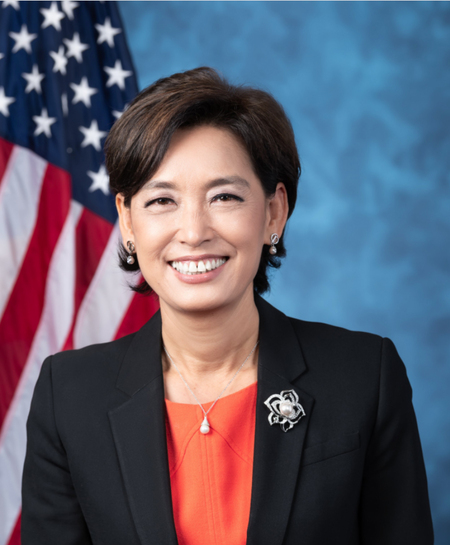
Rep. Young Kim
Sponsored bills
Supporting Every at-Risk Veteran In Critical Emergencies Act of 2021 or the SERVICE Act of 2021 This bill authorizes the Office of Community Oriented Policing Services within the Department of Justice to make grants to support the creation and operation of veterans' response teams in state, local, and tribal law enforcement agencies.
Care for Her Act This bill allows an eligible taxpayer to claim the Child Tax Credit for the tax year preceding the year the child is born. It also sets out other activities to support parents and pregnant women. Specifically, the bill establishes the Pregnancy Support Collaborative, which consists of representatives from the Department of Health and Human Services (HHS) and states that elect to participate. The collaborative must maintain a clearinghouse of information on providers of pregnancy and parenting supports and services. States must identify providers in their jurisdictions who meet applicable criteria for inclusion. In addition, the collaborative must share information about education and training opportunities for parents and pregnant women and identify successful programs (including workplace policies) to support them. Furthermore, the collaborative must award grants to states for local programs to improve maternal and infant health outcomes. If a community demonstrates that its program reduces Medicaid costs, it retains a portion of those savings. If approved by the collaborative, HHS must award grants to providers in the clearinghouse for mentoring and training pregnant women and new mothers and addressing gaps in the availability of maternity housing. Additionally, HHS may award grants for pregnancy and parenting supports and services. The Centers for Disease Control and Prevention and the Centers for Medicare & Medicaid Services must jointly maintain a database of de-identified epidemiological and Medicaid claims data to evaluate the effect of maternity homes on maternal and infant health outcomes.
Havana Syndrome Attacks Response Act This bill requires the President to sanction foreign persons and governments for carrying out clandestine attacks on U.S. personnel that have caused brain injury. Specifically, the President must impose visa- and asset-blocking sanctions on any foreign person that has directed or carried out such an attack. If the President determines a foreign government carried out such an attack, the President must notify Congress and sanction that country by terminating any foreign assistance (except for humanitarian aid or food or agricultural commodities or products) and arms transactions, restricting commercial exports, and denying access to U.S. credit or other financial assistance. The President must remove these sanctions after 12 months, provided that (1) the country's government gives reliable assurances that it will not conduct future attacks, and (2) the executive branch does not have persuasive information indicating an attack occurred in the preceding six months. The bill also requires a congressional briefing and report about suspected clandestine attacks on U.S. personnel that have caused brain injury, including hypotheses concerning the identity of the perpetrators and the technical methods used to carry out the attacks.

America's Cultivation of Hope and Inclusion for Long-term Dependents Raised and Educated Natively Act of 2021 or the America's CHILDREN Act of 2021 This bill provides lawful permanent resident status to certain college graduates who entered the United States as children and addresses other immigration-related issues. Specifically, this bill allows an alien to apply for lawful permanent resident status if the alien (1) was lawfully admitted into the United States as a dependent child of an alien on a temporary worker visa, (2) was in the United States with such status for at least four years, (3) has graduated from an institution of higher education in the United States, and (4) is not deportable or otherwise inadmissible. In addition, the alien must have been lawfully present in the United States for at least 10 years at the time of the application. The bill also modifies various provisions related to the calculation of an alien's age for immigration purposes and the priority date of certain immigration-related applications.
Hong Kong People's Freedom and Choice Act of 2021 This bill provides for temporary protected status (TPS) for qualifying Hong Kong residents and contains other immigration-related provisions. Hong Kong shall be treated as a TPS-designated territory for 18 months starting from this bill's enactment. (Qualifying nationals of a TPS-designated territory or country may not be removed from the United States and shall have employment authorization while the designation is in effect.) Furthermore, Hong Kong shall be treated as separate from China for the purposes of various numerical limitations on immigrant visas. (In the treaty that transferred sovereignty of Hong Kong to China, China pledged that Hong Kong "will enjoy a high degree of autonomy.") The bill also establishes Priority Hong Kong Resident status for qualified individuals. To obtain such status, an individual must meet certain requirements, such as having resided in Hong Kong for at least ten years as of the day of this bill's enactment and not having citizenship in any jurisdiction other than China, Hong Kong, or Macau. For seeking refugee status or asylum, a Priority Hong Kong Resident may establish a well-founded fear of persecution based on various factors, such as fear based on the individual's significant role in certain protests against China's encroachment into Hong Kong's autonomy. The Department of Homeland Security (DHS) or the Department of State may provide special immigrant status to an eligible Priority Hong Kong Resident with a bachelor's or graduate degree if DHS determines that doing so would provide a significant benefit to the United States.
Preventing Anti-Semitic Hate Crimes Act This bill requires a designated officer or employee of the Department of Justice (DOJ) to facilitate the expedited review of anti-Semitic hate crimes and reports of anti-Semitic hate crimes. Further, the bill requires DOJ to issue guidance for state, local, and tribal law enforcement agencies on expanding public education campaigns to raise awareness of anti-Semitic hate crimes. Finally, the bill increases the statutory maximum prison term for an individual who is convicted of a federal hate crime offense after a prior conviction for a hate crime offense under federal law or a hate crime felony under state law.
Second Chance Opportunity for Re-Entry Education Act of 2021 or the SCORE Act of 2021 This bill directs the Bureau of Justice Assistance within the Department of Justice to establish a grant program—the Second Chance Opportunity for Re-Entry Education Grant Program—to promote reentry training programs and reduce recidivism to county jails for qualified nonviolent inmates.
This resolution expresses the House of Representatives' support for the goals and ideals of National Veterans Small Business Week, celebrates the millions of people in the United States—especially veterans and their spouses—who benefit from Small Business Administration programs, and expresses appreciation for the continued service to the United States by the nation's veterans through small business ownership and entrepreneurship.
This resolution recognizes Filipino American History Month as a testament to the advancement of Filipino Americans and a time to renew efforts toward researching and examining the history of Filipino Americans to give all people of the United States an opportunity to learn about their contributions.