

Stop Corporate Capture Act This bill modifies the process for federal agency rulemaking. Specifically, it (1) requires interested parties who submit a study or research as part of a comment to a proposed rule to disclose the source of the funding for the study or research, (2) limits the use of the negotiated rulemaking process to government agencies, (3) provides statutory authority for the judicial principle that requires courts to defer to an agency's reasonable or permissible interpretation of a federal law when the law is silent or ambiguous (i.e., the Chevron doctrine), and (4) establishes an Office of the Public Advocate to support public participation in the rulemaking process.
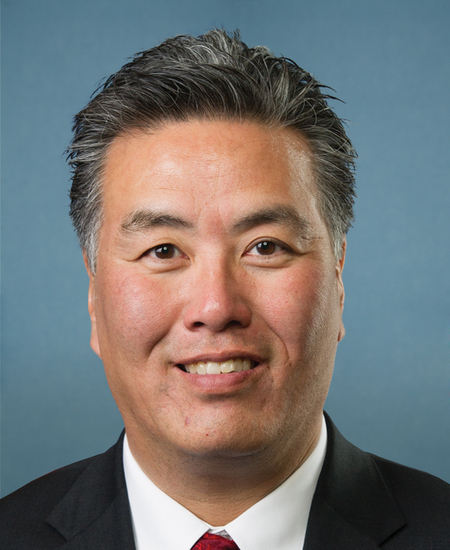
Rep. Mark Takano
Sponsored bills
Repeal Existing Policies that Encourage and Allow Legal HIV Discrimination Act of 2022 or the REPEAL HIV Discrimination Act of 2022 This bill addresses federal and state laws, policies, and regulations that may burden people living with HIV/AIDS. Specifically, the bill directs the Department of Justice (DOJ), the Department of Health and Human Services (HHS), the Department of Defense (DOD), and the White House Office of National AIDS Policy to initiate a national review of federal (including military) and state laws, policies, regulations, and judicial precedents and decisions regarding criminal and related civil commitment cases involving people living with HIV/AIDS. DOJ must transmit to Congress and make publicly available the results of such review with related recommendations. The White House Office of National AIDS Policy must also develop and publicly release guidance to assist states with handling relevant cases. The office, DOJ, HHS, and DOD must transmit to the President and Congress any proposals necessary to implement adjustments to federal laws, policies, or regulations. This bill shall not be construed to discourage the prosecution of individuals who act with the intent to do harm to another individual by intentionally transmitting HIV.
Lebanon TPS Act of 2021 This bill permits nationals of Lebanon to qualify for temporary protected status, which prevents their removal from the United States and allows them to obtain employment and travel authorization. Such status shall be available to qualifying nationals of Lebanon for 18 months starting from this bill's enactment. To qualify, an individual must meet various requirements, such as not having been convicted for certain crimes.
Customer Non-Discrimination Act This bill prohibits discrimination based on sex, sexual orientation, and gender identity with respect to public accommodations and facilities. Specifically, the bill defines and includes sex, sexual orientation, and gender identity among the prohibited categories of discrimination or segregation. The bill expands the definition of public accommodations to include places or establishments that provide (1) exhibitions, recreation, exercise, amusement, gatherings, or displays; (2) goods, services, or programs; and (3) transportation services. Protections against discrimination based on race, color, religion, sex, sexual orientation, gender identity, or national origin shall include protections against discrimination based on (1) an association with another person who is a member of such a protected class; or (2) a perception or belief, even if inaccurate, that an individual is a member of such a protected class. The bill prohibits the Religious Freedom Restoration Act of 1993 from providing a claim, defense, or basis for challenging such protections. The bill prohibits an individual from being denied access to a shared facility, including a restroom, a locker room, and a dressing room, that is in accordance with the individual's gender identity. The bill also prohibits the provision of less favorable treatment with respect to pregnancy, childbirth or related medical conditions as compared to other physical conditions.
Fair Adjudications for Immigrants Act This bill narrows the scope of certain crime-based grounds for barring or removing an alien from the United States. (Generally, a conviction for certain crimes, such as a crime that carries a term of incarceration of a certain length, may constitute grounds for denying an individual certain immigration benefits.) The bill redefines the term conviction to exclude convictions that have been dismissed, expunged, deferred, annulled, invalidated, withheld, vacated, or pardoned. The term must also exclude adjudications where a court issued a recommendation against removal, an order of probation without entry of judgment, or a similar disposition. In addition, any reference to a term of imprisonment or sentence must, unless otherwise provided (1) only consider the period of incarceration ordered by a court, and (2) exclude any suspended portion of a sentence. Currently, for immigration purposes, a term of incarceration includes any part of the sentence that was suspended. These provisions pertaining to the definition of conviction and terms of imprisonment shall apply to convictions and judgments entered either before or after this bill's enactment. Furthermore, certain crime-based grounds for barring or removing an alien shall not apply if the sentencing court issues a recommendation that the alien not be removed on the basis of the conviction.
Reduce Financial Barriers to Immigration and Citizenship Act of 2021 This bill prohibits the Department of Homeland Security (DHS) from charging fees for certain immigration applications (or petitions), requires DHS to provide fee waivers to certain applicants, and addresses related issues. DHS may not impose fees for certain applications for or related to (1) asylum or refugee status, (2) special immigrant juvenile status, (3) U or T non-immigrant visas (victims of certain crimes such as human trafficking), (4) the Violence Against Women Act, (5) special immigrant status for Afghan or Iraqi nationals employed by the U.S. government, or (6) immigration-related fee waivers. DHS must also waive immigration-related application fees for an applicant who receives a means-tested benefit or meets certain conditions related to financial hardship. However, DHS is not required to provide fee waivers for applications for certain employment-based immigration benefits. Receipt of a fee waiver may not be used as a factor (1) for determining whether an alien should be considered a public charge, or (2) when considering an affidavit of support filed by a sponsor. The bill also requires all collected immigration-related adjudication fees to be used only to fund the adjudication and administration of immigration benefits and naturalization.
Lifting Immigrant Families Through Benefits Access Restoration Act of 2021 or the LIFT the BAR Act of 2021 This bill repeals certain limits on the eligibility of noncitizens who lawfully reside in the United States for federal means-tested programs, including Medicaid, the Children's Health Insurance Program (CHIP), programs funded through Temporary Assistance for Needy Families (TANF) grants, Supplemental Security Income (SSI), and certain nutrition and housing programs.
Hold Accountable and Lend Transparency on Campus Sexual Violence Act of 2021 or the HALT Campus Sexual Violence Act of 2021 This bill addresses dating violence, domestic violence, sexual assault, or stalking incidents on college campuses, including by expanding requirements governing the disclosure of such incidents and efforts to prevent them. Specifically, the bill requires the Department of Education (ED) to make available an online survey tool regarding student experiences with domestic violence, dating violence, sexual assault, harassment, and stalking. ED must publish a biennial report that includes campus-level data for each institution of higher education (IHE). The bill permits ED to impose civil penalties on IHEs that have violated a law under the jurisdiction of its Office for Civil Rights. In addition, the bill directs ED, the Department of Health and Human Services, and the Department of Justice to create a task force on sex-based harassment and violence in education.
Journalist Protection Act This bill establishes new criminal offenses for intentional acts (or attempts to commit acts) that cause bodily injury to a journalist.
Restoring Justice for Workers Act This bill prohibits predispute arbitration agreements that require arbitration of an employment dispute. It allows a postdispute arbitration agreement if the employee enters into it voluntarily without coercion and is informed in writing of rights and protections under such agreement. An employer may not retaliate against an employee for refusing to enter into an agreement for arbitrating an employment dispute.