This resolution recognizes the annual celebration of Dia de los Muertos. The resolution urges the United States and the Department of Homeland Security to promote policies that uphold the human dignity of each migrant person and put an end to migrant deaths along the U.S.-Mexico border. Finally, this resolution calls on the United States and the Department of Health and Human Services to promote policies focused on COVID-19 protections and ensure that all communities have equal access to these to put an end to COVID-19 related deaths.
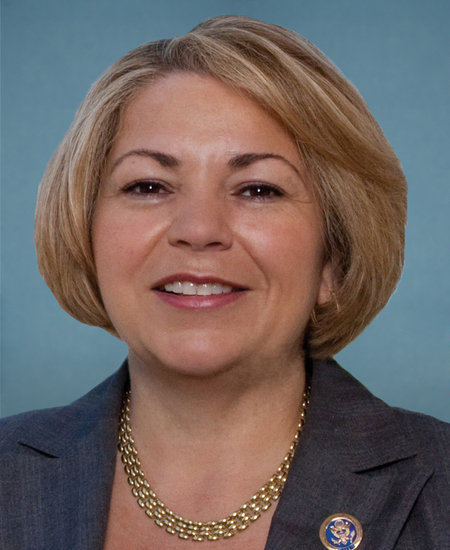
Rep. Linda T. Sánchez
Sponsored bills
This resolution recognizes Immigrant Heritage Month in honor of the contributions immigrants and their children have made to the United States. It also welcomes immigrants presently in the United States and individuals seeking to immigrate to the United States to contribute to the health, safety, diversity, and prosperity of the United States.
This resolution expresses support for (1) equal rights and protections for all people, regardless of actual or perceived sexual orientation or gender identity; and (2) the designation of LGBTQ Equality Day on June 26 to commemorate Supreme Court decisions handed down on that day in 2003, 2013, and 2015. The resolution also acknowledges the need for further legislation to ensure that people in the United States are free from all forms of discrimination on the basis of actual or perceived sexual orientation or gender identity.
Maddy summaryHRES 490 is a symbolic House resolution (not a law) passed on June 22, 2021, that reaffirms the U.S. commitment to supporting refugees and displaced persons globally. It highlights the scale of the global displacement crisis (over 82 million forcibly displaced people in 2020) and emphasizes the importance of the U.S. refugee resettlement program as a tool for security, diplomacy, and humanitarian aid. The resolution calls on the Secretary of State to continue robust funding, uphold U.S. leadership in refugee protection, support host countries, and meet refugee admissions goals. It directly affects U.S. foreign policy implementation and international humanitarian efforts, though it does not create new legal requirements or allocate funds.
Gun Violence Prevention and Safe Communities Act of 2022 This bill increases by .5% the excise tax on firearms, including pistols, revolvers, and shells and cartridges. The bill establishes the Gun Violence Prevention Trust Fund into which the increased tax revenues are deposited to fund gun violence prevention programs. The Trust Fund creates separate accounts for violence prevention, gun violence research, hate crimes data collection and enforcement, and firearm forensics. The bill also requires an inflation adjustment to the amount of the special tax on importers, manufacturers, and dealers in firearms and the transfer tax on firearms.
Afghan Adjustment Act This bill expands eligibility for special immigrant visas to certain Afghan nationals (and accompanying spouse and children) and addresses related issues. The Department of Homeland Security may provide such visas to Afghan nationals who provided qualifying service as a member of the Afghan Air Force or other specified entities and meet eligibility requirements, such as passing a background check. Currently, special immigrant visas for Afghan nationals are generally only available to those who were employed by or on behalf of the U.S. government in Afghanistan. Such visas shall also be available to an Afghan national who is a qualifying relative of a veteran or member of the U.S. Armed Forces. The bill also modifies procedures for providing lawful permanent resident status to certain classes of Afghan nationals, such as by (1) providing a streamlined process with specified vetting requirements for certain individuals, including those who provided support to the U.S. government in Afghanistan; and (2) preserving the eligibility of certain battered spouses whose eligibility for such status stemmed from a marriage that has terminated. Furthermore, the Department of State (1) must respond to inquiries from Members of Congress about specific applications from Afghan nationals seeking special immigrant or refugee status; and (2) establish an office in Afghanistan to perform certain tasks, such as issuing visas, if no U.S. embassies are operational in Afghanistan. The President must establish a task force to develop and implement a strategy to assist Afghan nationals who qualify for admission to the United States.

Renewing Immigration Provisions of the Immigration Act of 1929 This bill expands eligibility for a program that authorizes the Department of Homeland Security to, at its discretion, provide lawful permanent resident status to certain long-term residents of the United States, including individuals who are unlawfully present. Currently, this program, sometimes referred to as the Registry program, is only available to eligible non-U.S. nationals ( aliens under federal law) who entered the United States before January 1, 1972. The bill removes this entry cutoff date and opens up the program to eligible individuals who have resided in the United States for at least seven years. Existing requirements (e.g., the individual must not be inadmissible or deportable due to certain grounds related to crime or terrorism) continue to apply.
Multiple Firearm Sales Reporting Modernization Act of 2022 This bill expands reporting requirements with respect to sales or dispositions of multiple firearms. Currently, a federal firearms licensee (e.g., a gun dealer) must report multiple sales or dispositions of pistols or revolvers to the same person within five business days. This bill requires a federal firearms licensee to report multiple sales or dispositions of any firearms to the same person within five business days.
Protect Vulnerable Immigrant Youth Act This bill exempts Special Immigrant Juveniles visas from certain annual numerical limitations on such visas. (Generally, Special Immigrant Juvenile status is available to qualifying non-U.S. nationals under 21 years of age who are in the United States and have been abused, abandoned, or neglected by a parent.)
Honor Our Commitment Act of 2022 This bill limits the detention or removal of qualified Vietnamese nationals from the United States and contains other related provisions. A national of Vietnam may not be detained or removed if that individual (1) is subject to a final order of removal, and (2) has continuously resided in the United States since July 12, 1995, or an earlier date. An otherwise qualifying alien may not receive such protections if (1) the Department of Homeland Security (DHS) determines that the alien is directly responsible for harming U.S. national security, or (2) the alien is subject to extradition. A qualified Vietnamese national shall receive authorization to work in the United States. DHS must notify each qualified Vietnamese national about the provisions of this bill.