

Maddy summaryHR 4152, the Safe Storage Saves Lives Act, requires gun sellers to offer a compatible gun lock with every firearm sale. It directly affects licensed gun retailers, who must make such locks available at the point of purchase. The bill amends federal law to mandate that sellers provide a secure storage device compatible with the firearm, with violations subject to $1,000 civil penalties. Funds from these penalties must be used for distributing free/reduced-cost locks or public awareness campaigns about safe storage.
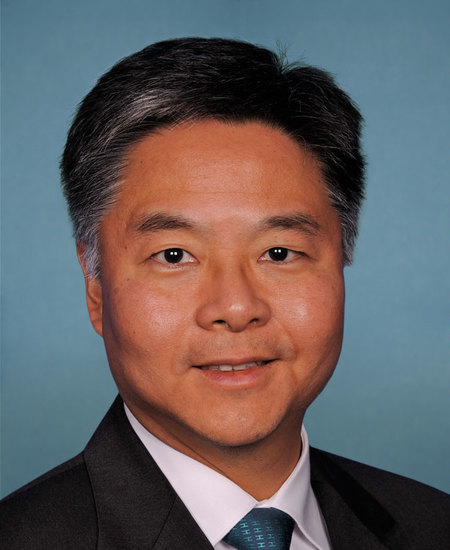
Rep. Ted Lieu
Sponsored bills
Maddy summaryHR 4187, the Stop Hate Crimes Act of 2025, amends federal hate crime law to clarify how bias motivation is proven. It changes the standard so that a protected characteristic (like race, religion, disability) only needs to be "a contributory motivating factor" for a crime, not the sole reason. This directly affects federal hate crime prosecutions by making it easier for prosecutors to prove bias was involved. The bill modifies Section 249(a) of Title 18, U.S. Code, to update the legal language defining hate crimes.
Maddy summaryThis bill prohibits defendants in federal criminal cases from using a victim's LGBTQ identity (sexual orientation, gender identity, or expression) as a defense to excuse or reduce punishment for violent crimes. It amends federal law to ban arguments that claim a "nonviolent sexual advance" or inaccurate perception of someone's LGBTQ status justified the defendant's actions. The law allows limited admission of past trauma evidence under standard federal rules but requires the Attorney General to annually report on federal prosecutions involving bias-motivated violence against LGBTQ individuals. This directly affects defendants in federal court cases where such defenses were previously used, aiming to end the practice of treating LGBTQ victims' identities as justification for violence.
Maddy summaryHRES 544 is a symbolic resolution designating June 2025 as "National Men’s Health Month." It does not create new laws or allocate funds but supports raising public awareness about preventable health issues affecting men. The resolution cites statistics on health disparities (like higher prostate cancer rates for Black men and lower health screenings among men) and references the existing annual observance of National Men’s Health Week (since 1994). It requests the President issue a proclamation encouraging communities, health organizations, and the public to observe the month with awareness events focused on early detection and preventive care. This resolution directly affects public awareness efforts, not specific individuals or policies.
Maddy summaryHR 4137, the Transparency in Security Clearance Denials Act, requires the Secretary of State to submit annual reports on security clearance denials, suspensions, or revocations for diplomatic personnel. The reports must include the number of denials by outcome type, appeal success rates, and the criteria used, disaggregated by position (e.g., Foreign Service officer, civil servant), ethnicity, race, national origin, and gender. This bill directly affects diplomatic personnel whose security clearances are denied or reviewed, ensuring transparency in the adjudication process. It does not change clearance standards but mandates public reporting on how decisions are made.
Maddy summaryThis bill makes technical corrections to the Camp Lejeune Justice Act of 2022 to streamline claims for individuals harmed by water contamination at Camp Lejeune. It clarifies the evidence required (30+ days at the base plus a link between contaminants and health harm), specifies that cases must be handled in North Carolina courts (with limited transfer options), and sets attorney fee caps (20% before suit, 25% after). These changes directly affect veterans and civilians who lived at Camp Lejeune and filed claims under the 2022 law. The bill does not create new eligibility but aims to improve the legal process for existing cases.
Maddy summaryThe Women's Health Protection Act of 2025 would protect access to abortion services across the United States by prohibiting states from imposing restrictions that are more burdensome than those on comparable medical procedures. The bill directly affects people seeking abortion care and health care providers by banning restrictions such as mandatory in-person visits, requirements for specific tests, limitations on telemedicine, and rules based on a patient's reason for seeking abortion. It prohibits state laws that single out abortion for unnecessary restrictions while allowing post-viability abortions when necessary to protect a patient's life or health. The bill preempts conflicting state laws and provides enforcement mechanisms through private lawsuits and actions by the Attorney General.
Maddy summaryHR 4108, the Refuge From Cruel Trapping Act, bans the possession or use of body-gripping traps (traps that kill or severely injure wildlife) in National Wildlife Refuges. It directly affects visitors, hunters, and trappers using such traps within refuge boundaries, with limited exceptions for federal agencies managing invasive species or endangered wildlife, dismantling traps, Alaska-specific use, and tribal subsistence hunting. The bill includes penalties of up to $500 per trap, potential jail time, and forfeiture of traps or captured wildlife for violations. It requires the Secretary of the Interior to issue implementing regulations within 120 days but takes effect 120 days after enactment.
Maddy summaryHR 4104 would expand access to Medicaid, CHIP, and Affordable Care Act (ACA) health coverage for immigrants lawfully present in the U.S., including those with deferred action or pending immigration applications. It removes state-level barriers to Medicaid/CHIP eligibility for lawfully present individuals, treats Federally authorized presence as "lawfully present" for ACA subsidies, and allows states to choose to cover undocumented individuals through Medicaid or CHIP. The bill also extends these changes to Medicare Part A and Part B, ensuring lawfully present immigrants qualify for coverage and subsidies under existing programs. These provisions apply to all federally funded health programs and take effect in 2026 for most ACA-related changes.
Maddy summaryThis bill creates federal funding for community-based violence intervention programs in high-violence areas, targeting communities with 35+ homicides annually or 20+ homicides with rates double the national average. It establishes grants for community organizations to implement trauma-informed violence interruption strategies, hospital-based programs for injured patients, and job training for "opportunity youth" (16-25 year olds not in school or work). The legislation authorizes $300 million in 2026, increasing to $700 million annually through 2033, with requirements for evidence-based approaches that reduce violence without contributing to mass incarceration. It creates a National Community Violence Response Center to coordinate data collection, research, and best practices for these programs. The focus is on prevention through economic opportunity, trauma care, and community-driven interventions rather than traditional law enforcement approaches.